Five Regional Airport Tourism Zones and Korea's 2027 Tourism Budget: A Question of Regional Lodging Quality
Reading the government's regional dispersal policy and new lodging programmes through the lens of service quality
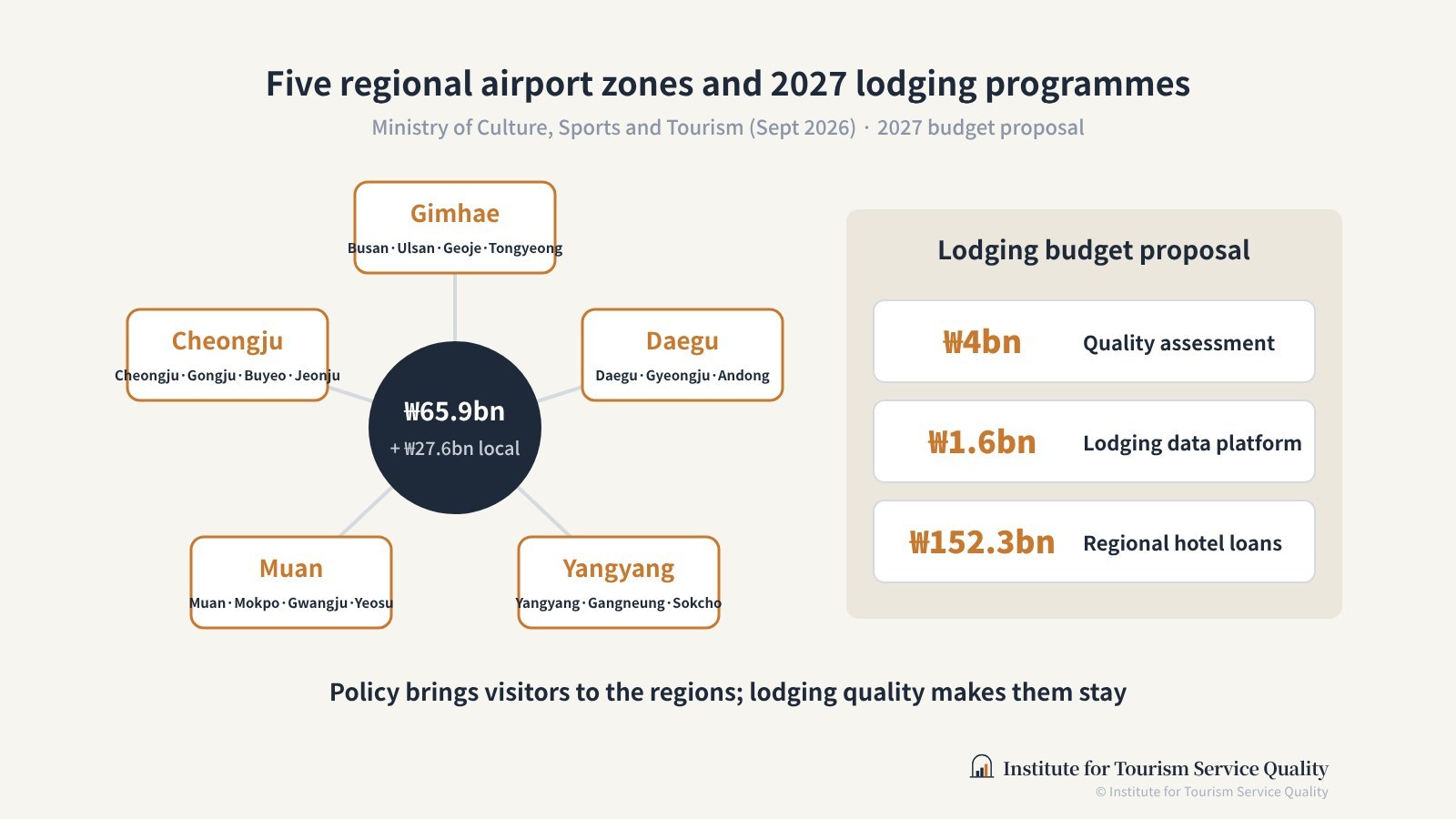
With more than 80% of foreign visitors to Korea staying in the Seoul metropolitan area, the government has introduced a regional tourism policy that uses regional airports as gateways. In September 2026 the Ministry of Culture, Sports and Tourism confirmed five tourism zones centred on regional airports, and its 2027 tourism budget proposal includes programmes for these zones along with new lodging programmes such as a lodging quality assessment and an integrated lodging information platform. For a policy that sends visitors to the regions to succeed, the places where those visitors stay, that is, regional lodging, must deliver on service quality. This article reviews the announcement and looks at what it means from a service quality perspective.
What was announced
According to Korea.kr and ZDNet Korea (10 September 2026), the five tourism zones confirmed by the ministry are as follows. A selection committee of private experts evaluated tourism appeal, transport conditions and potential for expansion, based on proposals from provincial governments and data on visitor demand.
- Gimhae Airport zone: Busan, Ulsan, Geoje and Tongyeong, linked to the Daegu zone via Gyeongju
- Daegu Airport zone: Daegu, Gyeongju and Andong, centred on cultural heritage
- Cheongju Airport zone: Cheongju, Gongju, Buyeo, Iksan and Jeonju, an inland zone of history and culture
- Yangyang Airport zone: Yangyang, Gangneung and Sokcho, combining mountains, sea and sports
- Muan Airport zone: Muan, Mokpo, Gwangju and Yeosu, a southwestern zone for longer stays that links air, rail and cruise travel
Based on the government's 2027 budget proposal, KRW 93.5 billion will be invested (KRW 65.9 billion from the national government and KRW 27.6 billion from local governments). The national funding is divided into KRW 18 billion for overseas marketing, KRW 14.3 billion for attracting visitors through regional airports and ports, KRW 14.9 billion for transport and payment convenience, and KRW 18.7 billion for specialised content. The government has set targets of 30 million foreign visitors and 5 million arrivals through regional gateways by 2029.
Reported figures for the overall tourism budget differ slightly depending on when they were published. Travel Times, reporting on the budget proposal released on 4 September, put the 2027 tourism budget at KRW 1.7581 trillion (up 18.8%), while The Financial News and Kyunghyang Shinmun, reporting on the minister's press conference on 28 October, put it at KRW 1.7562 trillion (up 19%). The difference appears to come from how the figures were compiled, but the original documents should be checked. In either case, it is a budget proposal awaiting review by the National Assembly.
Three items stand out in the lodging sector. According to MTN and Kyunghyang Shinmun, KRW 4 billion has been newly allocated to a programme that assesses the quality of general and serviced-residence lodging businesses and provides tailored consulting, and KRW 1.6 billion to an integrated lodging information platform that brings together scattered lodging data and statistics. Travel Times reported that the platform is intended for managing policy statistics, not as a service competing with private online travel agencies (OTAs). The Financial News and Kyunghyang Shinmun also reported that KRW 152.3 billion has been allocated to loans for building large hotels in the regions.
Policies that bring visitors, quality that makes them stay
First, regional dispersal becomes a question of the lodging experience. The tourism zone budget focuses on marketing, flight routes, transport and payment, and content. It is designed to bring visitors as far as the regional gateways. Whether those visitors stay an extra day, however, depends heavily on the cleanliness of their accommodation, the guidance they receive, and how easy it is to book and pay. A parliamentary audit finding that foreign visitors' length of stay and spending on accommodation have fallen was discussed in More visitors, shorter stays: the quality of welcome beyond the numbers.
Second, quality assessment reaches further. Hotels have had their quality managed through the grading system, but general and serviced-residence lodging, which make up much of regional accommodation, have had relatively weak frameworks of this kind. The KRW 4 billion quality assessment and consulting programme can be read as an attempt to build a loop of assessment and improvement in this area. We summarised the hotel grading reform in Korea's hotel star ratings have changed: when data protection earns stars. Detailed criteria, such as assessment items and how businesses take part, have not yet been confirmed in reports and should be checked in the original documents.
Third, what can be measured can be managed. The integrated lodging information platform is a statistical foundation that will collect data such as the number of guests, the share of domestic and foreign guests, and booking shares. Measuring the performance of each zone by indicators such as nights stayed and repeat visits, not just visitor numbers, requires this kind of data first.
Suggestions from the editorial team
Regional lodging businesses and hotels may want to check the following ahead of these policy changes.
- Check foreign guests' first-day journey: Confirm that transport directions from the regional airport to the property, check-in arrangements for late arrivals, and foreign-language guidance actually work.
- Keep basic records in preparation for quality assessment: Routinely keep materials likely to be checked in an assessment, such as room inspection checklists, complaint handling records and the posting of room rates.
- Cooperate at the level of the tourism zone: Each zone involves several local governments working together. Sharing multi-night packages or visitor information with nearby attractions and transport operators can help lengthen stays.
- Prepare to provide statistics: It is not yet known what information the integrated platform will collect or how. It is worth checking now that nationality and length-of-stay data are entered accurately in the property management system (PMS).
Bringing visitors to the regions is the job of transport. Making them come back is the job of lodging.
Conclusion
The five tourism zones and the 2027 tourism budget proposal show a clear intention to reduce the concentration of inbound tourism in the Seoul area. At the same time, the new programmes for lodging quality assessment and integrated statistics signal that the government has begun to treat the quality of accommodation and its data as policy issues. The budget will be finalised after National Assembly review and detailed criteria are still to come, but regional lodging providers can start checking the foreign guest experience and their record-keeping now.
References
Most sources are in Korean.
- 정책브리핑 (2026.9.10). 지방공항 중심 5대 관광권 선정…2029년 '입국 3000만' 목표. https://www.korea.kr/news/policyNewsView.do?newsId=148971662
- ZDNet Korea (2026.9.10). 문체부, 지방공항 중심 5대 대표 관광권 확정…지역 관광 육성 시동. https://zdnet.co.kr/view/?no=20260910174525
- 여행신문 (2026.9.7). 19% 확대된 내년도 관광 예산…지방공항·인바운드에 힘 싣는다. https://www.traveltimes.co.kr/news/articleView.html?idxno=500337
- MTN 머니투데이방송 (2026.9.9). 인디음악·숙박 정보 플랫폼...쏟아지는 문체부 새 지원. https://news.mtn.co.kr/news-detail/2026090908091147368
- 파이낸셜뉴스 (2026.10.28). K관광 3000만 시대로… 내년 예산 19% 증액. https://www.fnnews.com/news/202610282130317744
- 경향신문 (2026.10.29). 최휘영 문체부 장관 \"평생 한 번 가봤으면 하는 나라 한국, 외국인 관광객 4천만명 기대\". https://www.khan.co.kr/article/202610291359001/
Was this article helpful?
This is an English version of the original Korean article. If the two differ, the Korean original prevails.
© Institute for Tourism Service Quality. All rights reserved.