Travelling Korea on a Single Card: The Race for Foreign Visitors' Payment Convenience and What It Means for Hotels
Prepaid cards and contactless transit payments with foreign-issued cards, and the payment experience as a dimension of service quality
Paying for things on a trip is easy to overlook, yet it runs through almost every service encounter. Buying a transit card, settling a restaurant bill, leaving a deposit at a hotel: whenever a payment fails at one of these moments, the impression of the whole trip suffers. In 2026, card spending by foreign visitors to Korea has grown much faster than the number of visitors, and card issuers and payment companies are rushing to launch payment options designed for foreign travellers. This article reviews recent reports and reads payment convenience as a dimension of service quality.
What was reported
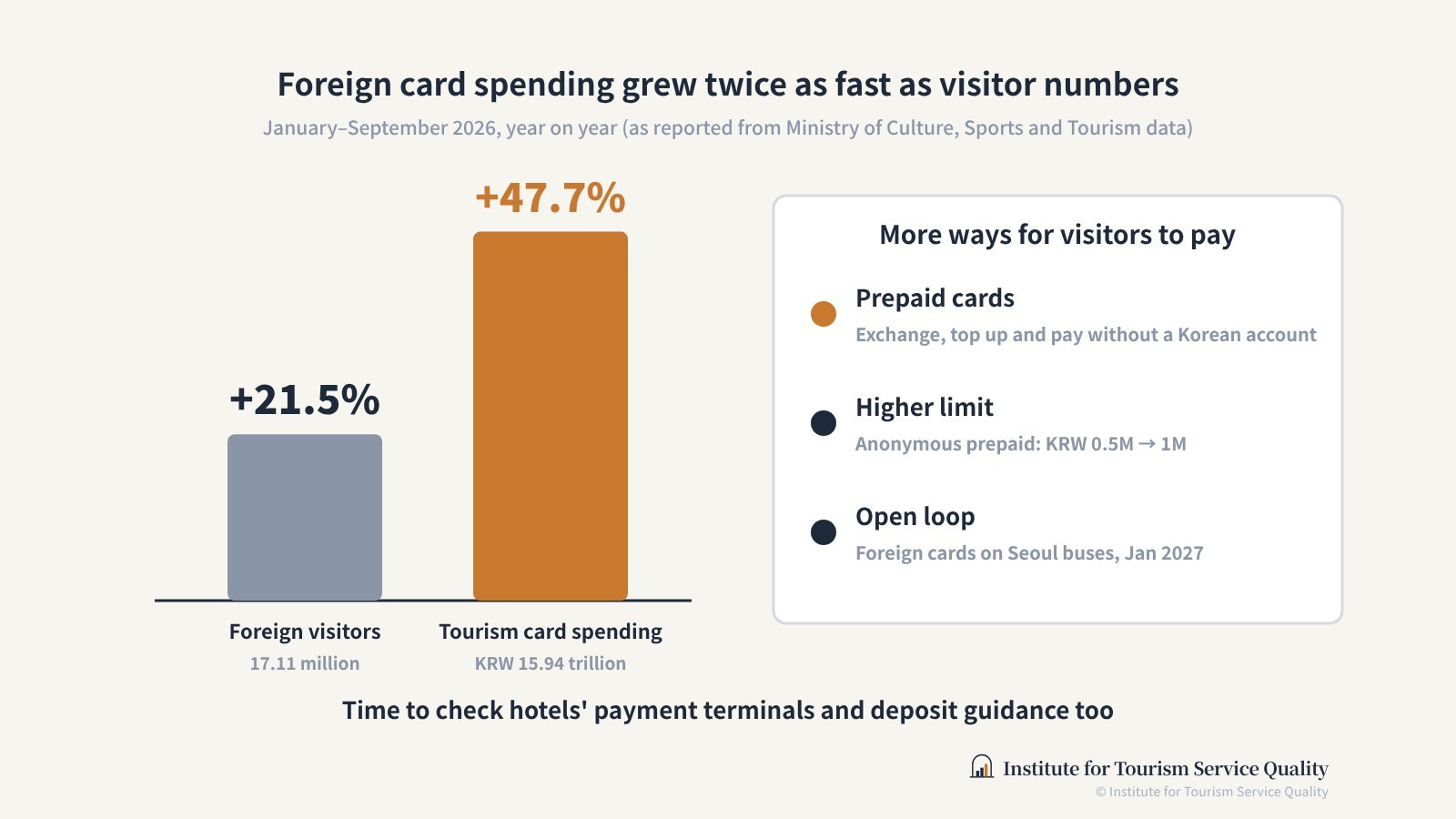
According to reports by Herald Economy (21 October 2026) and Pinpoint News (28 October) on figures released by the Ministry of Culture, Sports and Tourism, Korea welcomed 17.11 million foreign visitors in January–September 2026, up 21.5% on the same period a year earlier. Over the same period, foreign visitors' card spending in tourism reached KRW 15.94 trillion, up 47.7%. Card spending therefore grew more than twice as fast as visitor numbers. The reports do not identify which body compiled the spending figure or break it down by sector.
Three developments in payment methods were reported.
- Prepaid cards for foreign visitors: According to New Daily (2 October), a series of prepaid cards now let visitors exchange currency, top up and pay without a Korean bank account, and providers are competing to expand issuing and top-up kiosks at airports and in city centres.
- Regulatory sandbox: According to Newsis (15 July), the Financial Services Commission designated two prepaid services for foreign visitors as innovative financial services, allowing the limit on anonymous prepaid instruments for unverified foreign tourists to be raised from KRW 500,000 to KRW 1,000,000. Passport verification is required again at each top-up.
- Transit payments with foreign cards: According to Toyo Economy (22 September) and New Daily, Hana Card has signed agreements with T-money and global card brands to introduce an EMV open-loop service, which lets passengers tap foreign-issued credit cards directly on transit readers, starting with Seoul city buses in January 2027.
Pinpoint News also reported that one prepaid card provider said cards issued in a previous year accounted for 26%, 39% and 45% of cards used for payment in September over the last three years. This figure was provided by the company and has not been independently verified.
Spending grew, but not evenly
Where the spending went matters too. Hankyung (13 August) reported an analysis of foreign card sales by Korea Credit Data (KCD): of the 328,000 stores nationwide where foreign cards were used over the past year, the top 1% accounted for 66.9% of the value of payments, and Seoul accounted for 65%. As this analysis comes from a single source, it should be read alongside other statistics.
These figures show that payment convenience is also tied to how tourism is distributed across regions. This is one reason the government has set aside a separate budget for transport and payment convenience in tourism zones centred on regional airports, which we discussed in Five regional airport tourism zones and the 2027 tourism budget.
Payment is a hidden dimension of service quality
Service quality research rarely treats payment as a dimension of its own, yet the reliability and convenience that guests perceive can easily break down at the point of payment. When a foreign card is declined, a deposit hold is not explained, or nobody can say when a refund will arrive, guests begin to distrust the service as a whole. The spread of payment options for foreign visitors reduces these frictions, but if hotels' payment terminals and policies do not keep pace, new points of failure will appear.
Suggestions from the editorial team
Hotels and other accommodation providers may want to check the following.
- Test the payment methods you accept: Try foreign-issued cards, prepaid cards for foreign visitors and mobile payments at the front desk, in food and beverage outlets and at kiosks.
- Explain how deposits are handled: Prepaid cards have fixed balances and limits, so confirm how deposit authorisations and later settlements are processed, and explain this in foreign languages.
- Set a fallback when payment fails: Decide what staff should say when a card is declined and how they will offer an alternative. The same principle applies to failures at self check-in, as discussed in When the kiosk stops, service recovery is a human job.
- Track payment complaints separately: Classifying foreign guests' payment inquiries and complaints on their own shows which methods cause recurring problems.
When payment goes smoothly, guests do not remember it. When it fails, they remember that moment for a long time.
Conclusion
The growth in foreign visitors' card spending and the widening range of payment methods show that the convenience of travelling in Korea is moving up a level. Yet the more payment options there are, the more accommodation providers need to accept them, explain them and recover when they fail. So that a trip on a single card does not stop at the hotel door, it is time to treat payment as part of service quality checks.
References
Most sources are in Korean.
- 헤럴드경제 (2026.10.21). 외래객 1700만 돌파, 카드 소비 48% 급증…한국관광 '신기록 초읽기'. https://www.heraldk.com/article/2026102116224458208
- 핀포인트뉴스 (2026.10.28). 방한객 2000만 눈앞…'외국인 전용 지갑' 경쟁 본격화, 와우패스 \"재방한 재사용률 45%\". https://www.pinpointnews.co.kr/news/articleView.html?idxno=499364
- 뉴데일리 (2026.10.2). 외국인 관광객 지갑 노리는 카드사 … 결제망·선불카드 확대. https://biz.newdaily.co.kr/site/data/html/2026/10/02/2026100200124.html
- 토요경제 (2026.9.22). 하나카드, 해외 발급 신용카드로 서울 대중교통 결제…2027년 도입. https://sateconomy.co.kr/news/view/1065579035610209
- 한국경제 (2026.8.13). 3년 만에 '10배 잭팟' 터졌다…외국인 '폭풍 결제' 매장은 어디. https://www.hankyung.com/article/2026081379927
- 뉴시스 (2026.7.15). 예금토큰 지갑 확대·외국인 선불결제…'혁신금융서비스' 5건 지정. https://mobile.newsis.com/view/NISX20260715_0003711021
Was this article helpful?
This is an English version of the original Korean article. If the two differ, the Korean original prevails.
© Institute for Tourism Service Quality. All rights reserved.