Legalising Domestic Home-Sharing in Korea: Questions Remaining Nine Months After the Announcement
Lodging supply policy and quality management, seen through the urban guesthouse reform debate and the amended rural guesthouse act
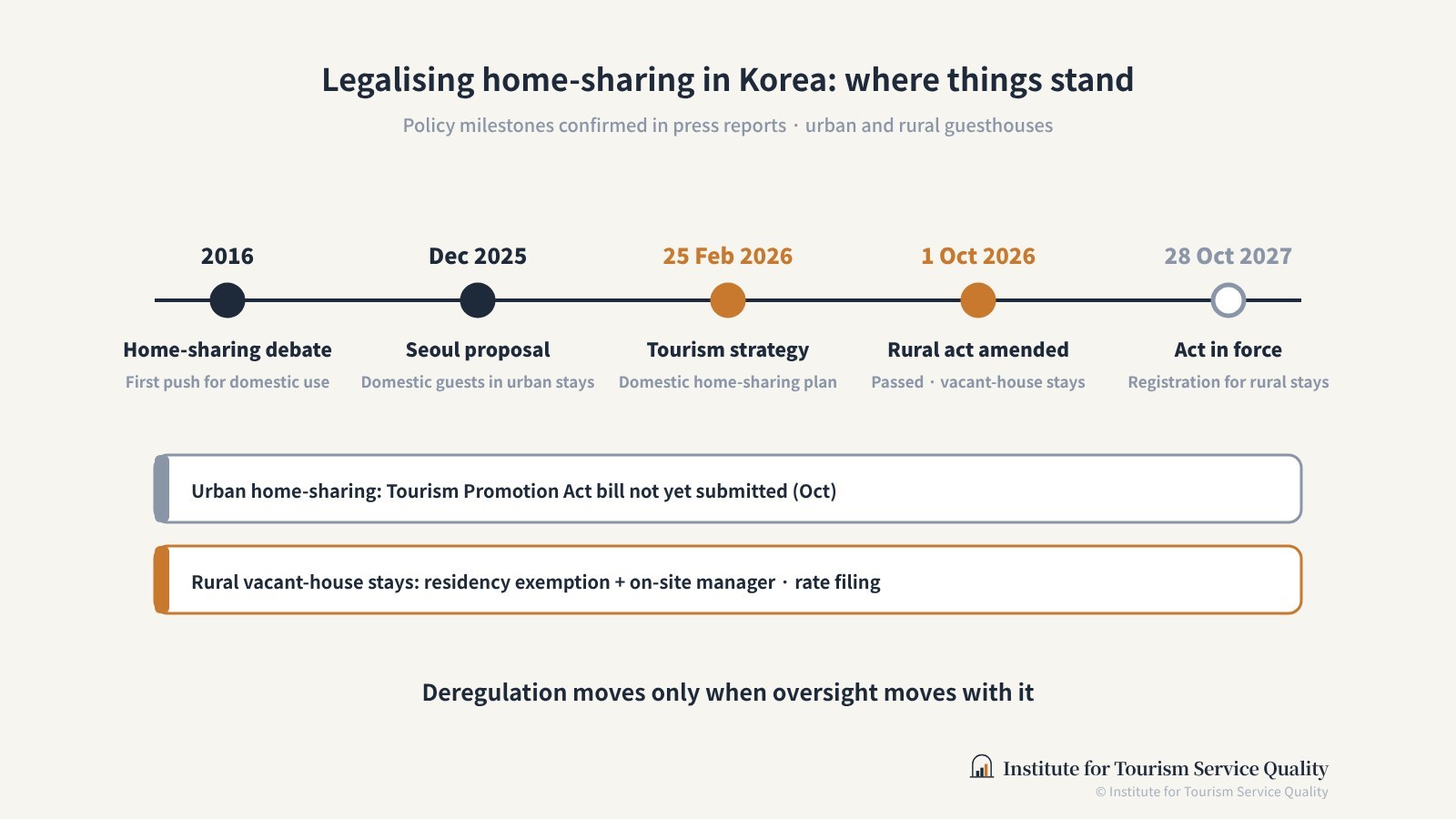
In 2026, the year foreign visitors to Korea passed 20 million a year, lodging supply became a central issue in tourism policy. At the National Tourism Strategy Council chaired by the President on 25 February 2026, the government announced plans to legalise domestic home-sharing and to promote guesthouses in vacant houses. Nine months on, the two policies are moving at different speeds. An amendment allowing guesthouses in vacant rural houses has passed the National Assembly, but the Tourism Promotion Act amendment that would provide the basis for urban home-sharing has not yet been submitted to the Assembly. This article reviews the progress confirmed in press reports and examines the questions that remain from a lodging quality perspective.
What was announced and how far it has come
Urban home-sharing: Under the current Tourism Promotion Act, foreign-tourist urban guesthouses (외국인관광 도시민박업) may be used only by foreign tourists, and the operator must actually live in the home. According to a Segye Ilbo report of 14 October 2026 based on Ministry of Culture, Sports and Tourism data obtained by the office of lawmaker Kim Jae-won, the ministry is pursuing a plan to extend use to Korean nationals and allow year-round operation while keeping the residency requirement, and as of October the related government bill had not been submitted to the National Assembly. The same report noted that since the 2016 debate on introducing a home-sharing business category, allowing domestic guests has never made it into law. According to a Financial News report of 8 November, the Seoul Metropolitan Government proposed allowing domestic guests in December 2025, and the ministry's position is that it is consulting with lawmakers' offices but the timing of an amendment is hard to predict.
According to the same Segye Ilbo report, registered foreign-tourist urban guesthouses grew from 2,044 at the end of 2022 to 8,183 at the end of 2025, and rooms from 5,081 to 13,785. Meanwhile, of 7,499 home-sharing properties approved under the regulatory sandbox, 5,420 (72.3%) were actually operating at the end of June 2026, and the report said the net increase in lodging supply attributable to the scheme cannot be calculated because the data do not exist. These figures rest on a single outlet's exclusive report.
Rural vacant-house guesthouses: An amendment to the Act on the Promotion of Urban-Rural Exchange passed the National Assembly plenary session on 1 October 2026, was promulgated on 27 October and takes effect on 28 October 2027 (as reported by Maeil Shinmun and CBS Nocut News). According to the reports, vacant-house guesthouses run by local governments, village enterprises, social enterprises and similar bodies are exempt from the residency requirement but must appoint a manager. At the same time, oversight measures were added, including replacing notification with registration, requiring operators to file and abide by room rates, and prohibiting unilateral cancellation of bookings without just cause.
Supply: According to a CBRE report cited by Financial News on 8 November, hotel and tourist hotel rooms in Seoul rose from 67,505 at the end of 2019 to 68,020 at the end of 2025, an increase of 0.8% over six years. Data cited by Segye Ilbo show tourist accommodation rooms in Seoul rising from 60,044 to 62,057 over the same period, an increase of 3.4%. The figures differ because the scope of counting differs, but both sources agree that supply has barely grown.
Interpretation
First, a scheme moves when deregulation and oversight go together. The rural vacant-house amendment granted a residency exemption but bundled it with a mandatory manager, registration, rate filing and a ban on cancellations. One reason the urban home-sharing debate has stalled for so long is that there is not yet agreement on safety and hygiene oversight to replace the residency requirement. The Segye Ilbo report also noted calls for designating responsible managers and establishing emergency response systems in place of the residency requirement.
Second, it is hard to speak of supply effects without data on actual operations. Without data distinguishing approved from operating properties, the scale of illegal lodging, and new supply from supply that has merely moved, the results of legalisation cannot be evaluated. Lodging policy needs to look not only at the number of rooms but also at the quality with which those rooms are operated.
Third, more diverse lodging requires more diverse quality standards. Hotels and guesthouses provide service differently, but for guests both are "a stay in Korea". Seoul room supply and conversion trends are covered in When Offices Become Hotels: Seoul Hotel Investment and Conversions in 2026, and the reception challenges of the 20-million-visitor era in Korea Passes 20 Million Foreign Visitors: Revisiting Reception Policy Ahead of the 30 Million Target.
Editors' proposals
While following the legalisation debate, the lodging industry and policymakers may wish to consider the following together. Detailed standards should be confirmed in the original texts of the amendments and subordinate regulations.
- Specify oversight standards to replace residency: Setting standards in terms guests experience, such as emergency contact and on-site response times, cleaning and hygiene inspection cycles, and fire and safety equipment, provides the grounds for deregulation.
- Publish operating data regularly: Periodically compiling and publishing the numbers of registered, approved and actually operating properties and the types of complaints and inconvenience reports makes it possible to judge the scheme's results and side effects.
- Align rate and booking practices across lodging types: Compare how the principles of rate filing and the ban on unilateral cancellation introduced for rural guesthouses apply to other lodging types, so that guests enjoy the same transactional trust whatever type of lodging they choose.
- Hotels should make their distinctive quality clear: As supply types diversify, hotels need to show guests clearly their standardised quality, such as safety, hygiene and consistency of service.
A policy that expands lodging supply sets not only the number of rooms but also the floor of the experience guests will have in them.
Conclusion
The two lodging policies of 2026 were announced on the same day but are moving at different speeds. Rural vacant-house guesthouses became law by bundling deregulation with oversight, while urban home-sharing remains under discussion. What is needed ahead of the 30 million target is not only to add rooms quickly but also a framework of oversight that ensures the additional rooms maintain consistent quality.
References
Most sources are in Korean.
- 세계일보 (2026.10.14). [단독] 공유숙박 제도화한다더니…정부, 운영 실태도 공급 효과도 '깜깜이'. https://www.segye.com/newsView/20261014500883
- 파이낸셜뉴스 (2026.11.8). 1300만 손님 묵을 곳 없네… 서울 호텔 객실 6년째 '제자리'. https://fnnews.com/news/202611081838385842
- 매일신문 (2026.10.26). 농어촌민박 문턱 낮추고 바가지요금엔 과징금. https://www.imaeil.com/page/view/2026102611213390465
- CBS노컷뉴스 (2026.10.26). '도농교류법' 개정안 27일 공포…농어촌민박 활성화·관리감독 강화. https://www.nocutnews.co.kr/news/6596820
Was this article helpful?
This is an English version of the original Korean article. If the two differ, the Korean original prevails.
© Institute for Tourism Service Quality. All rights reserved.