Korea's Hotel Star Ratings Have Changed: When Data Protection Earns Stars
The main points of the hotel grading reform that took effect in July 2026, and what they mean for service quality and IT management
A hotel's stars are among the first signals guests look at when choosing a room. The hotel grading system that decides those stars changed significantly on 1 July 2026. The Ministry of Culture, Sports and Tourism revised and enforced its public notice on the delegation and determination of hotel grades, stating that after industry hearings, briefings and expert consultations it had focused on making the evaluation more objective and effective while reducing the burden on the industry.
This article summarises the main points of the reform based on the ministry's press release and media reports, and looks at what they mean for service quality and hotel IT operations. Detailed scores and indicators should be checked in the original notice; this article covers only what has been confirmed in reports.
Main points of the reform
A single set of criteria
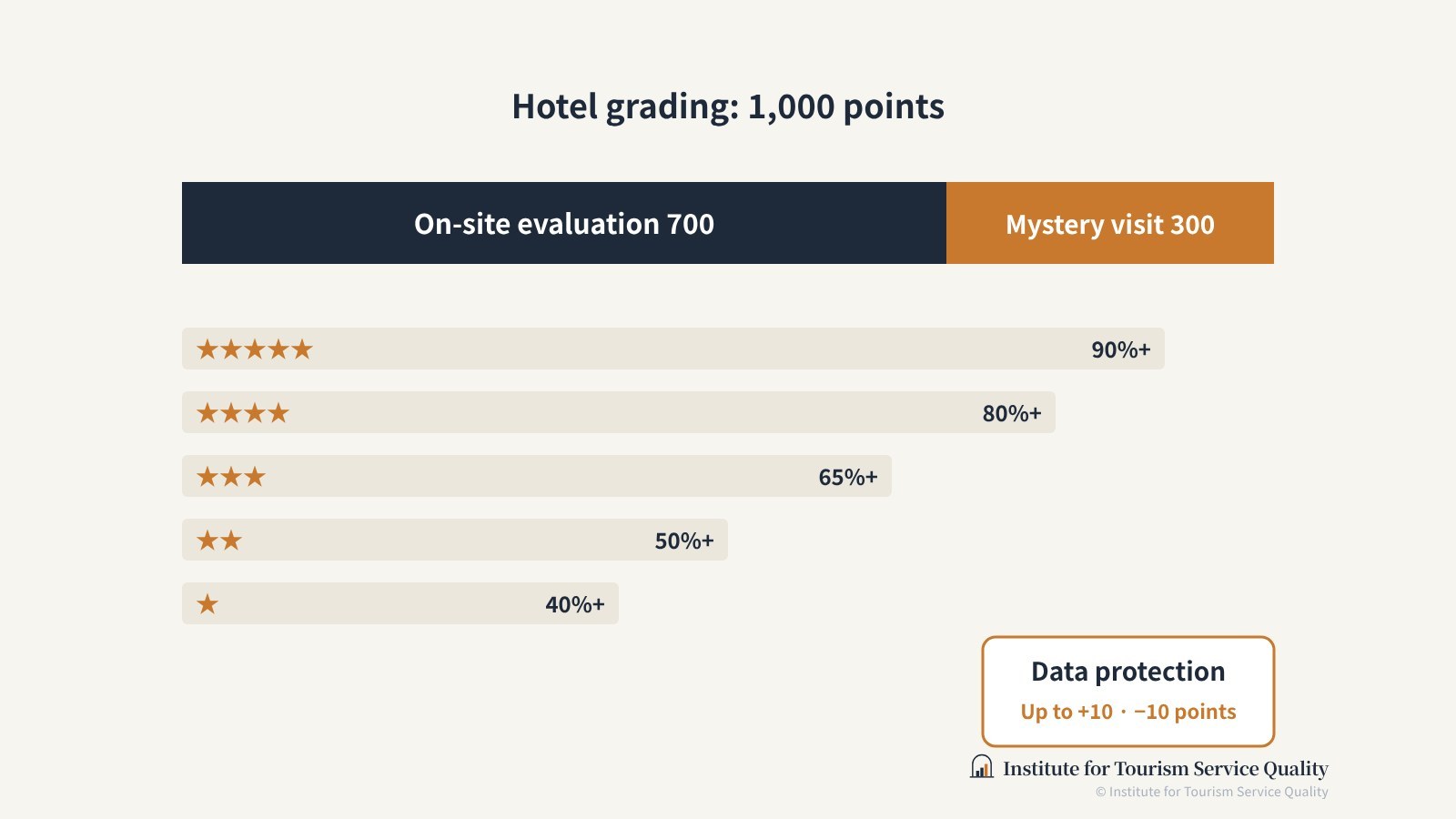
Evaluation criteria that had been divided into one- and two-star, three-star, four-star and five-star levels were merged into one system. According to media reports, the evaluation is scored out of 1,000 points: 700 points for the on-site evaluation and 300 points for a mystery or unannounced evaluation. Each grade is determined by the share of points achieved.
- Five stars: 90% or more
- Four stars: 80% or more
- Three stars: 65% or more
- Two stars: 50% or more
- One star: 40% or more
Two stages and mystery stays
The evaluation has two stages. In the first, inspectors visit after notifying the hotel, based on materials the operator has submitted. In the second, they visit without notice. For four- and five-star tourist hotels, the second stage keeps the mystery evaluation, in which an inspector stays one night and experiences the actual service; one- to three-star hotels receive a same-day unannounced visit. Because the second-stage methods differ, a hotel that applied for one to three stars cannot receive four or five stars even with a high score.
If the result is lower than the grade applied for, the hotel can accept it or defer the decision and request a re-evaluation. If it is higher, the hotel can choose either grade.
Safety, hygiene and consumer protection
Fire prevention and facility safety standards were reinforced and hygiene items were broken down in more detail. The penalty for charging unfair prices rose from 10 to 30 points. For medical tourism hotels, new indicators evaluate medical-linked services and convenience for medical tourists.
Bonus and penalty points for data protection
The change most directly related to hotel IT operations is the new set of personal data protection indicators. According to Digital Times, these indicators were introduced at the request of the Personal Information Protection Commission, because hotels handle large volumes of personal data from domestic and international guests, including passport numbers, stay records and payment information.
- Bonus points: A new indicator, "operating a guest data protection management system", awards 10 points for carrying out three or more of four activities, 7 points for two and 4 points for one. The activities are taking part in Privacy Week, joining the self-regulation programme for personal data, setting up and running a dedicated data protection team, and obtaining ISMS-P (Personal Information and Information Security Management System) certification.
- Penalty points: A new indicator, "administrative measures related to data protection", deducts 10 points if the hotel has received an administrative sanction, fine or penalty surcharge for violating the Personal Information Protection Act.
What it means for service quality
The grading system can be seen as a state-run framework for evaluating hotel service quality. Two trends stand out in this reform.
First, experience-based evaluation was kept. The mystery stay for four- and five-star hotels is a mechanism for evaluating the actual service experience rather than a list of facilities. As service quality research has long stressed, services are produced and consumed at the same time and cannot be stored, so they are hard to evaluate without experiencing them from the guest's position.
Second, the scope of service quality has widened. Making safety, hygiene, honest pricing and data protection part of the evaluation means that quality now covers not only the friendliness and facilities guests experience directly but also how well things are managed where guests cannot see. This can be read as the dimension of assurance, whether guests can trust the hotel with themselves and their information, entering the system.
Implications for hotel IT operations
The data protection indicators link a hotel's IT operations directly to its grade. In the editorial team's view, hotels may want to check the following. These are operational suggestions, not an interpretation of the notice.
- Map where personal data flows: Hotels need to document what personal data is stored and exchanged across booking channels, the property management system (PMS), kiosks, mobile check-in, payment systems and customer relationship management (CRM) systems. Since the penalty is based on a record of administrative sanctions, preventing violations in the first place is the surest response.
- Check how external solutions handle data: Hotel data is often processed through solutions from outside vendors, such as the PMS, kiosks and channel managers. Hotels should confirm that processor management, retention periods and deletion procedures are reflected in contracts and systems.
- Test data is personal data too: Using real guest data as-is when developing and testing systems can cause violations. Hotels should set a principle of testing with synthetic data or appropriately pseudonymised data. We also covered precautions for handling guest data in What to check before putting hotel guest data into AI.
- Use bonus activities to build a system: The burden of setting up a dedicated team or obtaining ISMS-P certification varies with hotel size. Rather than chasing points alone, hotels should use these activities as an opportunity to put their data protection management in order.
Conclusion
This reform broadens the answer to what a hotel's stars should guarantee. Beyond good rooms and friendly service, a good hotel is one that is safe, honest and protects its guests' information. Now that guest touchpoints are moving into systems through kiosks and mobile check-in, much of the work of meeting this standard also falls to the people who build and test those systems.
References
Most sources are in Korean.
- 문화체육관광부 (2026.7.1). 호텔 등급평가 제도 전면 개편, 업계와 소비자 목소리 담았다(보도자료). https://www.mcst.go.kr/site/s_notice/press/pressView.jsp?pSeq=22559
- 아시아경제 (2026.7.1). 문체부, 7월 1일부터 새 고시 시행. https://view.asiae.co.kr/article/2026070103312589226
- SBS Biz (2026.7.1). 호텔 성급별 평가기준 하나로…암행평가 유지·안전위생 강화. https://biz.sbs.co.kr/amp/article/20000320033
- 디지털타임스 (2026.7.1). 개인정보위 요청으로 문체부 고시 개정 시행. https://www.dt.co.kr/article/12070537
Was this article helpful?
This is an English version of the original Korean article. If the two differ, the Korean original prevails.
© Institute for Tourism Service Quality. All rights reserved.