Korea Passes 20 Million Foreign Visitors: Revisiting Reception Policy Ahead of the 30 Million Target
The background to the 20 million milestone as announced by the Ministry of Culture, Sports and Tourism, and what the next target asks of lodging providers
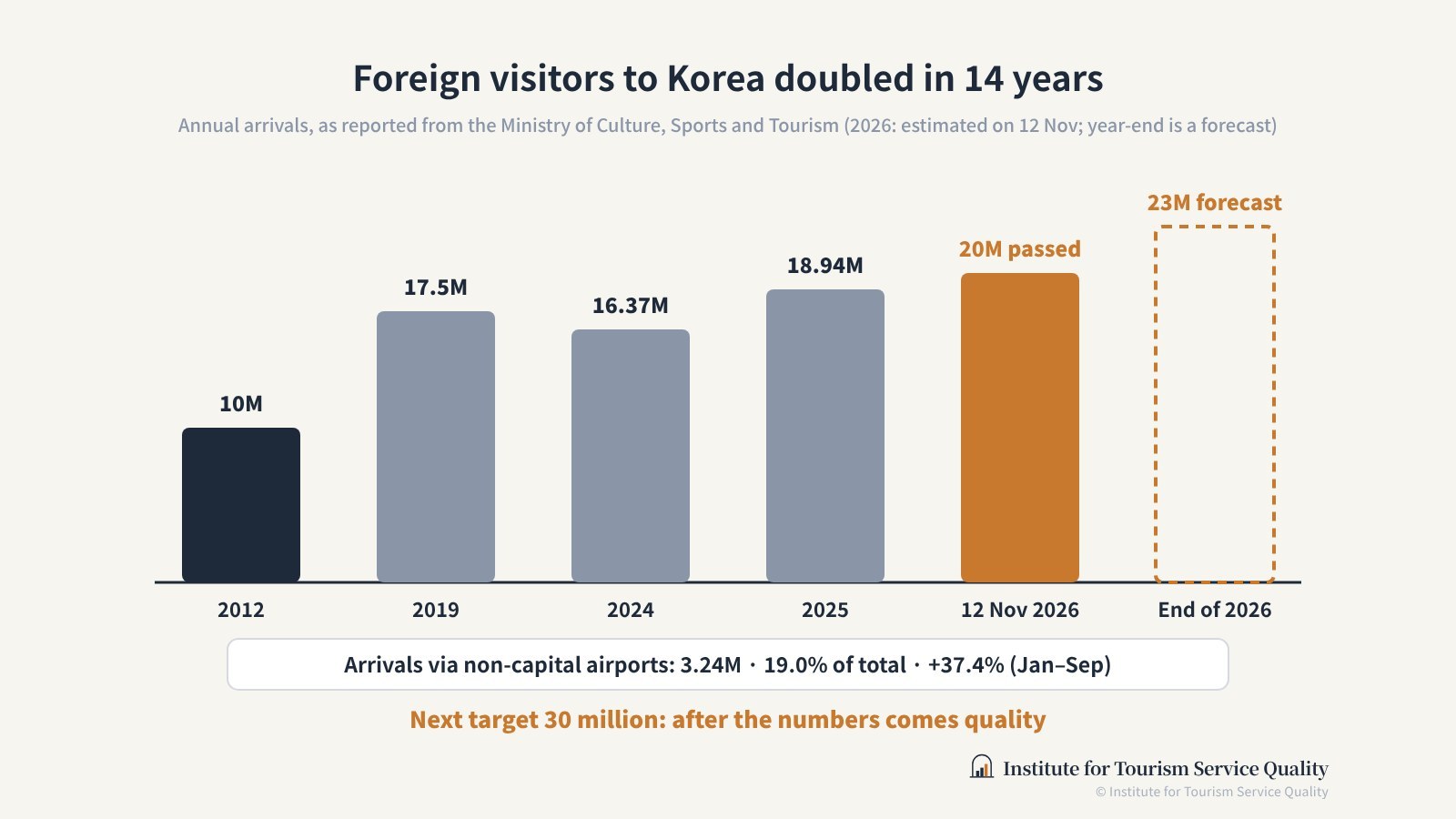
Foreign visitor arrivals to Korea passed 20 million in a single year for the first time on 12 November 2026. The figure has doubled in the 14 years since arrivals first passed 10 million in 2012. The government has described the milestone as "the starting point for becoming a tourism powerhouse" and says it will prepare for an era of 30 million visitors. Drawing on reports of the Ministry of Culture, Sports and Tourism announcement, this article sets out the background and policy tools behind the 20 million mark, and considers what the next target asks of the reception quality of lodging providers.
What was announced
According to reports by Newspim, the Kyunghyang Shinmun and Travel Times (12 November 2026) on the ministry's announcement, the main points are as follows.
- Cumulative arrivals to 11 November were a provisional 19.97 million. Adding this year's daily average of about 64,000 arrivals, the ministry estimated that the 20 million mark was passed on 12 November. The Financial News report notes that the announcement is based on this estimate rather than a confirmed figure.
- According to the Financial News, annual arrivals were 17.5 million in 2019, 16.37 million in 2024 and 18.94 million in 2025, and the ministry expects arrivals to reach about 23 million by the end of 2026.
- From January to September 2026, arrivals through non-capital-area airports (Gimhae, Jeju, Cheongju, Daegu and others) numbered 3.24 million, up 37.4% on the same period of the previous year and 19.0% of all arrivals. Arrivals through non-capital-area ports numbered 1.58 million (9.2%), up 14.5%.
- The government cited the spread of the Korean Wave, cross-ministry cooperation centred on the National Tourism Strategy Council chaired by the President, and the hospitality of the Korean public as the drivers of growth. Since the 11th National Tourism Strategy Council on 25 February, measures have included easier immigration procedures, more international routes at regional airports and stronger sanctions on price gouging.
- Through December, the ministry plans commemorative events, meetings with the industry, welcome events for arrivals at regional international airports and events linked to the Korea Grand Sale.
The fact that foreign visitors' tourism card spending grew at more than twice the rate of arrivals over the same period was covered in Travelling Korea on a Single Card: The Race for Foreign Visitors' Payment Convenience and What It Means for Hotels.
A policy variable also remains at the end of the year. According to Travel Times (11 November), visa-free entry for Chinese group tourists of three or more recruited by designated travel agencies (up to 15 days) and China's visa-free entry for Korean nationals (up to 30 days) both expire on 31 December 2026, and as of the report neither country had officially announced an extension. This is a single-outlet report, so later government announcements should be checked.
Interpretation: after the numbers come distribution and trust
First, 20 million is an outcome, and the indicators need to change. Policy between 10 million and 20 million centred on tools that bring visitors in, such as air capacity, immigration convenience and promotion. Most of the tools the government cited as achievements in this announcement also fall into this category. Thirty million, however, means receiving more people into rooms and transport in an already crowded capital region, so future policy performance should also be assessed with indicators that show the quality of the experience, such as length of stay, revisits and tourist complaints. Length of stay and revisit rates were discussed in More Visitors, Shorter Stays: The Quality of Welcome Beyond the Numbers.
Second, regional arrivals have grown, but still account for only one in five. The 37.4% rise in arrivals through non-capital airports can be read as an early result of policy centred on regional airports. Their share, however, remains at 19.0%. For visitors who arrive in the regions to stay there and return, the quality of regional lodging has to rise alongside air routes. This is why the government is pursuing the five regional airport tourism zones together with 2027 lodging quality programmes, as covered in Five Regional Airport Tourism Zones and Korea's 2027 Tourism Budget: A Question of Regional Lodging Quality.
Third, sanctions on price gouging are both a pricing policy and a trust policy. That the government listed stronger sanctions on price gouging among the policy tools behind the 20 million mark reflects a recognition that prices and trading practices at times of peak demand are directly linked to the country's hospitality reputation. The fact that accommodation makes up the largest share of foreign tourist complaints was set out in The Shadow Behind 12th Place: What a Hospitality Reputation Rank of 65th Asks of Korean Lodging.
Editorial suggestions
Ahead of the 30 million target, hotels and lodging providers may wish to check the following.
- Calculate peak-season capacity limits in advance: Use records from past peak seasons to find where the front desk queue, luggage storage and breakfast seating reach their limits first when foreign groups and independent travellers overlap.
- Prepare scenarios for policy changes: Prepare for both an extension and an end of visa-free entry for Chinese groups, a variable to be decided at the end of the year, and how each would affect group bookings and room allocation. Detailed criteria should be checked against government announcements.
- Check the first night for regional arrivals: Lodging near regional airports should separately check the touchpoints international passengers meet first, such as late arrivals, foreign-language information and airport transfer information.
- Check that rates and cancellation terms are consistent: Even at times of peak demand, check that rates and cancellation terms are presented consistently across channels, so that a legitimate pricing policy is not remembered as price gouging.
Twenty million is the number who came through the door; thirty million is the number the experience inside must be able to handle.
Conclusion
Passing 20 million foreign visitors shows that Korean tourism has moved beyond its pre-COVID-19 peak to a new scale. The next target of 30 million set by the government means attracting more visitors, but it also means ensuring that these visitors stay in the regions, experience fair prices and come back. The task for the next stage is whether policy that grew the numbers can broaden into policy that manages the quality within them.
References
Most sources are in Korean.
- 뉴스핌 (2026.11.12). 방한 외국인 관광객 2000만 대기록, 대한민국 관광 새 역사 쓴다. https://www.newspim.com/news/view/20261112000795
- 경향신문 (2026.11.12). 방한 외국인 관광객 첫 2천만명 돌파…14년 만에 두 배. https://www.khan.co.kr/article/202611121623001/
- 여행신문 (2026.11.12). 방한 외국인 관광객 사상 첫 2,000만 명…14년 만에 두 배로. https://www.traveltimes.co.kr/news/articleView.html?idxno=500712
- 파이낸셜뉴스 (2026.11.12). 외국인 관광객 2000만명… 쓴 돈은 16조 육박 [Weekend 문화]. https://www.fnnews.com/news/202611121818203326
- 여행신문 (2026.11.11). 한중 무비자 연말 동시 만료…연장 여부는 '아직'. https://www.traveltimes.co.kr/news/articleView.html?idxno=500676
Was this article helpful?
This is an English version of the original Korean article. If the two differ, the Korean original prevails.
© Institute for Tourism Service Quality. All rights reserved.