More Visitors, Shorter Stays: The Quality of Welcome Beyond the Numbers
Reading the 2026 parliamentary audit's findings on falling length of stay and spending through the lens of service quality
The number of foreign visitors to Korea is again growing quickly this year. Yet the 2026 parliamentary audit heard that the time visitors spend in the country and the money they spend there have actually fallen. The point being raised is that the quantity of visitors and the quality of their visits are not moving together. This article reviews recently reported figures and considers how they can be read from a service quality perspective.
The reported figures
According to SBS Biz and Discovery News (28 October 2026), citing Korea Tourism Organization (KTO) statistics, 2,062,042 foreign visitors came to Korea in September 2026, up 21.1% on the same month a year earlier. The cumulative total for January–September was about 17.11 million, up 21.5% year on year.
During the same period, the parliamentary audit presented figures from another angle. According to Newsis and Newspim (14 October 2026), Jeong Yeon-wook, a member of the National Assembly's Culture, Sports and Tourism Committee, made the following points based on materials submitted by the KTO.
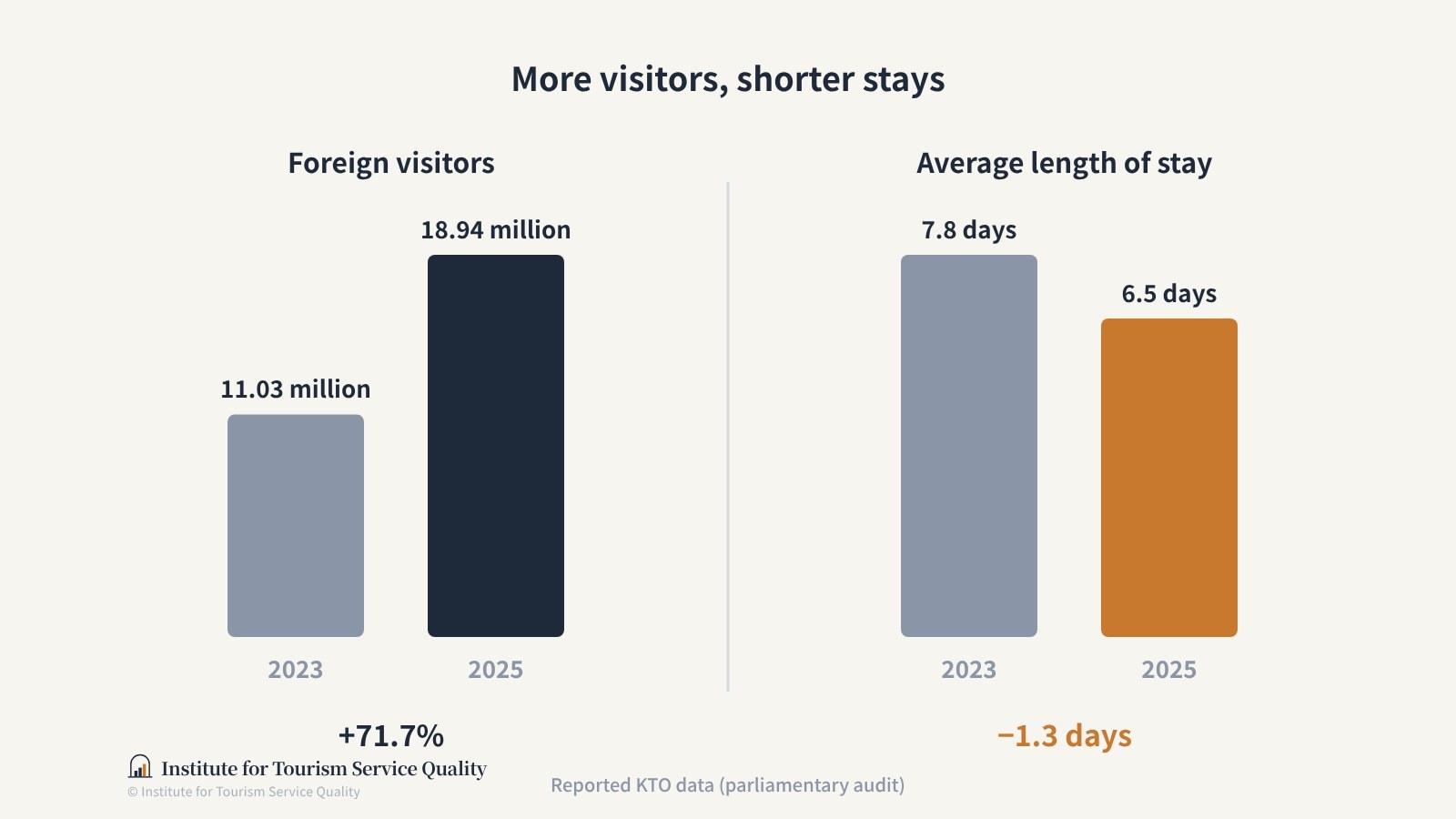
- Foreign visitors rose 71.7%, from 11.03 million in 2023 to 18.94 million in 2025.
- Over the same period, average length of stay fell by 1.3 days, from 7.8 to 6.5 days.
- Average spending per visitor fell 17.8% on accommodation and 16.9% on restaurants.
- The repeat visit rate has stayed in the 54–56% range for the past four years.
- Cruise passengers increased 4.5-fold over the past three years, but spending per passenger was 81% lower than ten years ago, and passengers calling at Busan stayed an average of 6.7 hours.
According to the reports, Jeong argued that length of stay and repeat visits should be included in the KTO's performance indicators. These figures, however, are materials obtained by the lawmaker's office as relayed by the media, and the survey methods and definitions of each indicator are not stated in the reports. The original data should be checked for an accurate interpretation.
Why they fell cannot yet be determined
Several explanations are possible for the decline in length of stay and spending. Short trips from nearby countries may have grown as a share of visits, accommodation types may have changed, and exchange rates and prices may also play a part. The reported data alone cannot identify the cause, so this article does not assume one. Whatever the cause, it is clear that getting visitors to stay longer and come back has been raised as a policy task.
Reading it through the lens of service quality
Service quality research has long shared the view that the quality of experience, more than the number of visitors, leads to satisfaction and repeat visits. From this perspective, the audit findings can be read in three ways.
First, the repeat visit rate is an outcome indicator of quality. Visitor numbers are heavily affected by promotion, flight supply and exchange rates, but the share of people who come back reflects more directly how the trip went. If the repeat visit rate has stalled, there is likely something to improve somewhere in the first-visit experience.
Second, problems become quality only when they are fixed quickly. According to the reports, 84 improvement items that the KTO identified in on-site inspections in June–July 2026 were not passed on to local governments until September. When the time between finding a problem and fixing it is long, visitors in the meantime experience the same inconvenience. The importance of a structure that turns collected customer feedback into improvements echoes the principle discussed in Customer feedback (VOC) shows where the next test should look.
Third, welcoming visitors covers everything between arrival and departure. According to Hankyung (30 October 2026), the Ministry of Culture, Sports and Tourism and the Visit Korea Committee are running a welcome week for foreign visitors at airports and cruise terminals from 30 October to 15 November. Events like this shape first and last impressions. The quality of a stay, however, is decided in between, across countless touchpoints in accommodation, restaurants and transport.
Tasks for hotels
The fall in spending on accommodation is a direct signal for the hotel industry. The editorial team suggests that hotels check the following.
- Collect foreign guests' difficulties separately: Problems that only foreign guests face, such as multilingual guidance, payment methods and how booking information is displayed, rarely show up in satisfaction surveys designed around domestic guests.
- Design reasons to stay one more night: Guests on multi-night stays experience housekeeping, laundry and local information differently from one-night guests. The multi-night experience needs to be checked on its own.
- Check language and exception handling at digital touchpoints: Hotels should confirm that kiosks and mobile check-in handle foreign names, overseas payments and time zone differences properly. We discussed accessibility at digital touchpoints in The service gap kiosks create, and how hotels can close it.
Visitor numbers count the people who opened the door. The repeat visit rate counts those who knocked again.
Conclusion
The target of 30 million foreign visitors is a symbol of the tourism industry's growth. The audit findings, however, can be read as a call to look at the quality of each visit that makes up that number. The detailed figures and indicator definitions need to be checked against the original data, but treating length of stay and repeat visits as outcomes of quality is a perspective hotels and tourism businesses can apply right away.
References
Most sources are in Korean.
- SBS Biz (2026.10.28). 9월 외국인 관광객 전년 대비 21.1% 늘어. https://biz.sbs.co.kr/amp/article/20000342717
- 디스커버리뉴스 (2026.10.28). 한국관광공사, 2026년 9월 방한 외래관광객 206만 명 달성. https://www.discoverynews.kr/news/articleView.html?idxno=1105167
- 뉴시스 (2026.10.14). 외국인 관광객 급증, 속 빈 강정? 정연욱 \"3000만명보다 내실 중요\". https://www.newsis.com/view/NISX20261014_0003825904
- 뉴스핌 (2026.10.14). [2026 국감] 정연욱 \"방한 외국인 71% 늘었지만 체류일수 감소…정책 전환해야\". https://www.newspim.com/news/view/20261014000442
- 한국경제 (2026.10.30). 갓 쓴 스누피가 반긴다…전국 5곳서 외국인 관광객 환영주간. https://hankyung.com/article/202610305205g
Was this article helpful?
This is an English version of the original Korean article. If the two differ, the Korean original prevails.
© Institute for Tourism Service Quality. All rights reserved.