Visitor Spending Heads to Dermatology Clinics and Pharmacies: Changes in How Visitors Stay That Hotels Should Read
The growth of medical and beauty tourism seen through foreign visitors' card spending data, and the tasks it sets for hotel services
Where foreign visitors spend money in Korea is changing. As spending shifts from duty-free stores and shopping towards dermatology clinics, pharmacies and cosmetics stores, medical and beauty tourism is becoming part of ordinary travel itineraries rather than the special purpose of a few visitors. This article sets out recently reported data on foreign visitors' card spending and considers what this shift means for how hotels design their services.
What was reported
According to Aju Business Daily (22 October 2026) and Maeil Ilbo (5 November), medical spending within foreign visitors' tourism-related card spending changed as follows in January–September 2026. Both reports cite the same figures, but Aju Business Daily attributes the source data to the Korea Tourism Data Lab of the Ministry of Culture, Sports and Tourism and the Korea Tourism Organization, while Maeil Ilbo attributes it to the Credit Finance Association and the card industry, so the original data need to be checked.
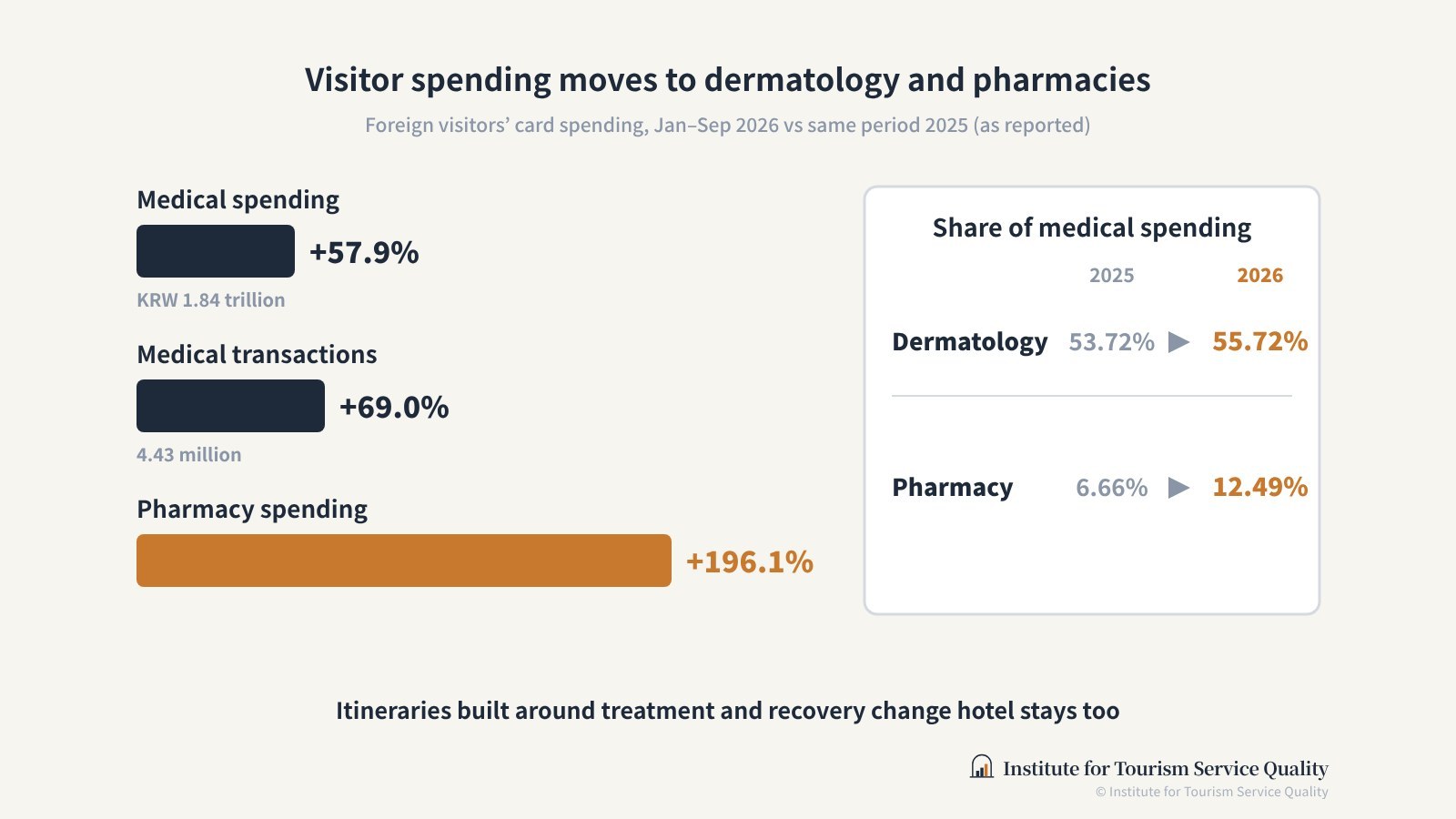
- Medical spending was KRW 1.8398 trillion, up 57.9% on the same period of the previous year (KRW 1.1653 trillion). The number of transactions was 4,427,613, up 69.0%.
- The share of dermatology within medical spending rose from 53.72% to 55.72%.
- Pharmacy spending rose by 196.1%, and its share of medical spending grew from 6.66% to 12.49%.
Companies' own figures point in the same direction. According to both reports, CJ Olive Young said cumulative purchases by foreign customers at its offline stores in Korea passed KRW 1 trillion in January–August 2026 (11.01 million transactions), and Kakao Pay said offline payments by foreign visitors rose 68.8% in the first half, with department stores (129.1%) and cosmetics (61.6%) showing large increases. These are company-reported figures.
There is also an analysis at the level of a single card company. According to the Segye Ilbo (4 August), BC Card analysed about 3.3 million cards used by foreign visitors and reported that their spending in the first half of 2026 was up 53.6% year on year. By sector, medical transactions rose 75.2% and skin-care and beauty spending rose 109.8%, while pharmacy spending rose 1,176.9%, the highest growth rate. The top areas by spending were Myeong-dong, Seogyo-dong, Yeoui-dong, Gwanghui-dong and Samseong 1-dong. This analysis is one card company's data as reported by one outlet.
Pharmacy spending growth differs widely between sources (196.1% in the January–September aggregate; 1,176.9% in BC Card's first-half data). The gap appears to come from differences in period, cards covered and sector classification, and this article presents both figures as they are. Either way, spending on pharmacies and dermatology grew faster than overall tourism spending.
Interpretation: medical and beauty spending changes how visitors stay
First, medical spending changes itineraries and routes. Shopping is part of a day's plan, but dermatology treatments shape the itinerary around appointment and recovery times. If visitors go out less after a treatment or return the next day, they spend more time at their accommodation, and the hotel's distance from the clinic may matter more than its distance from tourist sights. BC Card's analysis, in which an area in Gangnam (Samseong 1-dong) newly entered the top spending areas, can be read alongside this change.
Second, the rise in pharmacy spending points to "health-care" travel. The growing share of pharmacy payments can be interpreted as more spending on post-treatment care products, over-the-counter medicines or health supplements. However, the reported data do not show what was purchased, so this interpretation is the editors' inference.
Third, medical tourists are guests with different service expectations. A guest who has just had a treatment expects things that ordinary tourists may not, such as privacy, quiet routes through the hotel and flexible check-out times. These expectations are close to must-be quality: taken for granted when met, a source of strong dissatisfaction when not. This distinction was covered in Expected When Present, Infuriating When Missing: Hotel Service Attributes Through the Kano Model. The addition of indicators on medical tourist convenience to the grading of medical tourism hotels reflects the same context, as set out in Korea's Hotel Star Ratings Have Changed: When Data Protection Earns Stars.
Editorial suggestions
Hotels seeing more guests who travel for medical or beauty purposes may wish to check the following.
- Ask about the purpose of stay, but record as little as possible: Whether a guest has had a treatment helps in preparing services, but it is sensitive health-related information. Arrange the necessary services only within what guests choose to share, and keep what is stored in systems to a minimum.
- Create options for recovery stays: Prepare in advance, and explain in foreign languages, the services guests may request after a treatment, such as late check-out, in-room dining, ice and refrigerated storage, and allocation to a quiet floor.
- Define the scope of information about medical facilities: Information on nearby pharmacies and emergency contacts is a basic service, but recommending specific medical facilities or making bookings on guests' behalf may engage provisions of the Medical Service Act on attracting foreign patients. Detailed criteria should be checked against the original text and with experts.
- Rewrite location information: Consider adding how to reach major medical and beauty districts, not only distances to tourist sights, to the hotel's guidance and booking channel descriptions.
If visitors plan their itineraries around dermatology appointments, hotels need to plan their services around the recovery time.
Conclusion
Foreign visitors' card spending data show that the centre of inbound tourism is shifting from shopping towards experiential spending such as medical and beauty services. The figures differ between sources, but they agree on the direction: spending on dermatology and pharmacies is growing quickly. This change alters both the reasons for staying and the way visitors stay, and calls for new service standards in hotels that take privacy and recovery into account.
References
Most sources are in Korean.
- 아주경제 (2026.10.22). \"피부과 가고 올리브영 들르고\"…외국인 카드 소비 48% 급증. https://www.ajunews.com/view/20261022125514996
- 매일일보 (2026.11.5). \"피부과 찍고 약국 들러 올리브영\"… 외국인이 카드로 그린 'K-뷰티 지도'. https://www.m-i.kr/news/articleView.html?idxno=2014791
- 세계일보 (2026.8.4). 성형 대신 피부과·약국 투어…외국인 카드사용액 54% 급증 [경제 레이더]. https://www.segye.com/newsView/20260803517896
Was this article helpful?
This is an English version of the original Korean article. If the two differ, the Korean original prevails.
© Institute for Tourism Service Quality. All rights reserved.