When Booking Data Becomes Material for Fraud: Weak Links in Hotel System Security
Partner accounts, mobile apps and guest communication, seen through hotel security incidents reported in November 2026
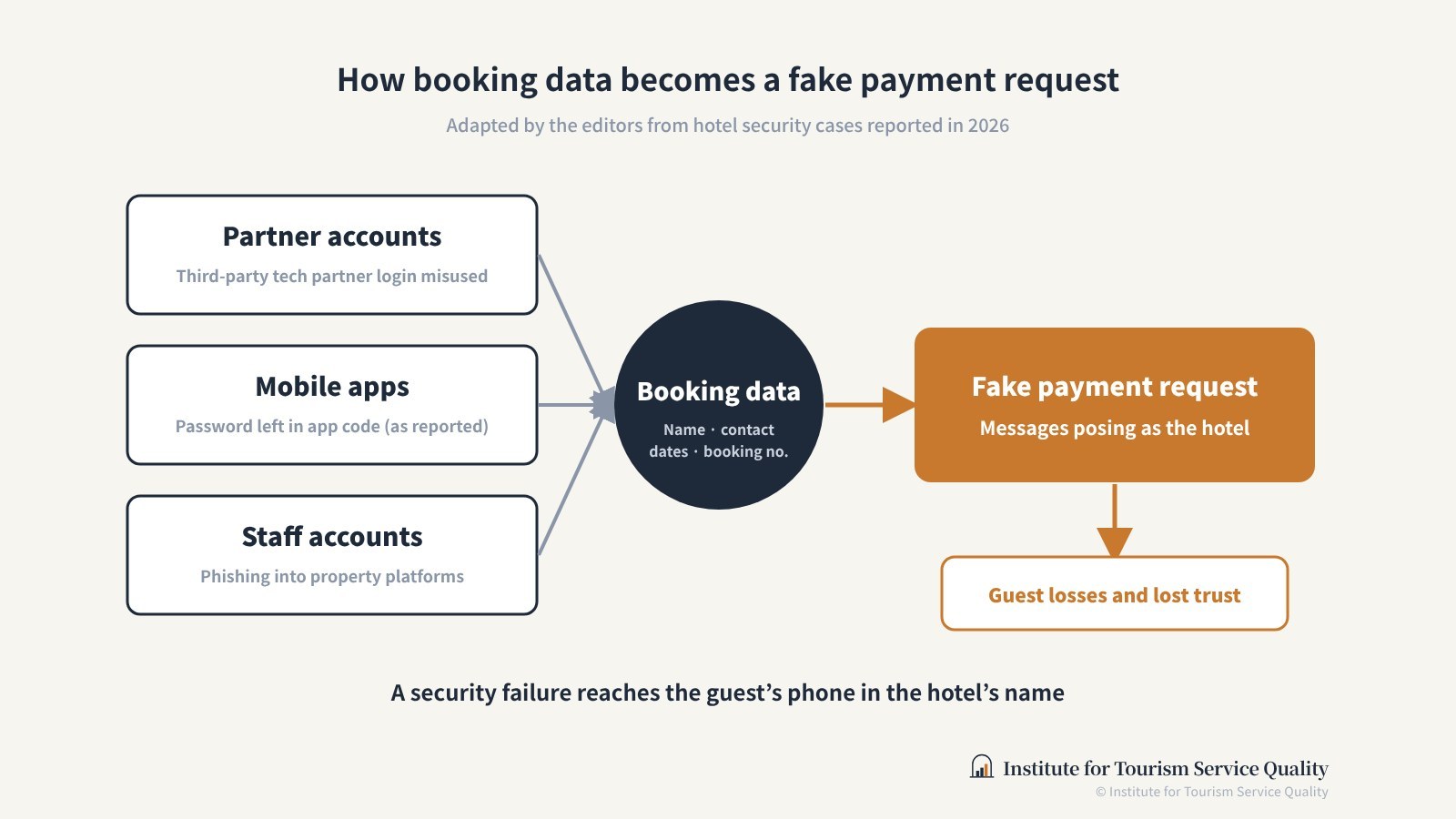
Hotel booking data has value even without card numbers. With a guest's name, contact details, stay dates and booking number, someone can pose as hotel staff and send a message saying "payment is needed to confirm your booking". In November 2026, security problems were reported in quick succession at a European luxury hotel group and a large US hotel franchisor. The two cases show that the weak links in hotel systems may lie not in head-office servers but at the edges, such as partner accounts and guest-facing apps.
What was reported
Kempinski: According to Kempinski's notice of 12 November 2026, as reported by La Revue des Hôtels, login credentials belonging to an external technology partner were used by an unauthorised person. The exposed information comprised guest names, stay dates, hotel names, booking numbers, mobile phone numbers and email addresses, and this information was used to contact guests while posing as Kempinski hotels and request payments. The company said payment card data was not stored in the affected system and was not accessed, and that it could neither confirm nor rule out exposure of passport or visa numbers. It said it had revoked the credentials, opened an investigation with external security experts and notified data protection authorities. The partner's name, the number of guests affected and the hotels involved were not disclosed. The German travel trade publication fvw also reported the incident, relaying the company's warning that payment requests arriving by email or WhatsApp are fraudulent.
Wyndham: TechCrunch reported on 9 November 2026 that a security researcher had found a hardcoded password inside Wyndham's Android app, and that this password allowed access to an internal customer database hosted on Salesforce. According to the report, customer names, email addresses, membership numbers and login tokens, among other data, were exposed to possible access, and the researcher used AI tools to analyse the app's code and find the problem. Wyndham revoked the credential after TechCrunch contacted it and said there was "no evidence of any unauthorized access." Subsequent reports by other outlets largely cite the TechCrunch report, so the facts rest in effect on a single report.
Such incidents have recurred in 2026. In March the security company Gen Digital analysed a "reservation hijack" technique in which attackers phish hotel staff accounts, enter property management platforms and then demand fake payments based on real booking data. In May BWH Hotels told guests that a web application holding booking data had been accessed without authorisation for more than six months.
Interpretation: how a data leak turns into service failure
First, attacks are moving to the edges of hotel systems. In the Kempinski case the entry point was a partner account, and in the Wyndham report the problem lay inside an app distributed to customers. The more tools a hotel uses, such as a property management system (PMS), channel manager, guest messaging and customer relationship management (CRM), the more accounts and integration points there are.
Second, the damage appears as guest experience. Fake payment requests arrive with real booking numbers and dates, so guests find them hard to tell apart. If a guest is defrauded, the experience is remembered as "I was fooled by a message from the hotel". An information security incident thus becomes a failure of trust and a service failure.
Third, the threshold for attack tools has fallen. In the Wyndham report, the researcher used AI tools to analyse the app's code. Because malicious actors can use the same methods, the basic principle of not leaving secrets inside apps has become more important. Integration and permission issues are also discussed in When the PMS Connects to AI Assistants: The Spread of MCP and the Challenge of Permissions.
Editors' proposals
To protect booking data, hotels may wish to check the following. Reporting and notification standards under Korean personal data protection law should be confirmed in the original texts.
- Keep an inventory of partner accounts: List every external partner account that can access booking data, and regularly check each account's scope of permissions, whether multi-factor authentication (MFA) is applied and when it was last used. Close unused accounts immediately.
- Restrict exports of booking data: Grant bulk query and export permissions only to roles that truly need them, and set alerts for unusually large queries.
- Tell guests the payment request policy in advance: If the hotel does not send payment links by messenger or text, state that policy clearly in booking confirmation emails and on the official website. Also provide an official channel for checking suspicious messages.
- Check that no secrets remain in apps and integration code: When procuring mobile apps, kiosks or web booking engines, require checks at the contract and acceptance stages that passwords or access keys are not embedded in the code.
- Open a vulnerability reporting channel: Publish a security reporting channel on the website so that external researchers can make contact when they find a problem. In the Wyndham report, the researcher could not find a reporting channel and alerted the company through the media.
Guests cannot see security, but the consequences of a security failure arrive on their phones in the hotel's name.
Conclusion
Not storing card numbers does not by itself make booking data safe. A name, dates and a booking number are enough to build a convincing fraudulent message. Hotel IT security must now treat partner accounts, guest-facing apps and messages exchanged with guests, beyond head-office systems, as a single perimeter. Guarding that perimeter is a foundation of service quality that allows guests to book with trust.
References
Most sources are in Korean.
- La Revue des Hôtels (2026.11.14). The Kempinski group, based in Munich, confirms a guest data breach followed by fake payment requests. https://larevuedeshotels.com/en/kempinski-data-breach-fake-payment-requests-munich
- fvw (2026.11.13). Gästedaten betroffen: Phishing-Angriff auf Luxushotelkette Kempinski. https://www.fvw.de/traveltech/sicherheit/gaestedaten-betroffen-phishing-angriff-auf-luxushotelkette-kempinski-266062
- TechCrunch (2026.11.9). Hotel giant Wyndham exposed customer data after app security lapse. https://techcrunch.com/2026/11/09/hotel-giant-wyndham-exposed-customer-data-after-app-security-lapse
- TechDogs (2026.11.10). Wyndham Exposed Customer Data After Leaving Database Password In Android App. https://www.techdogs.com/tech-news/td-newsdesk/wyndham-exposed-customer-data-after-leaving-database-password-in-android-app
- Cyber Security News (2026.4.1). Hackers Hijack Hotel Booking Workflows to Scam Guests With Fake Payment Requests. https://cybersecuritynews.com/hackers-hijack-hotel-booking-workflows/
- SecurityWeek (2026.5.12). BWH Hotels Says Hackers Had Access to Reservation Data for 6 Months. https://www.securityweek.com/bwh-hotels-says-hackers-had-access-to-reservation-data-for-6-months/
Was this article helpful?
This is an English version of the original Korean article. If the two differ, the Korean original prevails.
© Institute for Tourism Service Quality. All rights reserved.