When AI Agents Book Hotels: Are Direct Booking Channels Ready?
What Meta's Muse and its Cloudbeds integration reveal about agentic booking and the tasks facing hotel IT
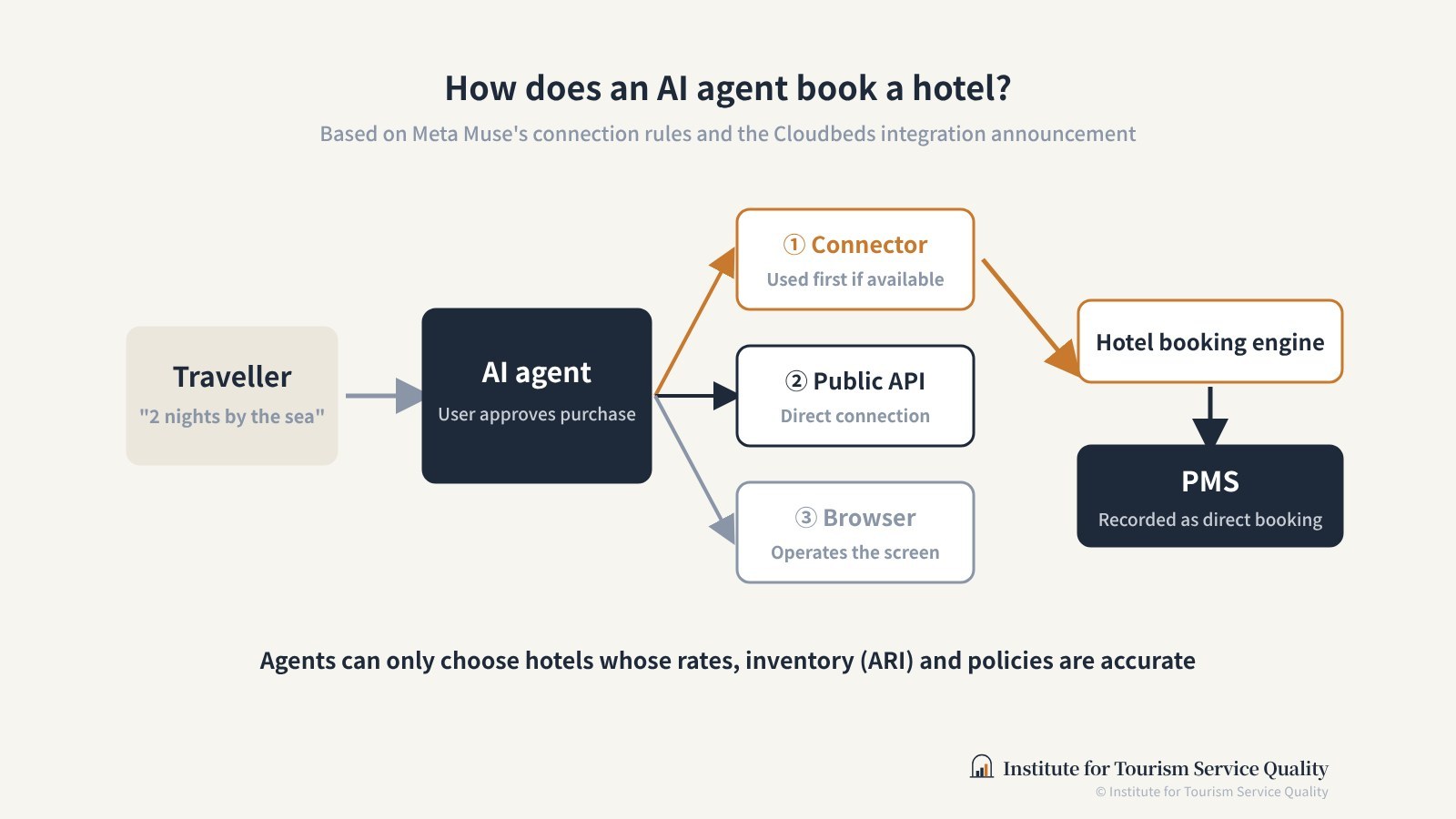
The scene in which a traveller hands an AI a request such as "book me two nights at a seaside hotel next month" instead of typing into a search box is close to becoming a real service. In September 2026 Meta announced Muse, a personal AI agent, and in October the hotel management system company Cloudbeds announced an integration that lets guests book hotels directly within Muse. Software, rather than people, choosing and booking hotels is often called agentic commerce. This article reviews what has been reported and the conditions hotel IT systems must meet when agents become a new booking channel.
What was announced
According to Hotel-Online, Meta announced Muse on 8 September 2026. Muse does not just answer questions; it makes plans, carries out tasks on websites and apps, and continues working after the user closes the app. Purchases go ahead only after the user approves them, and the service is available first in the Meta AI app and WhatsApp.
According to Cloudbeds' announcement of 20 October, reported by Hospitality Net, participating hotels will show live rates, inventory and policies inside Muse. Bookings are completed in the hotel's Cloudbeds booking engine and recorded as direct reservations in the property management system (PMS). The feature will be offered from Q1 2027 to customers in the United States as part of a digital marketing solution.
Hospitality.today (28 October) described the connection rules Muse follows: it uses a connector if a service provides one, connects directly if a public application programming interface (API) is available, and otherwise opens a browser and operates the screen as a person would. The same report said that Meta stated in its 21 October earnings call that it would charge fees on transactions brokered by Muse, without disclosing the amount.
What agents read and book
To book a hotel, an agent must correctly read rates, inventory and availability, together known as ARI. When a connector or public API exists, systems exchange this data directly; when it does not, the agent has to interpret web pages, which increases the chance of error.
A briefing by Hospitality Net on 27 October presented two pieces of evidence for this problem. In an agent test conducted by Terence Ronson on 19 October, Marriott, IHG, Accor and Choice reached the payment step, while results for Hyatt, Hilton and Wyndham were inconsistent. In a PMS survey by the AI Hospitality Alliance, only 7% of 343 vendors had fully published API documentation. Both sources are cited in the briefing, and their test methods and survey criteria should be checked in the originals.
What hotel IT should check
Agentic booking is still at an early stage, and the integration discussed here was announced for the US market. The direction is clear, however, so the editorial team suggests that hotels check the following in advance.
- Do rates and inventory match across systems? Agents compare and filter faster than people, so even small mismatches between the channel manager, booking engine and PMS will be exposed. We covered how to check these integrations in Channel manager integration testing.
- Are policies organised as data? If cancellation rules, breakfast inclusion and child rates exist only as long passages of text, agents may misread them. Structured, item-by-item information is needed.
- Can you calculate the cost of direct bookings? Even if bookings through an agent are recorded as "direct", platform fees have not yet been disclosed. To compare them with online travel agency (OTA) commissions, start by checking the contract terms.
- Will check-in become the first encounter? If a guest books without ever visiting the hotel's website, the confirmation message and pre-arrival information become the hotel's first point of contact. Procedures for handling bookings an agent got wrong should also be set in advance.
Conclusion
Agentic booking is an opportunity for hotels to increase direct bookings, and also a test of whether their systems are ready to be read by software rather than people. Accurate rates and inventory, well-organised policy data and open connection methods have so far been matters of operational efficiency; from now on, they become the conditions for being found and chosen by agents. In the age of agents, service quality may be decided before the guest ever sees a screen.
References
Most sources are in Korean.
- Hotel-Online (2026). Meta Unveils Muse as an AI Agent. Is Your Hotel Ready To Be Found? https://www.hotel-online.com/news/meta-unveils-muse-as-an-ai-agent-is-your-hotel-ready-to-be-found
- Hospitality Net (2026.10.20). Cloudbeds brings AI travel demand directly to hoteliers with Meta's Muse integration. https://www.hospitalitynet.org/news/4135008/cloudbeds-brings-ai-travel-demand-directly-to-hoteliers-with-metas-muse-integration
- Hospitality.today (2026.10.28). Meta's AI agent will book hotels direct. Nobody has named the price. https://www.hospitality.today/article/your-hotel-can-apply-for-a-line-into-metas-agent-after-all-nobody-has-said-what-it-costs
- Hospitality Net (2026.10.27). HN Brief: Is ARI Plumbing the Main Obstacle to Agentic AI?, Seven Components for Hotel Agent Governance. https://www.hospitalitynet.org/editorial/4135138/is-ari-plumbing-the-main-obstacle-to-agentic-ai-seven-components-for-hotel-agent-governance-hvs-broad-revpar-recovery-sets-an-elevated-base-for-2027
Was this article helpful?
This is an English version of the original Korean article. If the two differ, the Korean original prevails.
© Institute for Tourism Service Quality. All rights reserved.