The Lobby Serves Without Words: The Hotel's Physical Environment Through the Servicescape
How hotel spaces change the behaviour of guests and employees, seen through Bitner's (1992) servicescape framework
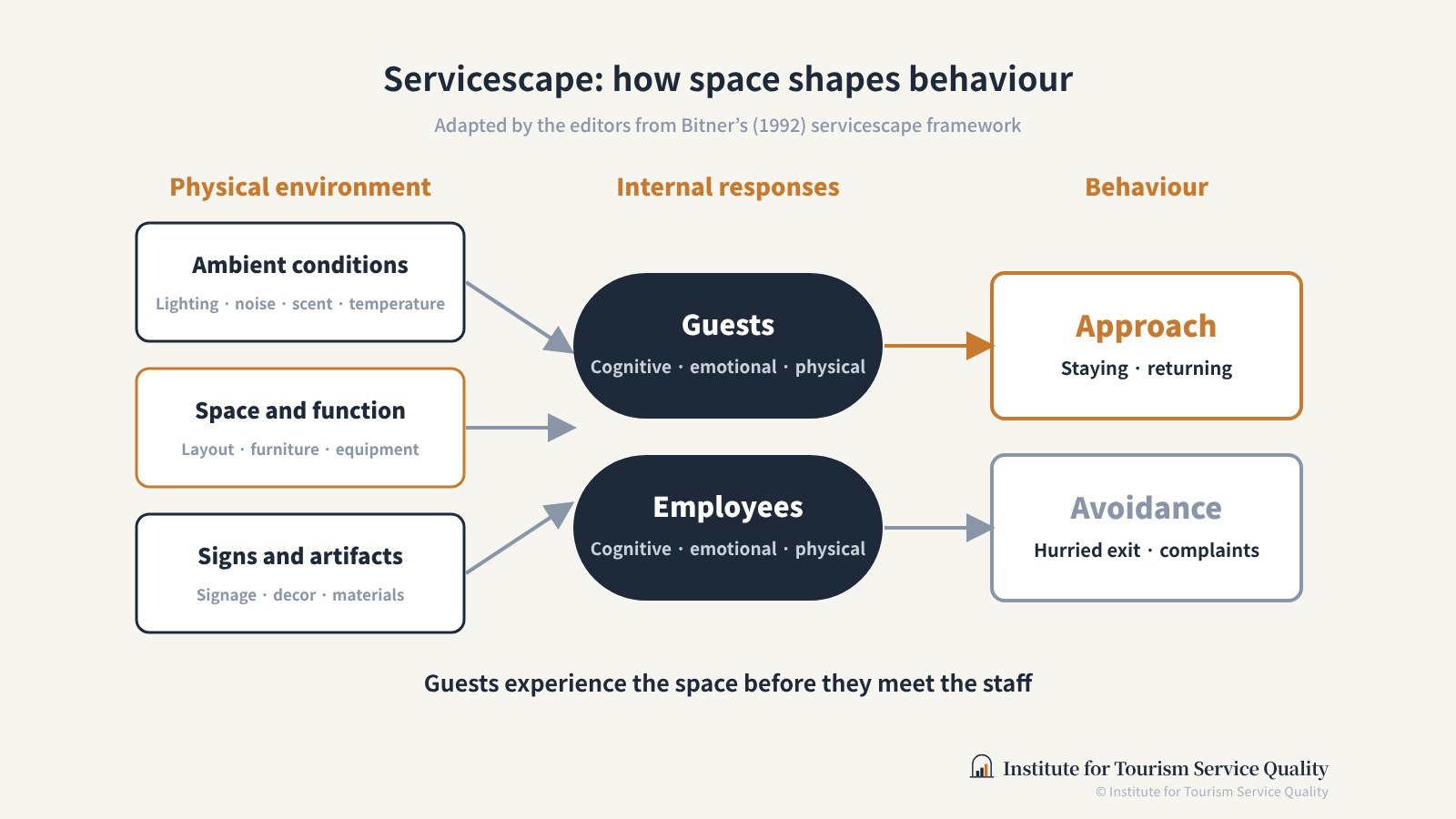
Hotel guests judge a great deal before they exchange a first greeting with staff. The directions at the car park entrance, the lighting and scent of the lobby, the route to the front desk and the signs in front of the lifts all feed that judgement. Service quality research has addressed the physical environment in which service takes place under the concept of the servicescape. This article focuses on Bitner's (1992) framework to set out how hotel spaces affect the behaviour of guests and employees.
What is the servicescape?
In a paper published in the Journal of Marketing, Bitner (1992) used the term servicescape for the built physical environment in which services are produced and consumed. The starting point is that services are intangible and their quality is hard to check in advance, so customers use the visible environment as a cue for evaluating the service. This shares the concern behind SERVQUAL (Parasuraman et al., 1988), which includes tangibles as one quality dimension, but the servicescape framework goes a step further by trying to explain the path through which the environment changes behaviour.
The framework divides the environment into three dimensions.
- Ambient conditions: Elements such as lighting, temperature, noise, music and scent that act on the senses even without conscious attention.
- Spatial layout and functionality: The arrangement of furniture and equipment, circulation, and the extent to which facilities work as intended.
- Signs, symbols and artifacts: Elements such as directional signs, decoration and materials that communicate the meaning and rules of a space.
These environmental elements trigger cognitive, emotional and physiological internal responses in both customers and employees, and those responses lead to approach behaviour, such as staying longer or returning, or avoidance behaviour, such as leaving in a hurry or complaining. This flow draws on Mehrabian and Russell's (1974) environmental psychology model, in which environmental stimuli lead through emotional states to behaviour.
Why the servicescape matters especially in hotels
First, a hotel is a service in which guests stay in the space for a long time. Bitner classified services into self-service, interpersonal services and remote services according to whether customers, employees or both act within the space, and distinguished lean from elaborate environments according to the complexity of the space. Hotels are a typical case of interpersonal service in which guests and staff spend time together in a complex space, so the influence of environmental design is inevitably large.
Second, the same space also affects employees' work. A distinctive feature of the servicescape framework is that it includes employees in the analysis. If circulation behind the front desk is inefficient or noise levels are high, staff fatigue and errors increase, and this eventually returns as lower quality in guest service. Problems in back-of-house spaces that guests cannot see connect with the issues "below the line of visibility" discussed in Hotel Check-In as a Service Blueprint: The Quality Below the Line Guests Cannot See.
Third, space also shapes interactions between customers. Bitner held that the physical environment affects social interactions between customers and employees and among customers. If the check-in queue overlaps with lobby circulation, waiting guests and passing guests inconvenience each other, and that inconvenience remains in their evaluation of the hotel.
The servicescape in an age of unstaffed service
As kiosks and mobile check-in spread, there are more moments when guests must interpret the space on their own without staff. At those moments, spatial layout and signage replace the explanations staff used to give. If the space cannot tell guests where the kiosk is, whom to call when something goes wrong, or how to get to their room, guests get lost regardless of the quality of the machine. Quality criteria for self-service technology are set out in Seven Criteria for Measuring Service Without Staff: SSTQUAL.
Editors' proposals
From a servicescape perspective, hotels may wish to check the following.
- Walk the arrival route at guests' eye level: Walk from the car park, main entrance and lobby to the front desk or kiosk, the lifts and the room as a first-time guest would, and record the points where you hesitate. Check at the same time whether signs are where they are needed and whether foreign-language labels are consistent.
- Measure ambient conditions by time of day: Even the same lobby differs in noise, temperature and crowding between a busy check-in afternoon and a quiet morning. Checking by time of day shows the environment guests actually experience.
- Apply the same criteria to staff spaces: Regularly gather staff views on whether inconveniences in the work area behind the front desk, housekeeping routes or staff rest areas are affecting service quality.
- Classify spatial cues in reviews: Collecting mentions of the physical environment, such as noise, smell, wayfinding and waiting areas, separately from other guest reviews and complaints provides a basis for setting improvement priorities.
Guests read space as the promise of a service. A well-designed space guides and reassures guests before staff say a word.
Conclusion
The lesson of servicescape research is simple. Service quality does not arise only from staff interactions; it is also created in the spaces that guests and employees share. The fewer staff and the more machines a hotel has, the more the space must speak on their behalf. Checking the space is not a matter of interior decoration but of service design.
References
Most sources are in Korean.
- Bitner, M. J. (1992). Servicescapes: The impact of physical surroundings on customers and employees. Journal of Marketing, 56(2), 57-71.
- Mehrabian, A., & Russell, J. A. (1974). An approach to environmental psychology. MIT Press.
- Parasuraman, A., Zeithaml, V. A., & Berry, L. L. (1988). SERVQUAL: A multiple-item scale for measuring consumer perceptions of service quality. Journal of Retailing, 64(1), 12-40.
Was this article helpful?
This is an English version of the original Korean article. If the two differ, the Korean original prevails.
© Institute for Tourism Service Quality. All rights reserved.