Crisis and Survival for Tourism Workers in the Great AI Transition: A Reflection
Looking at how tourism differs from industries where AI is already replacing work, what lies ahead for tourism workers, and how to prepare together

The Institute's website, where this column appears, was built by the author together with AI.
The author is not a developer. Before building this website, he had never used a tool called Git or worked with a service called Cloudflare. Yet the Institute's website now runs on its own domain, regularly publishes articles on tourism policy and hotel industry trends, and can be read in both Korean and English. AI helps with much of the work of drafting articles, drawing charts, translating into English and publishing them on the site. Until very recently, this would have been hard to imagine.
It has been a remarkable and convenient experience, but that convenience left a question behind. If one non-specialist can build a website with AI, what will become of the work people have done in the tourism industry? This column sets out the author's thoughts on that question. Rather than claiming to have the answer, it is meant as an attempt to find a way forward together with colleagues on the front line who share the same concern.
It has already begun in other industries
AI taking over people's work is no longer a distant forecast. The first areas affected have been customer support and office work.
Marc Benioff, CEO of US enterprise software company Salesforce, said on a podcast in September 2025 that after introducing AI agents the company had reduced its customer support staff from about 9,000 to 5,000. According to him, AI now handles half of customer conversations and people handle the other half.
There are cases in the opposite direction too. Swedish payments company Klarna announced in February 2024 that its AI assistant was doing the work of 700 customer service agents, but in May 2025 it began hiring customer service staff again. CEO Sebastian Siemiatkowski acknowledged that the AI-focused strategy had lowered costs but reduced the quality of service, and said customers should always be able to talk to a person if they want to.
The broader trend can be seen in the World Economic Forum (WEF) Future of Jobs Report 2025. The report projects that 170 million jobs will be created and 92 million displaced by 2030, a net increase of 78 million. Among the fastest-declining roles it lists cashiers, administrative assistants and graphic designers, and 41% of employers said they plan to reduce their workforce as AI automates tasks. Employers expect 39% of workers' core skills to change by 2030.
Taken together, the two company cases and the report make one thing clear: AI quickly takes over repetitive, standardised work, but where relationships and trust matter, AI alone is not enough.
How is tourism different?
Tourism is no exception to this trend. AI is already part of information work such as confirming bookings, answering inquiries, replying to reviews and setting rates. In Korean lodging, self check-in kiosks are evolving into unmanned front desks (From Check-In Machine to Unmanned Front Desk: How Lodging Kiosks Are Evolving in Korea), and in an overseas study the Institute reported on, 91% of hotel chains were already using AI (91% of Hotel Chains Use AI, but Only 13% Report Measurable Returns: Readiness, Not Adoption, Is the Problem).
The author, however, sees three ways in which tourism differs from other industries.
First, the product of tourism is an experience, and experiences are made on site. Guests experience the room, the meal and the attitude of the person serving them all at once. Unlike support work that ends with an answer on a screen, in tourism the physical space and the people are part of the product.
Second, exceptions are frequent. A family arriving at dawn after a delayed flight, a couple celebrating an anniversary, a guest who suddenly falls ill: every day brings moments that fixed rules cannot handle. The judgement and care shown in those moments are what guests remember.
Third, attempts to run on technology alone have already shown their limits. Japan's robot hotel, Henn na Hotel, retired about half of its robot staff in 2019. According to The Register, citing The Wall Street Journal, the in-room robot assistant mistook guests' snoring for speech and woke them up, and the luggage robots could move only on flat floors and so reached only some rooms. In the end, that work went back to people.
Because of these differences, AI in tourism is more likely to change the make-up of people's work than to replace people outright. That Korea ranked 12th in the Travel & Tourism Development Index but only 65th on the hospitality reputation index (The Shadow Behind 12th Place: What a Hospitality Reputation Rank of 65th Asks of Korean Lodging) also shows how large a share remains for people where technology falls short.
The outlook for tourism workers
Based on the cases from other industries and the characteristics of tourism, the author expects tourism workers' jobs to change as follows. This is the author's personal outlook, and the pace and shape of change may differ by the size of the hotel or organisation and its guest mix.
Some work will shrink: taking and confirming bookings, answering standard inquiries, simple check-in and check-out, and writing routine reports. This work is moving quickly to kiosks, mobile check-in and AI support. Change will be greatest first in tasks with little guest contact, such as those at night.
Some work will change shape. Front desk staff will move from processing paperwork to designing guests' stays and solving problems, and reservations staff from taking bookings to managing channels and rates. Revenue managers will spend less time calculating rates themselves and more time judging whether rates proposed by AI fit the hotel's strategy (When AI Sets Room Rates, What Does the Revenue Manager Decide?).
Some work will be created or grow: operating and connecting the many systems hotels now use, managing AI output and guest data, and designing deeper hospitality with the time technology saves. People who know the front line and understand systems are rare today and will become more valuable.
In short, what disappears in tourism is less the "job" as a whole than the "repetitive tasks" within it. What fills that space will shape each person's future.
Ways to prepare from now on
So what can front-line workers prepare? Drawing on the author's experience of building the website and working with AI in QA, here are some low-pressure ways to begin, offered as a guide.
1. Sort your work into three groups
You can begin by writing down what you do in a week and sorting it into work you can hand to AI as a first draft, work you do with AI but must check yourself, and work only a person can do. At the front desk, booking confirmation emails and foreign-language notices would fall close to the first group, answers to rate and cancellation questions to the second, and handling an angry guest or welcoming a regular to the third. Redrawing this table every quarter, you will naturally begin to see which parts of your work are shrinking and which are worth growing.
2. Get comfortable with AI through one small task
There is no need to use AI for everything from the start. It is enough to pick one task you do often, do it with AI for a few weeks, and note how long it took before and after. Good starting points might be draft replies to inquiries in reservations, draft proposals in sales, tidying the inspection checklist in housekeeping, or classifying guest complaint records for duty managers. As hands-on experience builds, you develop a feel for what to hand over and what to keep, and a record in numbers is solid evidence when you propose a change in how your team works.
3. Build the habit of checking
What AI produces can look plausible yet contain mistakes. Before sending anything to a guest, simply recalculating amounts and dates, comparing it against your hotel's actual policies, and never entering guests' personal data in the first place can greatly reduce errors. The principles are set out in What to Check Before Putting Hotel Guest Data into AI.
4. Keep a record of front-line knowledge
The author would recommend gathering in one document the maximum occupancy for each room type, cancellation rules, frequent exceptions and how to handle them, and recurring guest complaints with how they were resolved. This record becomes the context you hand to AI along with a task, making the results far more accurate. At the same time, it becomes a valuable asset that shows your experience. In the end, the person who has written down what AI does not know becomes the person who uses AI best.
5. Give the time you save back to hospitality
If the time AI saves is filled with more paperwork, guests will notice no difference. It helps to decide in advance how to give that time back to guests: reading a guest's history before arrival to prepare the welcome, checking in once during the stay before they ask, or greeting a guest who complained once more before they check out. The more technology lightens people's work, the deeper hospitality can become.
6. Take an interest in the job one step to the side
There are more digital roles where front-line experience comes to life than you might think: QA or implementation support at hotel IT companies, property management system (PMS) operations, revenue management and data analysis, and customer relationship management (CRM) and digital marketing. Even without changing jobs right away, taking on the role of conveying the front line's voice when your company introduces a new system is a good start. The author, too, moved into QA building on the sense developed at the front desk, and along the way studied for the international software testing qualification (ISTQB) and was able to put names to his front-line experience.
For those who lead organisations
Because individual effort has limits, the role of managers and executives also matters. Setting rules on which AI tools may be used and with what information lets staff try them with confidence. Evaluating the quality of guest service, not just volume handled, allows the time saved to flow naturally back to guests. It also helps to create short sessions in each department where staff who tried AI first share their experience with colleagues. Change on the front line tends to spread faster through the colleague at the next desk than through training.
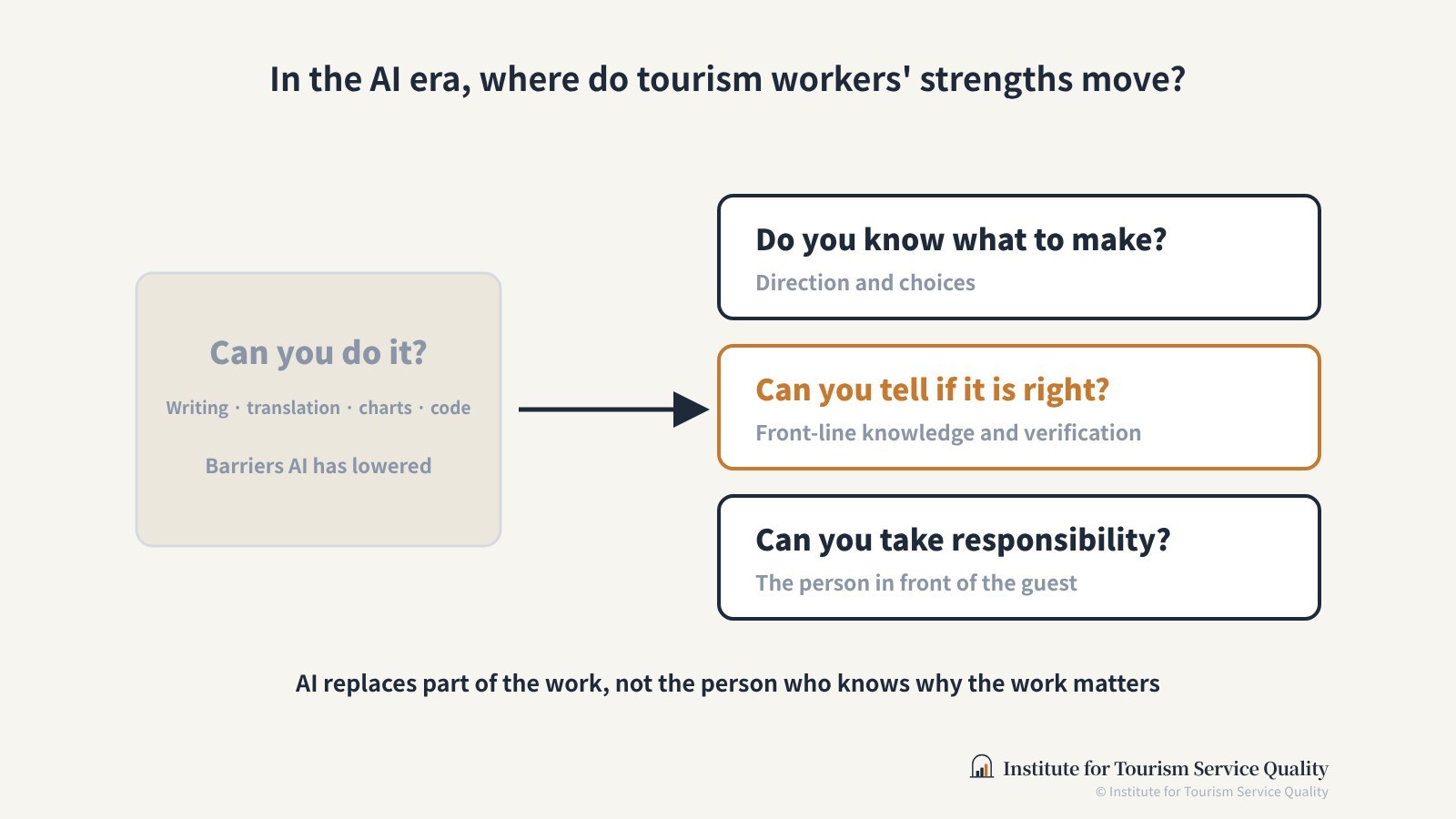
What AI replaces is part of the work, not the person who knows why that work is needed.
Turning crisis into questions
When he worked at a hotel front desk, the author feared that kiosks would one day take over that work. That fear led him into the world of hotel IT, and today he has written a book about working with AI agents, built a website with AI and runs a research lab. Looking back, what protected him was not learning technology first, but reaching for new tools without letting go of the sense built on the front line.
The great AI transition is clearly a crisis for tourism workers. Yet as the cases from other industries show, what AI can quickly replace is repetitive work, while trust and care between people remain the work of people. As long as we remain people who can ask, in front of an answer AI has given, "Is this really right for the guest?", tourism will remain an industry of people. The author hopes this column serves as a small guide for colleagues on the front line who share the same concern.
References
Most sources are in Korean.
- World Economic Forum (2025.1.8). Future of Jobs Report 2025: 78 Million New Job Opportunities by 2030 but Urgent Upskilling Needed to Prepare Workforces. https://www.weforum.org/press/2025/01/future-of-jobs-report-2025-78-million-new-job-opportunities-by-2030-but-urgent-upskilling-needed-to-prepare-workforces/
- World Economic Forum (2025.1). The Future of Jobs Report 2025. Chapter 3: Skills outlook. https://www.weforum.org/publications/the-future-of-jobs-report-2025/in-full/3-skills-outlook/
- TechRepublic (2025.9.3). Salesforce 'Needs Less Heads,' So It Cut 4,000 Jobs, As AI Takes Over. https://www.techrepublic.com/article/news-salesforce-cuts-4k-jobs/
- Computing (2025). Salesforce confirms 4,000 job cuts as AI takes over customer support. https://www.computing.co.uk/news/2025/ai/salesforce-confirm-4000-ai-driven-job-cuts
- Entrepreneur (2025.5.9). Klarna Is Hiring Customer Service Agents After AI Couldn't Cut It on Calls, According to the Company's CEO. https://www.entrepreneur.com/business-news/klarna-ceo-reverses-course-by-hiring-more-humans-not-ai/491396
- The Register (2019.1.15). World's first robot hotel massacres half of its robot staff (Wall Street Journal 보도 인용). https://www.theregister.com/2019/01/15/worlds_first_robot_hotel_massacres_robot_staff/
- 박건희 (2026). 이제 QA, AI Agent랑 같이 합시다. 부크크.
Was this article helpful?
Trained in hotel management, he worked as a front office manager at an international brand hotel and earned a Ph.D. in Tourism from Kyonggi University. He now leads service planning, customer feedback (VOC) analysis and quality assurance at a hotel IT solutions company.
This is an English version of the original Korean article. If the two differ, the Korean original prevails.
© Institute for Tourism Service Quality. All rights reserved.