Hotel Brands Beyond the Guest Room: When Kimchi and Bedding Become the Hotel Experience
The expansion of private-brand (PB) products at Korean luxury hotels and the tasks it leaves for service quality management
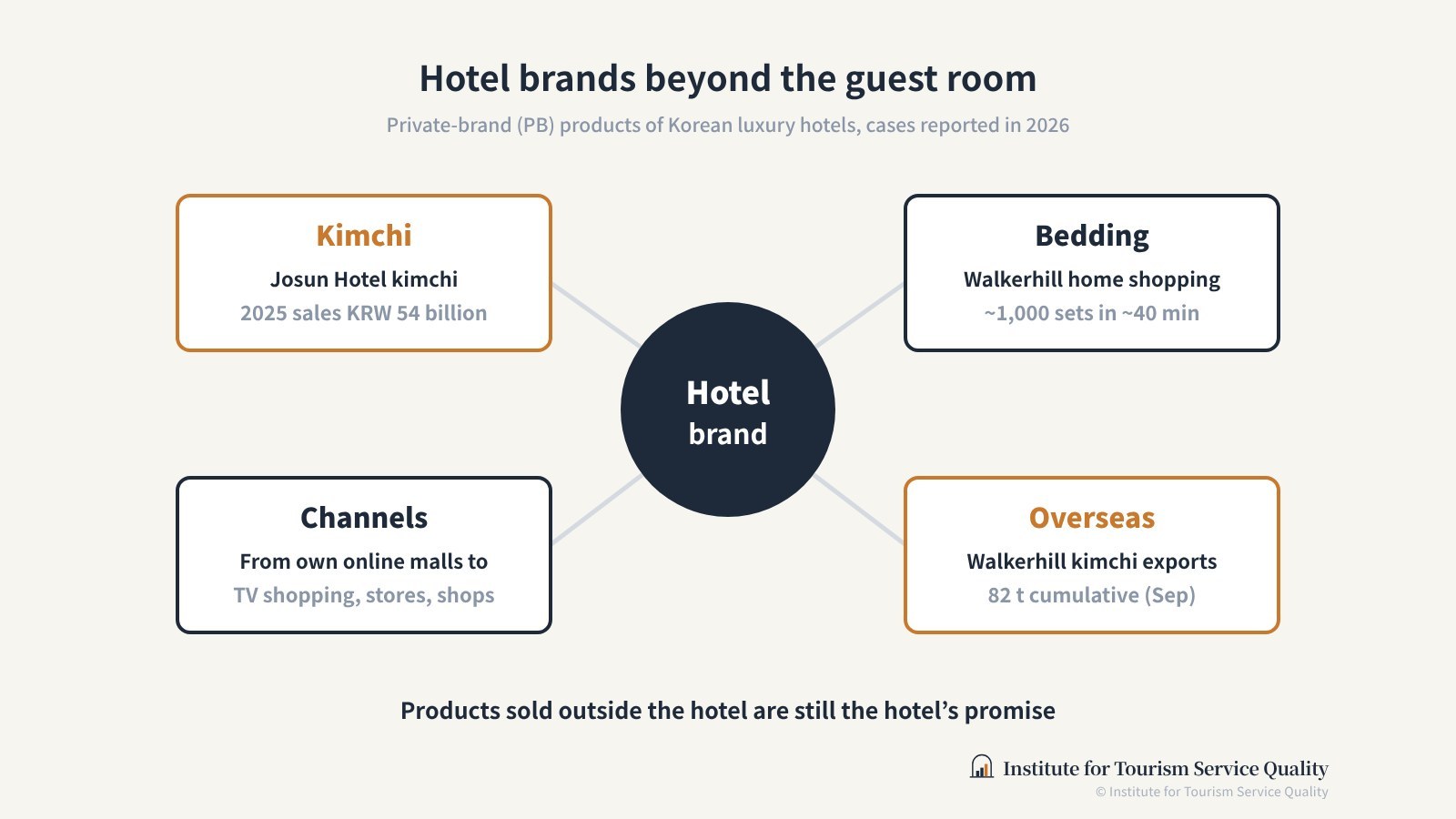
A hotel's products are no longer confined to its guest rooms and restaurants. Korean luxury hotels are turning kimchi made from their restaurants' recipes and the bedding used in their rooms into private-brand (PB) products, sold through online malls, TV home shopping, department stores and overseas markets. A structure has emerged in which consumers who have never visited a hotel experience its brand first. This article sets out recently reported cases and figures, and considers what hotel experiences sold outside the guest room mean for brand and service quality management.
What was reported
Food: starting with kimchi and going overseas. According to Newsis (21 July 2026) and Metro Seoul (5 October), sales of Josun Hotels & Resorts' kimchi reached KRW 54 billion in 2025, passing KRW 50 billion for the first time, and the company has set targets of KRW 62 billion for 2026 and KRW 100 billion for 2030. According to the same reports, Lotte Hotels & Resorts' kimchi sales in 2025 were up 42% on the previous year, and in July it held a kimchi pop-up at the Daimaru department store in Tokyo. Walkerhill Hotels & Resorts began exporting to the United States in September 2025 and extended supply to Australia in March 2026, and Metro Seoul reported its cumulative overseas exports at 82 tonnes as of September. Sales targets and export volumes are company-reported figures.
Bedding: bringing the hotel bed home. According to Metro Seoul (2 November), CJ OnStyle launched a bedding collection planned with Walkerhill on a TV home shopping programme on 7 November. According to MTN (12 November), close to 1,000 bedding sets were sold in about 40 minutes of that broadcast, and Lotte Hotel opened a store for its own bedding brand "he:on" in a department store. In the same report, Lotte Hotel said he:on's sales for January–October 2026 were about 26% higher than in the same period of the previous year, and Josun Hotel's total PB sales, including food and bedroom goods, were reported to be 21% higher than a year earlier. The sales volume and growth rates are company figures from a single MTN report.
Wider sales channels. A feature in Hotel & Restaurant (15 May) noted that hotel PB businesses, which began with hotels' own online malls, have expanded into hypermarkets and convenience stores, and that product lines are extending from food to bedding, diffusers and merchandise. The same article reported the industry's view that PB generates revenue unrelated to stays and cushions against seasonal and economic fluctuations.
Interpretation: a business of selling the hotel experience in parts
First, PB is both non-room revenue and a gateway to the brand. Room revenue fluctuates sharply with the season and the economy, but kimchi and bedding sell regardless of stays. In the editors' interpretation, however, the greater significance of PB lies in customer touchpoints rather than revenue. As in a case introduced in the Hotel & Restaurant article, if a hotel product received as a gift leads to a first visit, PB acts as a step before room sales. The way Korean hotel companies are reorganising their brands was covered in Up to High-End, Out to the Regions: How Korean Hotel Companies Are Reshaping Their Brands.
Second, the brand promise is tested outside the hotel. A customer disappointed by the quality, delivery or exchange handling of bedding bought through home shopping or a department store remembers it as an experience of "the hotel". The hotel directly manages service inside the guest room, but PB products that pass through outsourced manufacturing (OEM) and distribution channels involve many stages the hotel does not control. The brand name is the same, but the structure of quality management is different.
Third, the definition of the "hotel experience" is widening. Demand to use a hotel's bedding again at home is also a signal of what guests found valuable during their stay. Growth in Korea's lodging market relying on room rates was discussed in Pricier Rooms, the Same Guests: Reading Korea's Lodging Market in Q3 2026; PB sales data may, in reverse, reveal which elements of the room experience justify higher prices.
Editorial suggestions
Hotels operating or considering private-brand products may wish to check the following.
- Manage quality to the same standards as rooms: Document how the quality standards of rooms and restaurants apply to outsourced products, and make responsibility for checks at the production, storage and delivery stages clear.
- Treat after-sales handling as hotel service: Set standards for exchanges and returns, delivery delays and product enquiries at the same level as hotel guest service, and agree the division of responsibility with distribution channels in advance.
- Use PB customers' voices to improve rooms: Recurring praise and complaints in reviews of bedding or amenities show the strengths and weaknesses of the room experience. Analyse product reviews and stay reviews together.
- Balance brand exposure and scarcity: Wider channels mean more touchpoints, but may weaken the scarcity of a luxury hotel brand. Decide which products to sell through which channels as part of brand strategy.
To customers, a product sold outside the hotel is still the hotel's promise.
Conclusion
The PB businesses of Korean luxury hotels are expanding from kimchi to bedding, and from their own online malls to TV home shopping, department stores and overseas markets. This trend complements a hotel revenue structure that has depended on rooms, while responding to consumer demand to take the hotel experience beyond the guest room. Products carrying a hotel's name, however, face the same expectations as its rooms. For a brand that has left the guest room to keep those expectations, quality management and customer service must leave the guest room with it.
References
Most sources are in Korean.
- MTN 머니투데이방송 (2026.11.12). 홈쇼핑부터 백화점까지…고객 맞이 나가는 호텔들. https://news.mtn.co.kr/article/2026111216155142991
- 메트로신문 (2026.11.2). CJ온스타일, 프리미엄 침구 프로모션으로 슬립노믹스 공략. https://www.metroseoul.co.kr/article/20261102500029
- 메트로신문 (2026.10.5). 객실에서 세계 식탁으로…호텔업계, 프리미엄 식품 사업에 힘준다. https://www.metroseoul.co.kr/article/20261005500109
- 뉴시스 (2026.7.21). \"호텔 셰프 손맛을 식탁으로\" 조선·워커힐·롯데, 프리미엄 김치시장 경쟁. https://www.newsis.com/view/NISX20260721_0003716126
- 호텔앤레스토랑 (2026.5.15). [Hotel On] 호텔 PB 마케팅의 진화 - 수익 모델 너머, 호텔의 헤리티지를 전파하는 경험 자산. https://www.hotelrestaurant.co.kr/news/articleView.html?idxno=21690
Was this article helpful?
This is an English version of the original Korean article. If the two differ, the Korean original prevails.
© Institute for Tourism Service Quality. All rights reserved.