When AI Sets Room Rates, What Does the Revenue Manager Decide?
The state of AI revenue management systems seen through Duetto's acquisition of FLYR Hospitality and practitioners' accounts
Revenue management is the work of deciding when, to whom and at what price to sell the same room. In the past, revenue managers made these decisions by looking at booking trends and competitors' rates, and revenue management systems (RMS) were tools to support them. Now AI is moving to the stage of setting rates itself and changing them in real time. This article reviews a recent industry acquisition and practitioners' accounts, and looks at the role revenue managers should take on as automation advances.
AI has become the centre of the pricing engine
According to Hospitality Net (8 October 2026), hotel revenue management software company Duetto acquired FLYR Hospitality, a company specialising in automated revenue management and business intelligence. The price was not disclosed. FLYR's pricing engine calculates several demand scenarios rather than a single forecast, learns continuously through reinforcement learning, and changes rates in real time. An analytics tool that answers questions asked in everyday language also came with the deal. Duetto said it would integrate these into its existing products so that hotels can choose between manual adjustment and full automation.
The same trend is visible in the field. In an article in the US trade magazine Hotel Management (20 August 2026), a vice president of revenue at a hotel group said that almost every RMS now includes AI or machine learning. Even if hotels do not accept every recommendation, their pricing strategies already rely on AI outputs.
What is automated and what remains
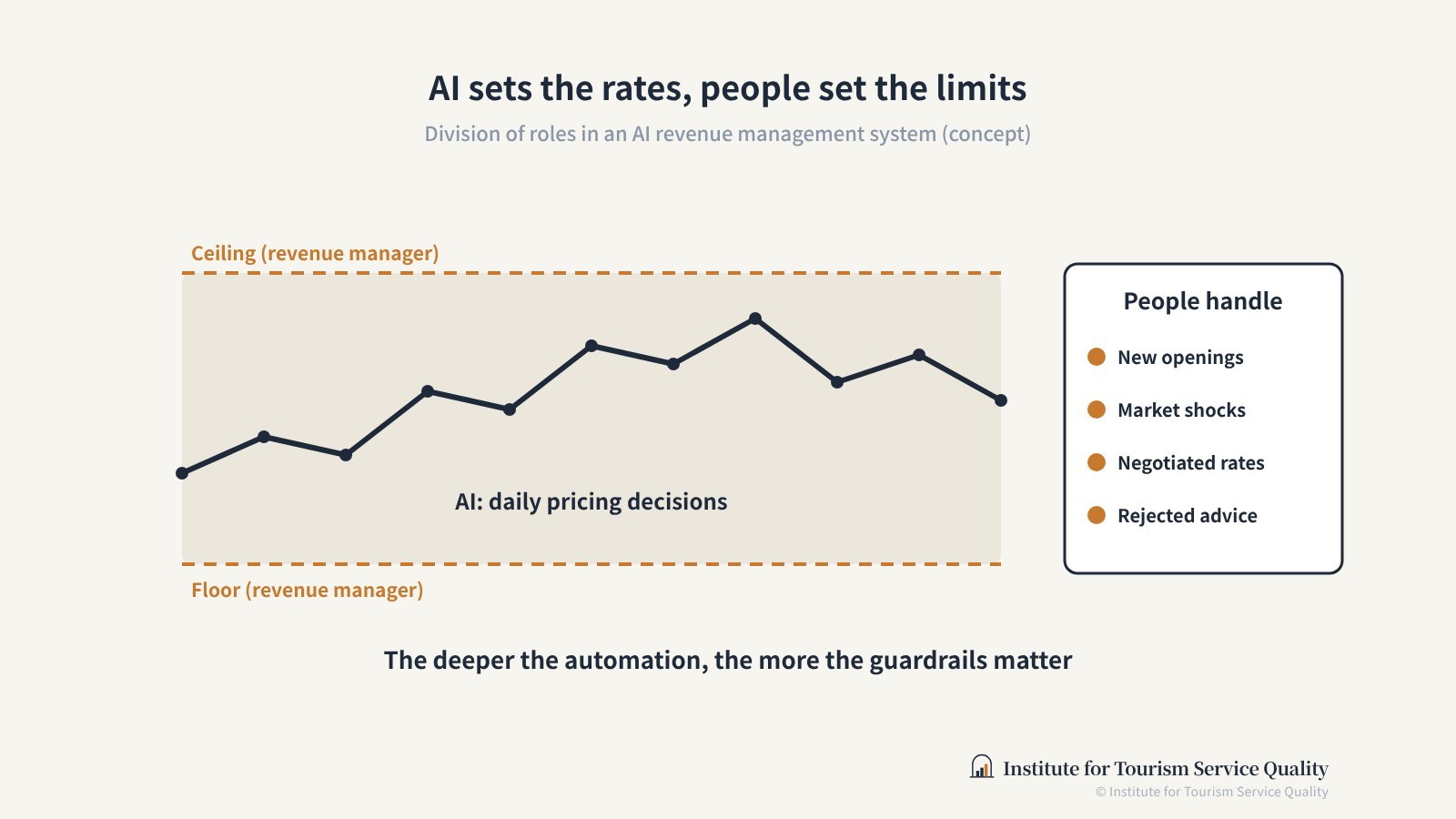
Practitioners quoted in the same article drew a fairly clear line between the roles of AI and people. A revenue executive at a hotel chain explained that the AI system sets daily rates within ranges the hotel defines, while revenue managers handle new hotel openings, sudden market changes and negotiated rates such as corporate and airline crew rates. Duetto's chief technology officer stressed a structure in which revenue managers set the ranges, or guardrails, and AI executes within them. An executive at another management company said experienced operators need to understand the market and challenge the data when necessary.
These accounts point in one direction: AI handles the large volume of repetitive pricing decisions, and people handle the boundaries and exceptions of those decisions. These are, however, the views of US practitioners presented in a single outlet, not evidence of the level of adoption or its effects at Korean hotels.
Where rate automation meets the guest experience
Price is a matter of revenue and also the first piece of service information a guest encounters. We noted in Pricier rooms, the same guests that growth in Korea's lodging market in Q3 2026 came mainly from higher room rates. Given that expectations rise with prices, a system that changes rates automatically must produce prices that can be explained. The editorial team suggests checking the following when introducing AI pricing.
- Document the guardrails: Revenue managers should set and record rate floors and ceilings, the maximum daily change and the acceptable range relative to competitors. The standards must remain even if the system or the person in charge changes.
- Set criteria for switching out of automation: For periods when historical data does not fit, such as major events, disasters or system outages, decide in advance the conditions under which automation stops and people decide.
- Record why recommendations were rejected: When a revenue manager does not accept the AI's recommendation, recording the reason provides a basis for adjusting the system and learning material for the team.
- Check rate consistency across channels: The more often rates change, the more important it is that the channel manager and booking engine reflect the same rates on time. We covered integration checks in Channel manager integration testing.
- Ask whether you can explain it to guests: If the rate for the same date changes significantly within a few hours, guests will ask why. Explanations should be ready at a level the front desk and reservations staff can give.
Conclusion
AI revenue management systems are changing where the revenue manager's work sits rather than eliminating it. Stepping back from daily pricing decisions, designing the boundaries and exceptions those decisions must respect becomes the revenue manager's core role. The higher the level of automation, the more the judgement of the people who set and enforce the guardrails will shape both a hotel's revenue and guests' trust.
References
Most sources are in Korean.
- Hospitality Net (2026.10.08). Duetto acquires FLYR Hospitality to expand its platform and accelerate innovation for hoteliers. https://www.hospitalitynet.org/news/4134812/duetto-acquires-flyr-hospitality-to-expand-its-platform-and-accelerate-innovation-for-hoteliers
- PhocusWire (2026.10). Duetto acquires FLYR Hospitality to boost AI capabilities. https://www.phocuswire.com/news/technology/duetto-acquires-flyr-hospitality-boost-ai-capabilities
- Rajecki, R. (2026.08.20). The new revenue playbook: AI-powered, human-led. Hotel Management, August/September 2026. https://hotelmanagement.mydigitalpublication.com/articles/the-new-revenue-playbook-aipowered-human-led
Was this article helpful?
This is an English version of the original Korean article. If the two differ, the Korean original prevails.
© Institute for Tourism Service Quality. All rights reserved.