What Makes Guests Absorbed at a Hotel Kiosk?
A review of my doctoral dissertation on self-service technology quality (SSTQUAL), flow, continuance intention and digital literacy

Self check-in kiosks in hotel lobbies are no longer an unfamiliar sight. Yet when hotels introduce kiosks, what they mainly review is the initial build cost, monthly maintenance fees and labour savings; how guests remember the experience of using the device receives relatively little attention. My doctoral dissertation starts from this gap. It examines empirically which qualities of a kiosk make guests absorbed, whether that absorption leads to a desire to use it again, and whether these relationships vary with guests' digital skills.
This article summarises the dissertation's research problem, design and main results, and introduces the practical implications and limitations it presents. All figures are taken from the original dissertation.
1. The problem: hotel kiosks differ from restaurant kiosks
The dissertation first points out that the technical requirements of hotel kiosks differ greatly from those of restaurant kiosks. Restaurant kiosks follow a relatively simple flow of choosing from a menu, ordering and paying, so screen design and ease of use are the main quality concerns. Hotel self check-in and check-out kiosks, by contrast, run a complex process linking booking lookup, room assignment, room key issuance, payment, payment for extra services and check-out, and must exchange this information in real time with the hotel's property management system (PMS).
Because of this structural difference, the dissertation finds that the hotel industry tends to view kiosks in terms of stability and maintenance efficiency rather than user experience (UX), and as a result kiosks can be perceived as tools that are hard for guests to use on their own. In addition, the relationship between self-service quality and flow had mainly been studied in internet environments (e-SERVQUAL), and research on settings like kiosks, where people handle devices on site, was rare.
2. Research design
Four concepts
- Self-service technology quality (SSTQUAL): A scale for the quality of self-service technology developed by Lin and Hsieh (2011) on the basis of SERVQUAL. It consists of seven factors: convenience, functionality, design, security/privacy, enjoyment, assurance and customisation.
- Flow: A concept proposed by Csikszentmihalyi (1975), referring to a positive psychological state of complete absorption in an activity. Flow theory holds that absorption occurs when the user's skill level and the level of challenge of the task are in balance.
- Continuance intention: The intention to keep using the self-service in future.
- Digital literacy: The ability to find, share, evaluate and use information with digital technology. In this study, it was introduced as a moderating variable that changes the relationship between quality and flow.
Survey and analysis
- Participants: Guests who had used a self check-in or check-out kiosk at a hotel in Korea in the past three months
- Sample: 528 questionnaires distributed, 503 returned, and 461 analysed after excluding 42 insincere responses
- Period: About four weeks in February–March 2025
- Measures: 20 SSTQUAL items, 3 flow items, 5 continuance intention items and 4 digital literacy items, all on five-point Likert scales
- Analysis: Exploratory factor analysis, reliability analysis, correlation analysis and multiple regression using SPSS 23.0. Mediation was tested with Baron and Kenny's (1986) three-step procedure, and moderation with hierarchical regression entering mean-centred interaction terms.
3. Main results
Only enjoyment and customisation drove flow
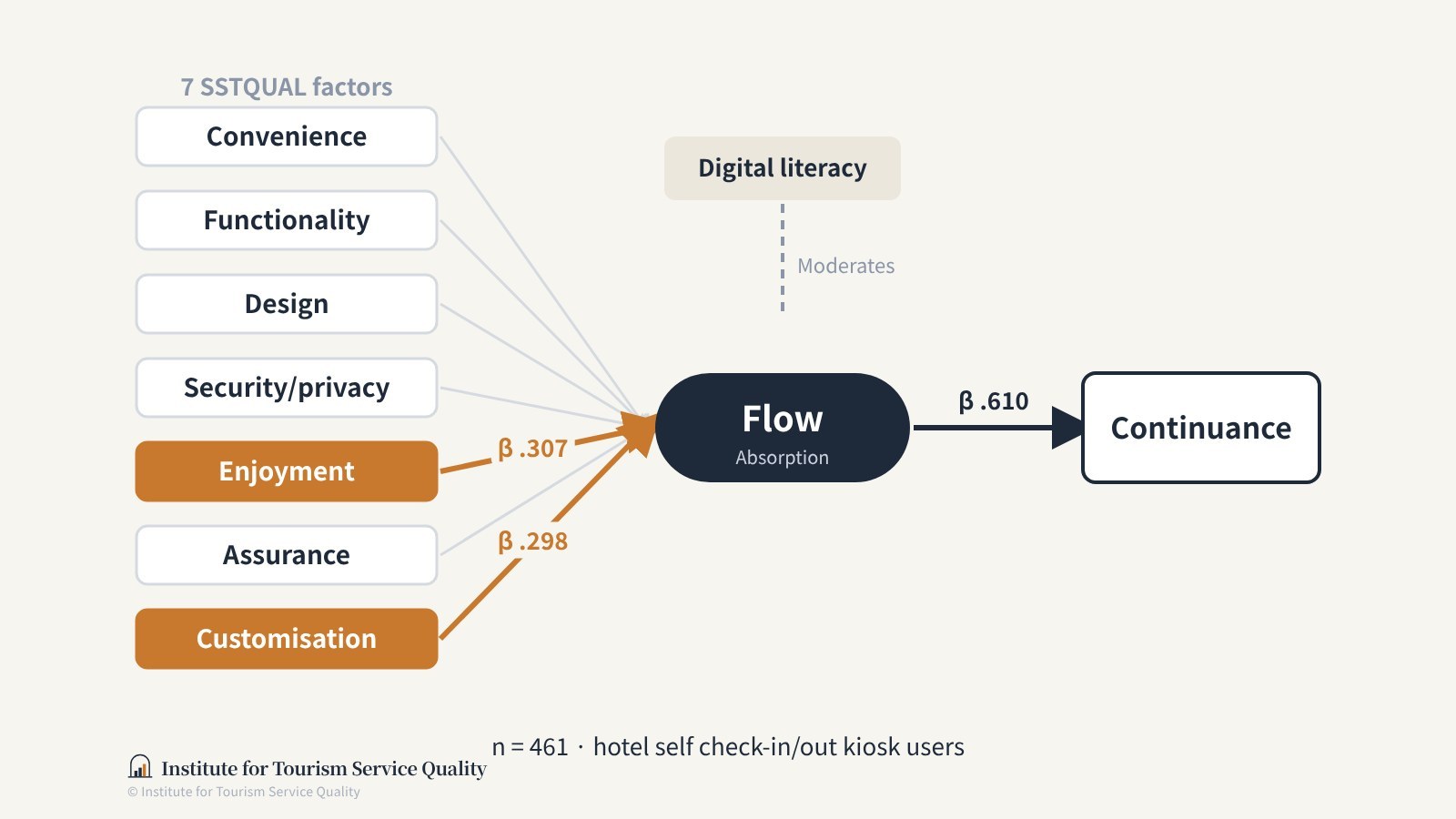
The model predicting flow with all seven SSTQUAL factors entered together had an adjusted R² of .372. Of the seven factors, only two were statistically significant.
- Enjoyment: β = .307, p < .001
- Customisation: β = .298, p < .001
Convenience (β = .008), functionality (β = −.060), security/privacy (β = .001) and assurance (β = .079) were not significant. Design, at β = .105 and p = .052, fell just short of the significance threshold and was rejected; the dissertation adds that follow-up studies might produce different results.
Most quality factors affected continuance intention
The model predicting continuance intention with the same seven factors had higher explanatory power (adjusted R² = .552). All six factors except convenience (β = .042, p = .340) were significant.
- Enjoyment β = .197, functionality β = .183, customisation β = .172 (each p < .001)
- Design β = .149 (p = .001), assurance β = .124 (p = .002), security/privacy β = .106 (p = .006)
The effect of flow on continuance intention was also clear (β = .610, p < .001, adjusted R² = .371).
Flow played a partial mediating role
Mediation was tested for enjoyment and customisation, the two factors significant for flow in the first step. When continuance intention was predicted from these two factors alone, enjoyment had β = .428 and customisation β = .363. When flow was added, enjoyment fell to .319 and customisation to .257 but both remained significant, and flow was also significant (β = .306). The dissertation interpreted this as partial mediation by flow. Enjoyment and personalised service raise the intention to use the kiosk again both directly and through the experience of flow.
Digital literacy moderated only two factors
Adding digital literacy raised the explanatory power of the flow model from .372 to .470, and adding the interaction terms raised it by a further 1.5 percentage points to .485. Two of the individual interaction terms were significant.
- Design × digital literacy: β = −.135, p = .017. The dissertation interpreted design as having a greater effect on flow among users with low digital literacy.
- Assurance × digital literacy: β = .130, p = .017. Assurance was interpreted as having a positive effect on flow among users with high digital literacy.
The other five interaction terms were not significant.
4. How to read the results
In one sentence: a kiosk's functional quality helps make guests want to use it again but does not create flow; what creates flow is the experience of enjoyment and of service tailored to oneself. On this basis, the dissertation proposed a tentative framework in which the factors that trigger flow may differ by SST setting, online or offline.
On the moderating effect of digital literacy, the dissertation draws a paradoxical implication. If the effect of perceived quality varies with guests' digital skills, then the hotel industry, which has long valued standardised service, should strengthen the factors less affected by guests' skills: convenience, functionality, security/privacy, enjoyment and customisation.
I believe these results also raise questions for quality assurance practice. QA for hotel systems generally focuses on checking that functions work as required and that payments are processed without errors. As this study shows, that is a condition for reuse, but not for flow. Explicitly including items related to customisation, such as multilingual and age-appropriate guidance and reflecting guests' preferences, in test and acceptance criteria is worth considering for those who supply and verify kiosks. This connection, however, is my own interpretation and was not directly tested in the dissertation.
5. Practical implications in the dissertation
The dissertation stresses that the hotel industry should see kiosks not merely as cost-cutting tools but as subjects of quality management on a par with face-to-face service, and proposes the following.
- Adoption criteria centred on flow: Use an intuitive UI, engaging technologies (such as facial recognition), multilingual and voice guidance, and appealing photos and messages as review items when adopting kiosks.
- Kiosk booths: Entering names and contact details amid lobby traffic disrupts flow and creates anxiety about exposing personal information. The dissertation proposes separate booths, like bank ATMs.
- Narrowing gaps in digital skills: Place a video monitor explaining how to use the kiosk next to it, and assign staff dedicated to guests using the kiosk.
- Barrier-free kiosks: Introduce kiosks designed for wheelchair users so that service is standardised physically as well.
6. Limitations and future research
The dissertation acknowledges the following limitations.
- Currency of the measurement tool: SSTQUAL was developed in 2011 for self-service technology in general and is limited in evaluating today's advanced hotel kiosks in detail. A new measurement tool specific to kiosks is needed.
- Recall-based responses: Because the survey asked about use within the past three months, impressions of the whole stay may have mixed into the kiosk evaluation. A design collecting responses on site immediately after use was suggested as a remedy.
- Heterogeneity of devices and hotels: Users of kiosks from different vendors and of hotels of various grades and regions were mixed, so differences in technical quality between vendors could not be controlled.
- Age skew in the sample: More than 91% of respondents were in their 20s to 40s, so digital literacy was generally high, which may have weakened the moderating effect. Follow-up research on people aged 60 and over was proposed.
I would add that, since this study used a single-point, self-reported survey with a convenience sample, it is safer to read the relationships between variables as significant associations rather than as causal relationships. Mediation was also tested with the Baron and Kenny procedure, so follow-up analyses estimating indirect effects directly, for example through bootstrapping, would make the conclusions more robust.
Conclusion
The trend of kiosks taking over part of the front desk is hard to reverse. The message this study leaves is that even where machines replace people, the question of service quality does not disappear. When guests enjoy themselves at a kiosk and feel that the service is tailored to them, flow arises, and that experience becomes a reason to return to the hotel. The moment of truth (MOT) happens on the kiosk screen too.
The full dissertation (in Korean) is available on RISS.
References
Most sources are in Korean.
- 박건희 (2025). 호텔 키오스크의 셀프 서비스 기술 품질(SSTQUAL)이 플로우(Flow)와 지속이용의도에 미치는 영향: 디지털 리터러시의 조절효과를 중심으로. 박사학위논문, 경기대학교 대학원 호텔경영학과. https://www.riss.kr/link?id=T17289997
- Lin, J. S. C., & Hsieh, P. L. (2011). Assessing self-service technology encounters: Development and validation of SSTQUAL scale. Journal of Retailing, 87(2), 194-206.
- Csikszentmihalyi, M. (1975). Beyond Boredom and Anxiety: Experiencing Flow in Work and Play. San Francisco: Jossey-Bass.
- Meuter, M. L., Ostrom, A. L., Roundtree, R. I., & Bitner, M. J. (2000). Self-service technologies: Understanding customer satisfaction with technology-based service encounters. Journal of Marketing, 64(3), 50-64.
Was this article helpful?
Trained in hotel management, he worked as a front office manager at an international brand hotel and earned a Ph.D. in Tourism from Kyonggi University. He now leads service planning, customer feedback (VOC) analysis and quality assurance at a hotel IT solutions company.
This is an English version of the original Korean article. If the two differ, the Korean original prevails.
© Institute for Tourism Service Quality. All rights reserved.