The Shadow Behind 12th Place: What a Hospitality Reputation Rank of 65th Asks of Korean Lodging
Reading Korea's results in the World Economic Forum's Travel & Tourism Development Index alongside tourist complaint statistics, from a service quality perspective
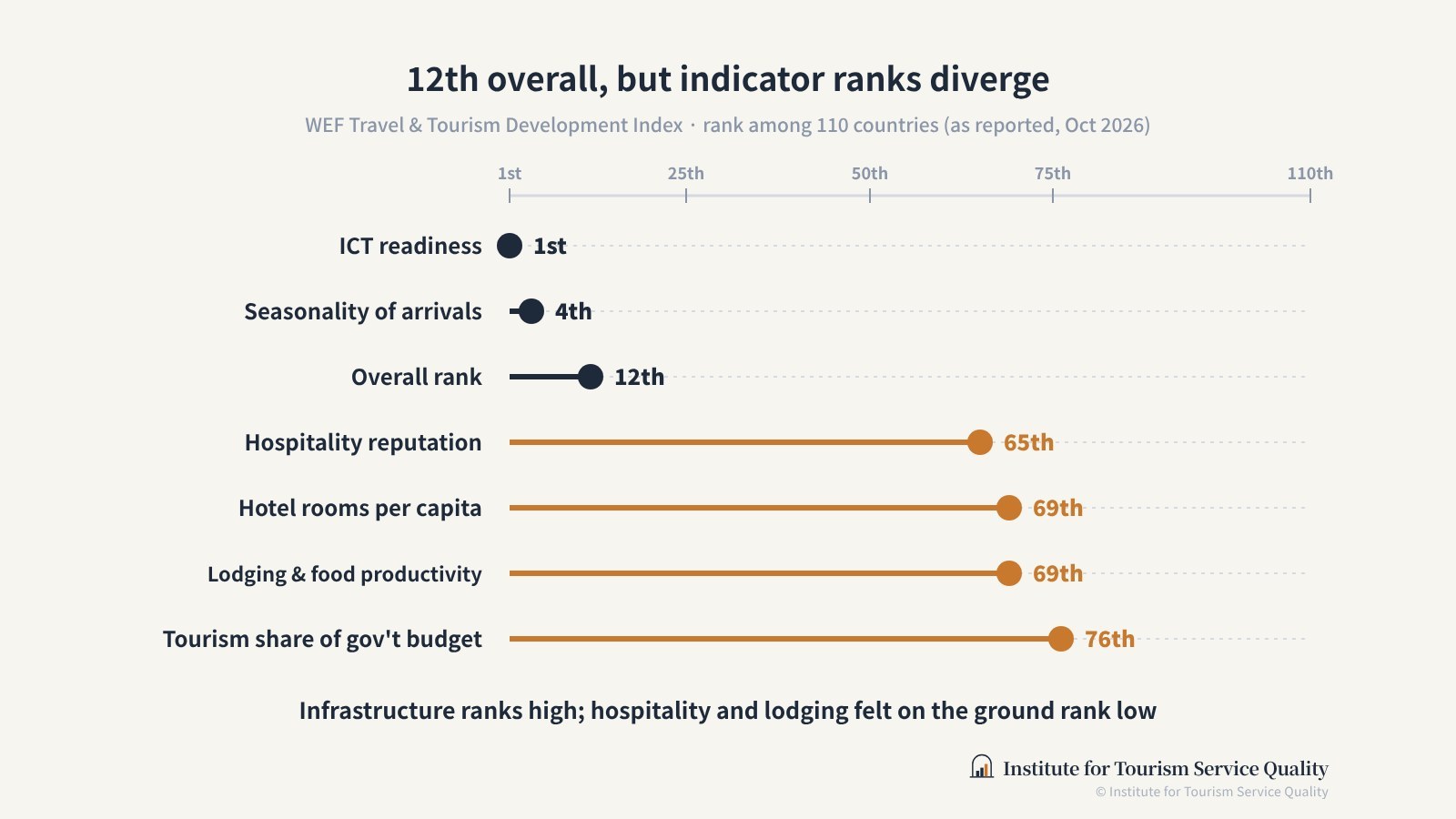
In autumn 2026, as inbound visitor numbers passed the previous year's record, an international indicator of national tourism competitiveness also rose by one place. On 8 October, the Ministry of Culture, Sports and Tourism announced that Korea ranked 12th of 110 countries in the World Economic Forum (WEF) Travel & Tourism Development Index (TTDI). The detailed indicators, however, show that items directly linked to the quality of the front line where visitors are received are still near the bottom. This article places Korea's TTDI results alongside tourist complaint statistics released around the same time, and reads the tasks facing the lodging sector from a service quality perspective.
What was announced
The TTDI is the WEF's biennial assessment of national tourism competitiveness, made up of five areas: enabling environment, travel and tourism policy and enabling conditions, infrastructure and services, travel and tourism resources, and travel and tourism sustainability. According to Zurich's commentary, this edition (TTDI 2026) was released on 25 September 2026, with Japan ranked first. Korean announcements and reports label the results as the "2025 Travel & Tourism Development Index", so the report title and the reference-year label differ.
According to the Herald Business report (8 October 2026) and the MTN report (20 October) on the ministry's announcement, Korea's main results are as follows.
- Its overall rank was 12th, one place up from its recalculated 2023 rank (13th). It rose in all five areas.
- Tourism sustainability rose most, from 20th to 13th, and the indicator for the seasonality of international arrivals moved from 33rd to 4th. Korea ranked 1st in ICT readiness.
- By contrast, travel and tourism policy and enabling conditions was the lowest of the five areas at 47th. Korea ranked 76th for tourism's share of government spending and 62nd for air service agreements.
- The Hospitality Reputation Index ranked 65th, and all four price competitiveness indicators for hotels, purchasing power parity, fuel and short-term rentals were outside the top 50.
The Herald Korea (US edition) report gave more detail on lodging-related indicators: Korea ranked 69th for hotel rooms per 100 people, 69th for labour productivity in accommodation and food services, and 109th for the share of high-wage jobs in the tourism industry. The calculation method and source year for each indicator should be checked in the WEF original.
Tourist complaint statistics released around the same time point in the same direction. According to a Yonhap report carried by Korea JoongAng Daily (6 September 2026), citing Korea Tourism Organization data, there were 1,753 tourist complaints from January to July 2026, already above the total for all of 2025 (1,744). Foreign visitors accounted for 84.3%, and by category, accommodation was the largest with 500 cases (about 28.5%). The main issues in accommodation complaints were one-sided booking cancellations and excessive cancellation fees.
Interpretation: rankings rise, but the feeling of being well treated does not follow
First, the strengths are infrastructure; the weaknesses are people and prices. The indicators where Korea ranks near the top, such as ICT, transport and sanitation, are closer to foundations the country has built. The low-ranked indicators cluster in areas visitors experience directly on the ground: hospitality reputation, price competitiveness, and productivity and jobs in lodging. In the language of service quality research, it is a structure in which tangibles score highly but assessments of empathy and reliability do not keep pace.
Second, complaints are micro-level evidence for hospitality reputation. What a national indicator such as hospitality reputation reflects needs to be checked in the original, but it is clear that the largest share of complaints from foreigners concerns accommodation, and that they are about booking cancellations and fees. Experiences of cancellation rules not being explained in advance in a language the guest understands, or of confirmed bookings being cancelled unilaterally, accumulate beyond individual properties into the nation's hospitality reputation.
Third, price competitiveness is not just about rates. Being seen as expensive overlaps with the perception of being expensive for the service received, in other words, with perceived value. Raising room rates when inbound demand peaks is a normal revenue management decision, but if cancellation and refund handling and service quality falter at the same time, the higher price is remembered as "overcharging".
Visitors' length of stay and revisit rates were covered in More Visitors, Shorter Stays: The Quality of Welcome Beyond the Numbers, and the lodging quality assessment programme in Five Regional Airport Tourism Zones and Korea's 2027 Tourism Budget: A Question of Regional Lodging Quality.
Editorial suggestions
If lodging businesses and hotels turned the TTDI's weak indicators into checkpoints for their own operations, they might look like this.
- Make cancellation rules visible before booking: Show the free cancellation deadline, fee rates and reference time (whether the hotel's local time) on the booking screen and in confirmation emails in the guest's language, and check that the wording is the same on every channel.
- Manage cancellations caused by the hotel as a separate procedure: Decide in advance on alternative accommodation, who pays the difference, and how guests will be contacted when a booking must be cancelled because of overbooking or facility problems. Remember that one-sided cancellation is the largest cause of complaints.
- Look at peak-season pricing and service quality together: In periods when rates rise, also check front desk staffing, foreign-language service and response times to inquiries. A price increase raises expectations with it.
- Record and classify complaints: Gathering guest complaints in one place regardless of channel and classifying them by type makes it possible to find recurring causes and to prepare for quality assessments.
National competitiveness brings visitors in, but a reputation for hospitality is built one room at a time.
Closing
Twelfth place in the TTDI shows that the foundations of Korean tourism are internationally recognised. At the same time, 65th place for hospitality reputation and complaints concentrated in accommodation show that the quality of the front line receiving growing inbound demand has not yet caught up with those foundations. The room to climb in the next assessment lies less in grand facilities than in a single line explaining cancellation terms, and a single interaction at the desk.
References
Most sources are in Korean.
- 문화체육관광부 (2026.10.8). 대한민국, 세계경제포럼 관광발전지수 '순위 1개 상승' 12위 기록. https://www.mcst.go.kr/site/s_notice/press/pressView.jsp?pSeq=22760
- 헤럴드경제 (2026.10.8). WEF Travel and Tourism Development Index results released. https://biz.heraldcorp.com/article/10896381
- 헤럴드경제 미주판 (2026.10.8). 고임금 일자리·숙박·예산이 없다…한국관광 발목 잡는 요소는. https://www.heraldk.com/article/2026100814142432460
- MTN 머니투데이방송 (2026.10.20). 관광발전지수 12위로 보는 '다시 찾고 싶은 한국'의 조건 [엔터그알]. https://news.mtn.co.kr/article/2026101910590348801
- Korea JoongAng Daily (2026.9.6). Tourist complaints in Korea hit record as travel boom exposes service gaps. https://www.koreajoongangdaily.com/lifestyle/tourist-complaints-in-korea-hit-record-as-travel-boom-exposes-service-gaps/12861231
- Zurich (2026). Travel & Tourism Development Index (TTDI) 2026: Rankings, trends and key findings. https://www.zurich.com/insights/travel/ttdi26-rankings-trends-and-key-findings
Was this article helpful?
This is an English version of the original Korean article. If the two differ, the Korean original prevails.
© Institute for Tourism Service Quality. All rights reserved.