From Check-In Machine to Unmanned Front Desk: How Lodging Kiosks Are Evolving in Korea
Expanding kiosk functions and the service quality challenges they raise, seen through new products from Sanha IT and OA Tech
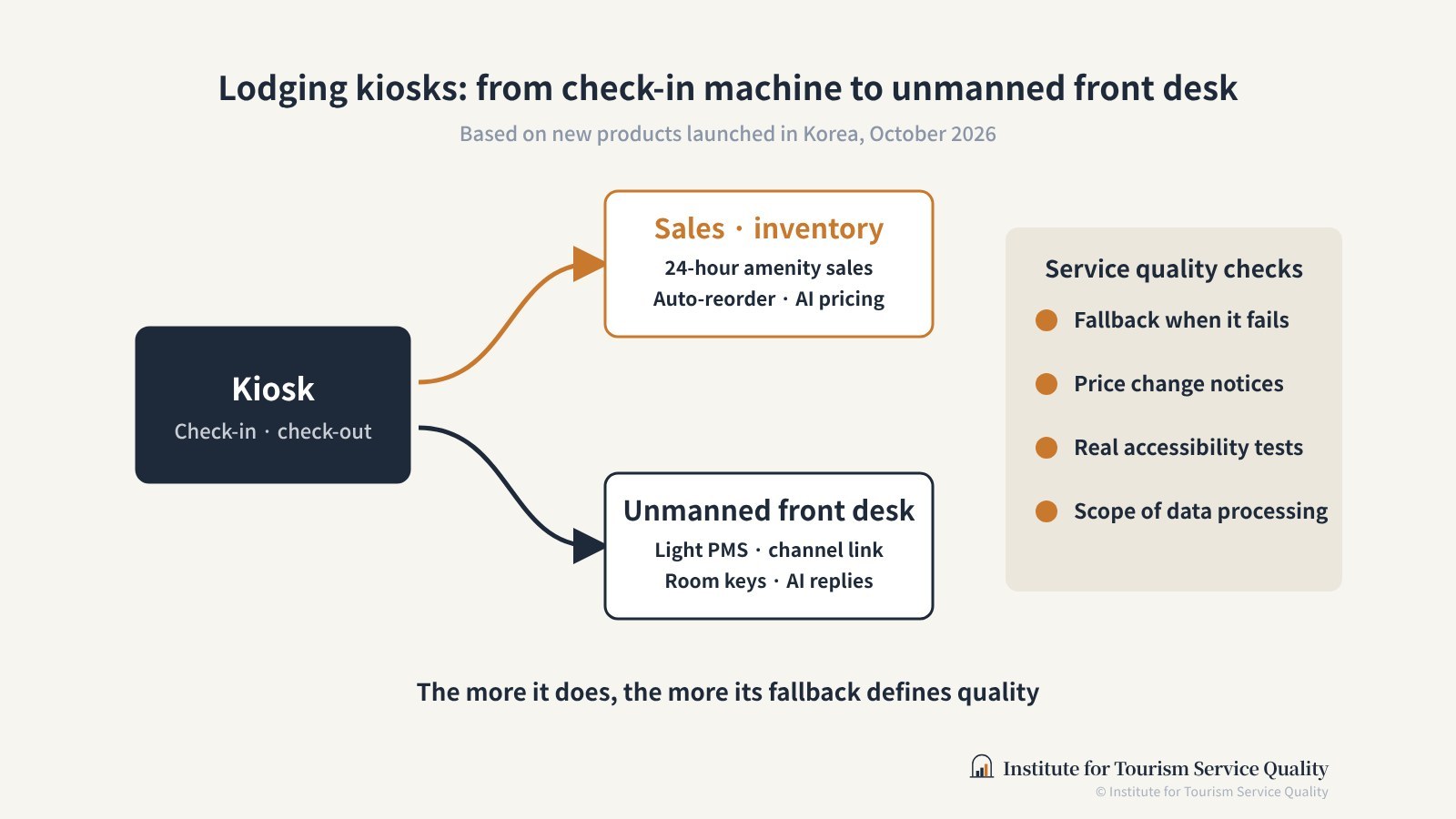
Kiosks at lodging properties have so far mainly been machines that replace check-in and check-out. New products launched one after another by Korean lodging IT companies in October 2026 show that the kiosk's role is widening. One hands amenity sales and inventory management to the kiosk; the other hands it everything from reservations to room access and guest responses. This article summarises the two announcements and looks at the service quality challenges to check when kiosks take over the whole front desk. The content is based on reports of each company's announcement; actual results from deployment have not yet been published.
A kiosk that handles sales and inventory
According to The Financial News (15 October) and Newstap (18 October), Sanha IT, a Yanolja Group affiliate, launched a "smart amenity kiosk" that sells hotel amenities unattended around the clock. Guests can buy amenities, K-beauty products, snacks and chargers without going to the front desk. Sales and inventory for each product are tallied in real time, and items are reordered automatically when stock falls below a set level. The kiosk analyses sales trends, demand by time of day and purchasing patterns by nationality, and includes an AI function that adjusts prices in real time according to demand. It supports Korean, English, Chinese and Japanese, includes barrier-free features, and revenue is settled monthly. Both reports are based on the same company announcement.
A kiosk that handles the whole front desk
According to Digital Times (21 October), lodging IT company OA Tech launched "OA KIOSK ONE" for small hotels, motels, residences and guesthouses for which building a separate property management system (PMS) is a burden. The product combines a web-based lightweight PMS, channel manager integration, kiosk check-in, physical card keys and mobile keys, and AI responses to repeated questions. Kiosk check-in issues room keys after adult verification and payment, and equipment status checks and software updates are handled remotely. It also has a low-screen mode for wheelchair users, a high-contrast display and voice guidance. This information is based on a single outlet's report.
What the two directions tell us
The two products take different directions. Sanha IT's product turns the kiosk into a revenue channel outside the room; OA Tech's turns it into an unmanned front desk platform for small properties. Both, however, are transforming the kiosk from a single-purpose device into a touchpoint where operational data comes together.
From the perspective of SSTQUAL, a framework for measuring the quality of self-service technology, more functions mean greater demands for functionality and security (data protection). At the same time, the growth in functions that count as customisation, such as multilingual responses and product selection, is a positive sign. Research on hotel kiosks found that enjoyment and customisation drove guests' flow, as discussed in Does flow happen at the kiosk?.
The editorial team suggests checking the following when expanding unmanned kiosk operations.
- Calculate the impact of a failure: When check-in, room keys and guest responses are concentrated in one device, the whole front desk stops when that device stops. Decide in advance on staff call-outs, backup devices and manual check-in procedures. We discussed this in When the kiosk stops, service recovery is a human job.
- Be transparent about price changes: If guests buy without knowing that the same product costs different amounts at different times, it can lead to distrust. If AI pricing is used, operators must be able to control how prices are displayed and how much they can change.
- Actually test accessibility: Having barrier-free features is not the same as being usable. Checks in which older adults and wheelchair users try the kiosk themselves are needed. We summarised the issues in The service gap kiosks create.
- Confirm the scope of personal data processing: Adult verification, payment and purchase analysis by nationality all involve guest information. Confirm what is collected, how long it is kept and how much is entrusted to the vendor at the contract stage.
Conclusion
Lodging kiosks in Korea are evolving from check-in machines into sales channels and unmanned front desks. For small and mid-sized properties struggling with staff shortages, they can be a realistic alternative. But the more the kiosk does, the more the response when it stops or confuses guests becomes the property's service quality. The success of unmanned operation depends less on the number of functions than on how well exceptions have been prepared for.
References
Most sources are in Korean.
- 파이낸셜뉴스 (2026.10.15). 호텔 용품 판매 자동화…산하정보기술, AI 키오스크 출시. https://www.fnnews.com/news/202610151134014328
- 뉴스탭 (2026.10.18). 산하정보기술, 호텔 편의용품 판매부터 재고·발주까지 자동화하는 AI 키오스크 출시. https://www.newstap.co.kr/news/articleView.html?idxno=335943
- 디지털타임스 (2026.10.21). 오아테크, 소형 숙박시설용 올인원 무인 키오스크 'OA KIOSK ONE' 출시. https://www.dt.co.kr/article/12090342
Was this article helpful?
This is an English version of the original Korean article. If the two differ, the Korean original prevails.
© Institute for Tourism Service Quality. All rights reserved.