91% of Hotel Chains Use AI, but Only 13% Report Measurable Returns: Readiness, Not Adoption, Is the Problem
The gap between adoption and results in h2c's 2026 study of hotel chains, and the data foundations hotels need
In the hotel industry, artificial intelligence (AI) is no longer an experiment. The tasks it touches, from answering guest inquiries and replying to reviews to forecasting rates and writing reports, have multiplied quickly. But "we use AI" and "we get results from AI" are different things. A study of hotel chains released in October 2026 by h2c, a consultancy specialising in hotel technology, puts numbers on that gap.
What was announced
h2c's AI Opportunity Study 2026, reported by Hospitality Net on 1 October 2026, surveyed 113 hotel chains (101 online surveys and 21 executive interviews) across Europe, the Middle East and Africa, Asia Pacific and the Americas. The responding chains operate more than 8,200 hotels and about 1.3 million rooms, and results were not weighted by chain size. The main findings are as follows.
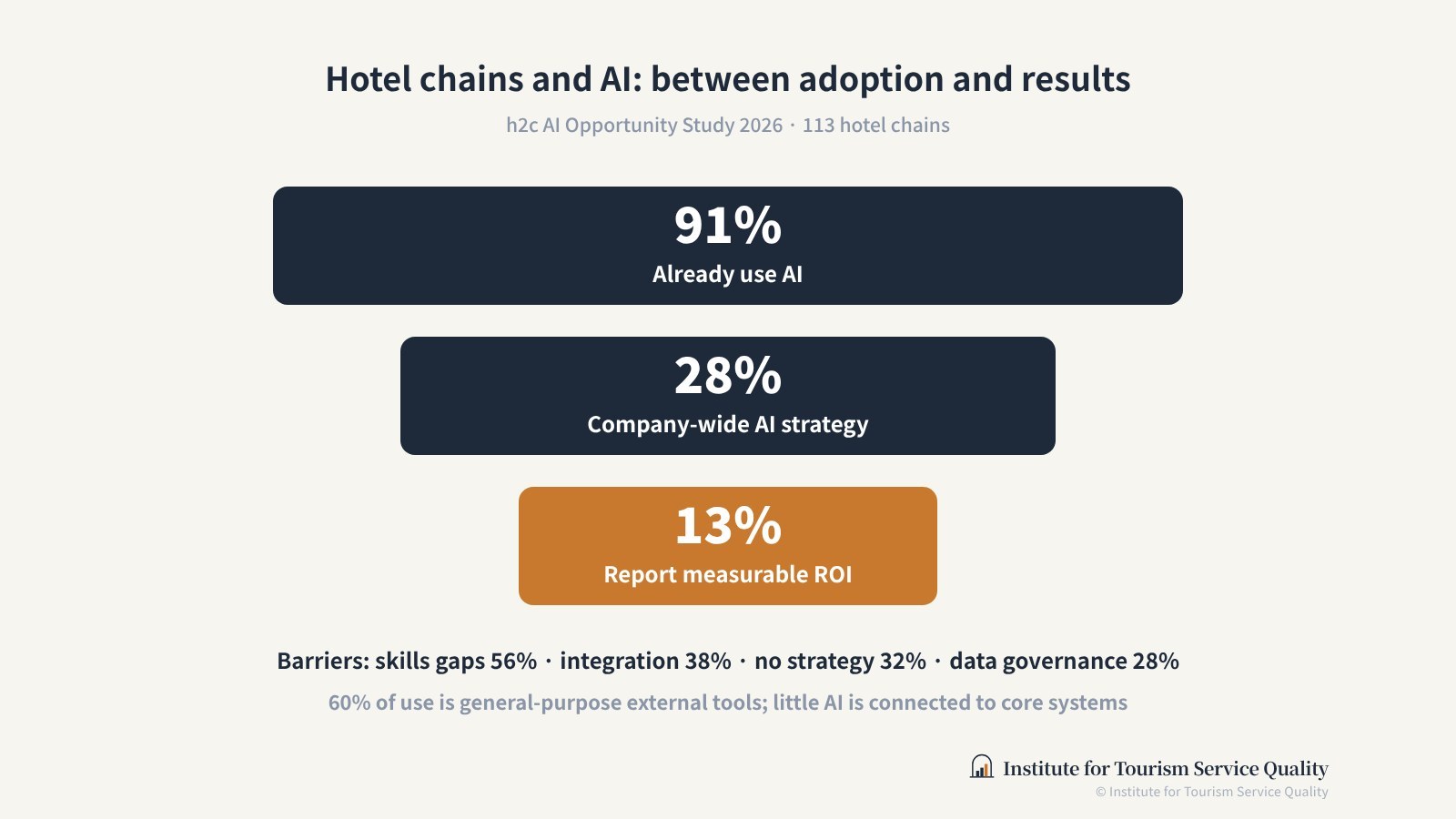
- Adoption: 91% already use AI, and 8% plan to adopt it within 12 to 24 months.
- Strategy: 28% have a company-wide AI strategy led by senior management.
- Results: About 70% said operational efficiency and automation had improved and 59% said staff could focus on higher-value tasks, but 32% reported a better guest experience and only 13% reported measurable return on investment (ROI). AI's contribution to business performance was rated 5.6 out of 10.
- Barriers: Gaps in skills, expertise and training (56%), integration with existing systems (38%), no clear strategy (32%), data security and privacy concerns (29%), and data governance and access management (28%).
- How AI is used: 60% of use is through general-purpose external tools such as ChatGPT, 27% is AI embedded in vendor solutions, and 12% is AI developed or hosted in-house.
- AI search and booking: 70% expect AI booking channels to increase direct bookings, but only 22% systematically monitor their presence in AI search results.
These figures come from a single h2c study, and the various media reports cite the same study.
Interpretation: data and integration block the way before AI does
First, AI has arrived, but not inside the systems. That 60% of use is through general-purpose external tools means that staff are often using AI individually, without connection to core systems such as the property management system (PMS) or customer relationship management (CRM). Such use may save individuals time, but it is hard to measure as hotel-level performance.
Second, integration and data hold back results. Responding chains named system integration, data governance and security as major barriers. This connects with earlier research. In a survey of more than 250 hotel IT decision-makers released by Starfleet Research in August 2025, 24% said their core systems, including the PMS, revenue management system (RMS), POS and booking engine, were fully connected, and 34% said they managed guest data centrally. If the same guest exists as separate records in the rooms, restaurant, spa and loyalty systems, AI cannot recognise that guest as one person.
Third, solution vendors are targeting the same problem. In October 2026, Hapi released a guest identity function that links guest records from multiple systems into a single profile, and Revinate launched a platform that uses guest data in response to events such as bookings and check-ins. Both companies presented scattered and duplicated guest data as the problem to solve. Each company's performance figures are company claims and have not been independently verified.
The arrival of AI as a booking channel is covered in When AI Agents Book Hotels: Are Direct Booking Channels Ready?, and permission issues in connecting AI with the PMS in When the PMS Connects to AI Assistants: The Spread of MCP and the Challenge of Permissions.
Editorial suggestions
Before bringing in more AI tools, hotels may want to check the following foundations.
- Check whether one guest can be seen as one record: Start by finding out how many records the same guest is split into across systems and which of email, phone number and membership number can link them. Records merged incorrectly can lead to privacy incidents in which one guest's information is shown to another, so set conservative merging rules.
- Define performance indicators before adoption: Only by recording the indicators AI is expected to change, such as response time, volume handled, direct booking conversion and guest satisfaction, and their baselines before adoption, can a hotel later speak of return on investment.
- Set rules for external tools: Define the scope of use and pseudonymisation procedures so that staff do not enter guest information into general-purpose AI tools. The basic principles are set out in What to Check Before Putting Hotel Guest Data into AI.
- Check how your hotel appears in AI search: Regularly check whether AI search and conversational services describe your rooms, rates and policies accurately. Wrong information comes back as complaints after booking.
The results of AI depend first not on the model's performance, but on how well organised the data it can read is.
Closing
The h2c study shows that AI adoption in the hotel industry has moved past the "trying it out" stage into the stage where results must be proven. What closes the gap between 91% and 13% is not new AI tools but connected systems, well-organised guest data, and agreement on what counts as a result. Guests do not see AI. What they feel is one thing: whether the hotel remembers them and serves them accurately.
References
Most sources are in Korean.
- Hospitality Net (2026.10.1). New h2c Study: AI Adoption Is Widespread Among Hotel Chains, but Enterprise Readiness Remains Limited. https://www.hospitalitynet.org/news/4134680/new-h2c-study-ai-adoption-is-widespread-among-hotel-chains-but-enterprise-readiness-remains-limited
- Hospitality Net (2025.8.15). Research: Fewer Than One in Four Hotels Have Fully Integrated Core Systems. https://www.hospitalitynet.org/report/4128547/research-fewer-than-one-in-four-hotels-have-fully-integrated-core-systems
- Hotel Online (2026.10.1). Hapi Eliminates the Guesswork by Connecting Guest Identity Across Hotel Systems. https://www.hotel-online.com/news/hapi-eliminates-the-guesswork-by-connecting-guest-identity-across-hotel-systems
- Hospitality Net (2026.10.14). Revinate launches hospitality's first data activation platform. https://www.hospitalitynet.org/news/4134921/revinate-launches-hospitalitys-first-data-activation-platform
Was this article helpful?
This is an English version of the original Korean article. If the two differ, the Korean original prevails.
© Institute for Tourism Service Quality. All rights reserved.