Expected When Present, Infuriating When Missing: Hotel Service Attributes Through the Kano Model
Why not every improvement raises satisfaction, and how hotels can use the Kano model to set investment priorities
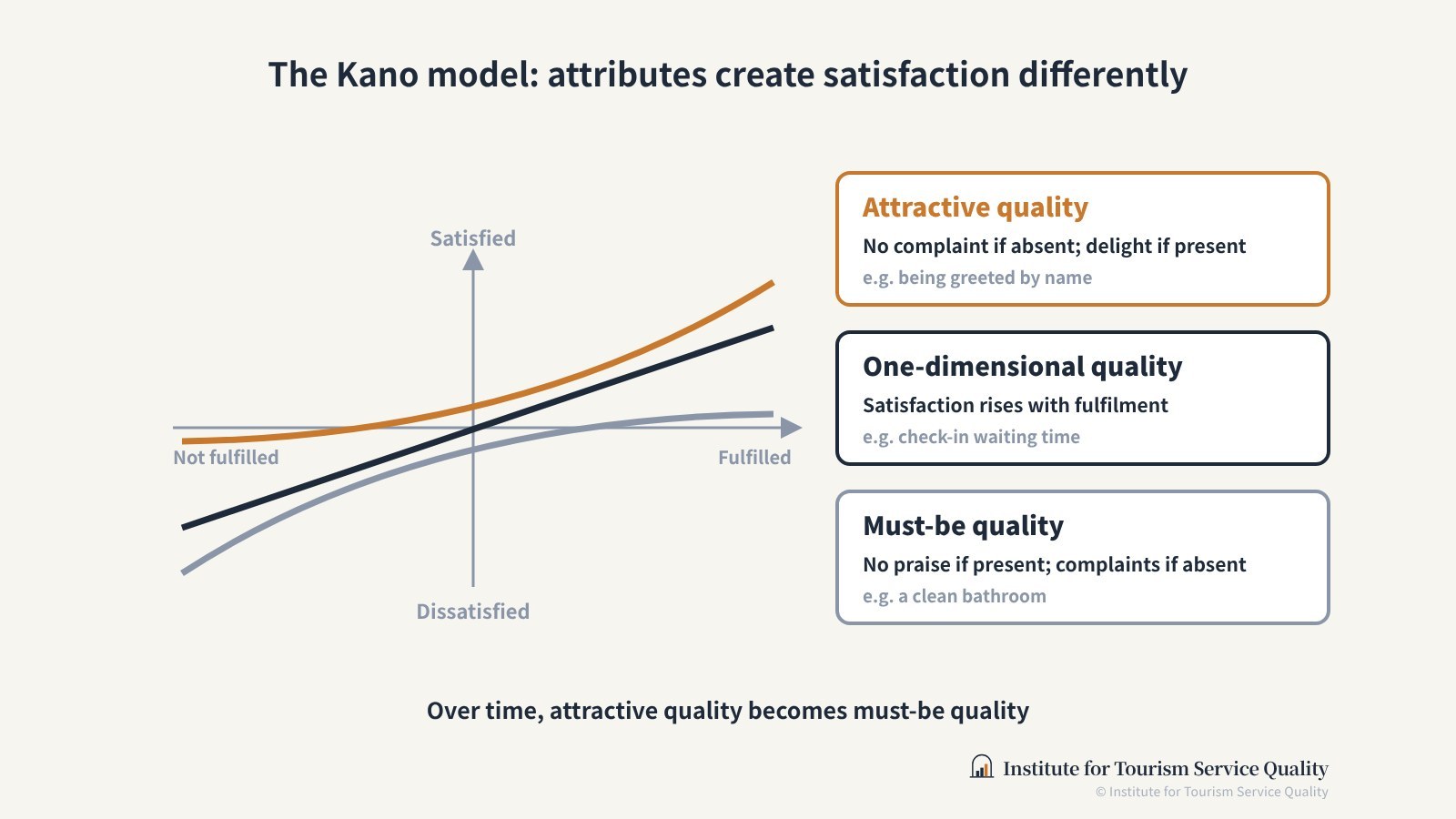
A familiar puzzle arises in hotel guest satisfaction surveys. A hotel spends heavily on room cleanliness, yet its cleanliness score stays the same; it changes only its welcome message, and positive reviews increase. If every service attribute is assumed to create satisfaction in the same way, such patterns are hard to explain. The Kano model, proposed in 1984 by Japanese quality management scholar Noriaki Kano and colleagues, addresses exactly this point.
Satisfaction and dissatisfaction do not sit on one line
The traditional view holds that satisfaction rises in proportion to how well an attribute is fulfilled. The Kano model holds that the relationship between fulfilment and satisfaction differs by attribute, and divides quality attributes into five types.
- Must-be quality: Fulfilling it does not raise satisfaction much, but failing to fulfil it causes strong dissatisfaction. Customers take it for granted and do not even mention it.
- One-dimensional quality: The more it is fulfilled, the higher satisfaction rises; the less, the greater the dissatisfaction. The relationship is proportional.
- Attractive quality: Its absence causes no dissatisfaction, but its presence creates unexpected satisfaction.
- Indifferent quality: Present or absent, it has little effect on satisfaction.
- Reverse quality: The more it is fulfilled, the greater the dissatisfaction. It appears in attributes where customer preferences run in opposite directions.
Applying this to hotels makes it easier to grasp. The following are examples the Editorial Team uses to explain the concept; actual classification must be confirmed through guest research. Bathroom cleanliness and bedding hygiene are close to must-be quality, and check-in waiting time or Wi-Fi speed close to one-dimensional quality. A welcome that remembers a guest's name and previous stay can be attractive quality. In-room smart devices, on the other hand, may be attractive to some guests but reverse quality for guests who find them hard to use.
How it is measured
A Kano survey asks a pair of questions for each attribute: "How would you feel if this feature were present?" (the functional question) and "How would you feel if this feature were absent?" (the dysfunctional question). Respondents choose one of "I like it", "I expect it", "I am neutral", "I can live with it" and "I dislike it" for each, and the combination of the two answers is placed in an evaluation table to classify the attribute. For example, answering "I like it" if present and "I am neutral" if absent classifies the attribute as attractive quality.
Berger et al. (1993) set out a way to summarise the distribution of responses in two coefficients. The satisfaction coefficient (Better) is (attractive + one-dimensional) ÷ (attractive + one-dimensional + must-be + indifferent), and indicates how likely satisfaction is to rise when the attribute is fulfilled. The dissatisfaction coefficient (Worse) is (one-dimensional + must-be) ÷ (the same denominator) with a negative sign, and indicates how likely dissatisfaction is when it is not fulfilled. Plotting the two coefficients makes it possible to compare the relative positions of attributes at a glance.
Over time, attractive becomes expected
An important property discussed in research on the Kano model is that an attribute's type is not fixed. Attractive quality that once surprised guests moves, as competing hotels copy it and guests get used to it, through one-dimensional quality to must-be quality. Free in-room Wi-Fi is the classic example: once a differentiator, it is now an attribute whose absence causes complaints. Mobile check-in and self check-in kiosks are likely on the same path.
This property also matters when looking at the quality of self-service technology. Research on hotel kiosk users, covered in Does Flow Happen at the Kiosk?, found that functionality contributed to the intention to reuse but did not create flow; what created flow was enjoyment and customisation. In the language of the Kano model, a kiosk's functionality can be read as an attribute moving towards must-be quality. The quality dimensions of self-service technology are set out in Seven Criteria for Measuring Service Without Staff: SSTQUAL.
Editorial suggestions: how hotels can use the Kano model
- Manage must-be quality with a target of zero: Attributes with a large dissatisfaction coefficient, such as cleanliness, hygiene, safety and booking accuracy, should be managed by the number of complaints and whether they recur rather than by satisfaction scores. The goal for these attributes is not praise but no failures.
- Divide improvement investment by attribute type: With the same budget, it is rational to first remove defects in must-be quality, then raise the level of one-dimensional quality, and use what remains to experiment with attractive quality.
- Analyse guest groups separately: Business travellers and families, domestic and international guests may classify the same attribute differently. Looking only at the overall average can mix different types and make an attribute look indifferent.
- Survey again regularly: Attractive quality becomes expected over time. Do not rely on one survey for long; check again whenever a new service is introduced.
- Look at it alongside complaint data: Attributes that appear often in guest inquiries and complaints (VOC) are likely to be must-be quality. Using VOC is covered in Customer Feedback (VOC) Shows Where the Next Test Should Look.
Guests do not praise what they take for granted. But when it is missing, they always remember.
Closing
The Kano model turns the question "What should we do better?" into "What must we never miss, and how will we surprise guests?" If tools that measure the dimensions of service quality, such as SERVQUAL, show the level of quality, the Kano model shows how each attribute acts on satisfaction and dissatisfaction. Using the two perspectives together makes it clearer where limited budgets and staff should go first. The relationship between measurement tools and system quality was examined in After SERVQUAL: Is Hotel Service Quality Measurement Looking at Systems?.
References
Most sources are in Korean.
- Kano, N., Seraku, N., Takahashi, F., & Tsuji, S. (1984). Attractive quality and must-be quality. Journal of the Japanese Society for Quality Control, 14(2), 39-48.
- Berger, C., Blauth, R., Boger, D., Bolster, C., Burchill, G., DuMouchel, W., Pouliot, F., Richter, R., Rubinoff, A., Shen, D., Timko, M., & Walden, D. (1993). Kano's methods for understanding customer-defined quality. Center for Quality of Management Journal, 2(4), 3-36.
Was this article helpful?
This is an English version of the original Korean article. If the two differ, the Korean original prevails.
© Institute for Tourism Service Quality. All rights reserved.