Japan's Hotels After the Drop in Chinese Visitors: Tokyo Up, Osaka Down
Shifts in the mix of demand seen through 2026 visitor statistics and room rate data, and what Korean hotels can learn
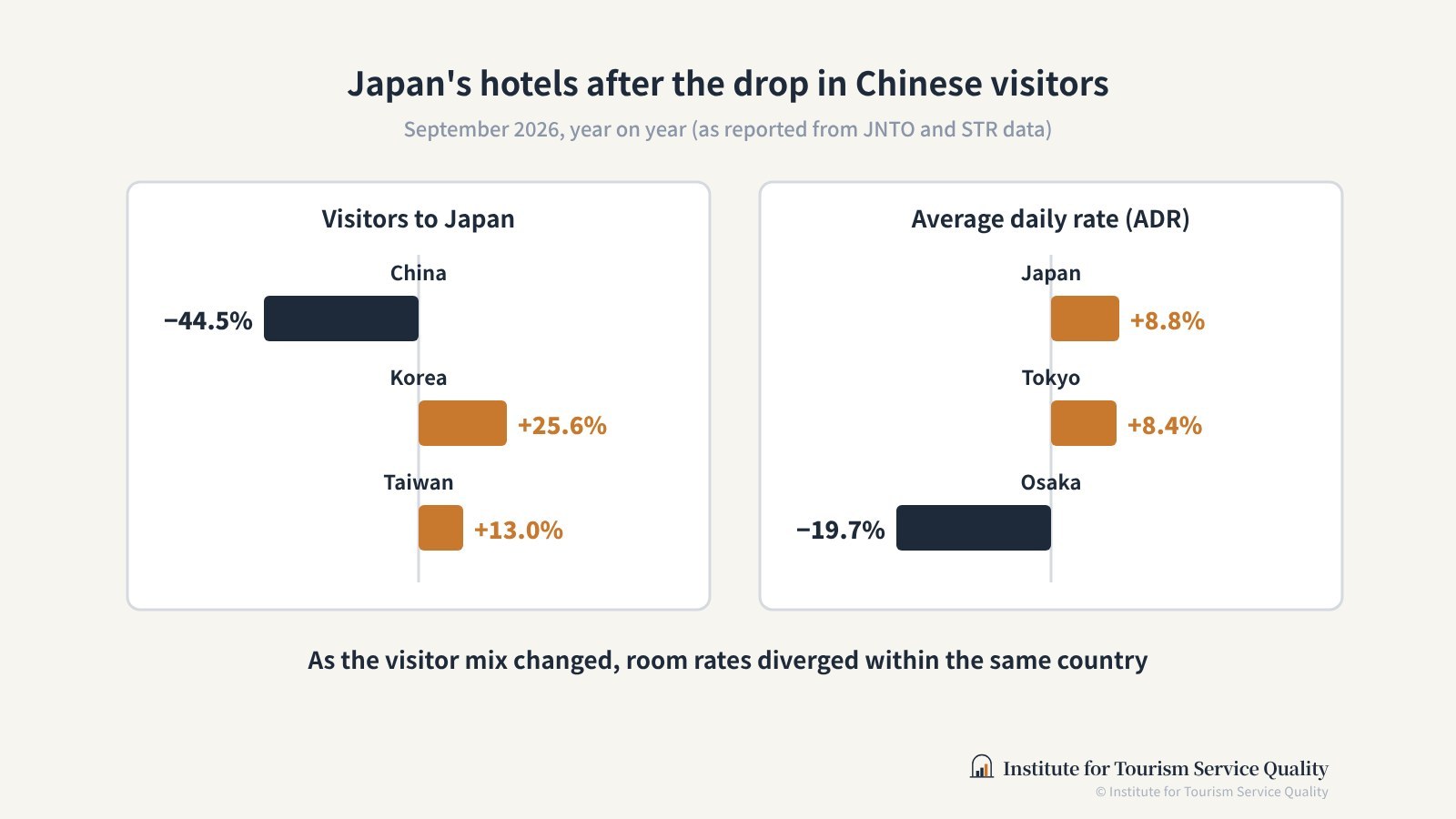
In 2026, visitor numbers and hotel prices in Japan's tourism market moved in different directions. Chinese visitors, formerly the largest market, fell by more than half, but growth in visitors from Korea and Taiwan pushed tourism spending to a record high, and room rates rose nationwide. By region, however, rates rose in Tokyo and fell sharply in Osaka. This article summarises Japan National Tourism Organization (JNTO) statistics and room rate data from hotel data company STR, and looks at what the changing mix of demand means for hotel operations.
Fewer visitors, more spending
According to JNTO statistics reported by Travel Voice (26 October 2026) and Korean media, 3,103,700 international visitors came to Japan in September 2026, down 5.0% on the same month a year earlier, the second consecutive monthly decline. Chinese visitors fell 44.5% to 430,800. Korean visitors, by contrast, rose 25.6% to 842,300, the largest of any country or region and the highest September figure on record. Visitors from Taiwan also rose 13.0% to 595,600.
For January–September, international visitors totalled 30,730,200, down 2.9%, with Chinese visitors down 55.5%. Korean media attributed this to the deterioration in China–Japan relations since November 2025 and the Chinese government's advice against travel to Japan. Even so, international visitor spending in January–September rose 1.9% to JPY 7.0574 trillion, a record for the period (EBN, Asia Economy). The reports also mentioned the effect of the weak yen.
Accommodation demand fell more than visitor numbers. According to Japan Tourism Agency accommodation statistics compiled by Japanese hotel market outlet HotelBank, total guest nights in January–August 2026 fell 5.0% to 413.4 million, with foreign guest nights down 8.7%.
Room rates diverged by region
Korea Economic TV (3 November) and Insight (4 November) both cited the same Nikkei report analysing STR data. According to it, the average daily rate (ADR) at Japanese hotels in September 2026 was JPY 20,657, up 8.8% year on year. In Tokyo it rose 8.4% to JPY 28,276, while in Osaka it fell 19.7% to JPY 18,762. The decline in Osaka was interpreted as a reaction to the sharp rise in accommodation prices during Expo 2025 Osaka, Kansai. STR expects national room rates to keep rising in single digits until next spring on the back of foreign demand.
In short, Japan in 2026 was a market where hotels raised prices even as guest nights fell. That increase, however, was concentrated in areas such as Tokyo that draw visitors evenly from Korea, Taiwan, Europe and North America; Osaka, hit by both the base effect of a major event and the decline in Chinese demand, could not hold its prices.
What it means
The editorial team draws three points from this case. First, dependence on a single country can collapse in a short time because of political and diplomatic factors. Across Japan, other markets filled the gap, but Osaka, where the decline in Chinese demand coincided with the event base effect, could not hold its prices. Second, prices raised for an event become the next year's baseline. This is the same as US hotels' concerns about the period after the World Cup, discussed in US hotels held up without international visitors: what the 2026 outlook tells us. Third, a market can only be read properly by looking at guest nights, room rates and spending together with visitor numbers. Spending can rise even when visitors fall, and the reverse is also possible.
These changes matter for Korean hotels too. In the editorial team's interpretation, the sharp rise in Korean travel to Japan also means that part of domestic travel demand is heading abroad. Conversely, in the inbound market, hotels should check the share of particular countries and the regions where that demand is concentrated.
Suggestions from the editorial team
- Manage dependence on each nationality as an indicator: Regularly review the nationality mix of guests and the share of the top one or two markets, and prepare alternative sales plans for political and diplomatic risks in markets with a large share.
- Plan for the period after an event in advance: In a year when rates are raised for a major event, the next year's baseline rises. Prepare products and customer segments to support demand after the event.
- Watch accommodation indicators, not visitor numbers: Rather than relying on regional visitor statistics alone, track guest nights, average length of stay, room rates and occupancy together.
- Check the experience when you raise prices: In markets like Tokyo where rates are rising, guests' expectations rise too. Use guest reviews to confirm that the service matches the higher price.
Conclusion
Japan's hotel market in 2026 is a rare case of raising overall prices despite losing its largest market. The results, however, differed by region, and only places with diversified demand could hold their prices. For Korean hotels growing on the back of rising foreign visitors, it is a case that prompts the question of where demand comes from and how diverse its sources are. The discussion of the quality of inbound demand continues in More visitors, shorter stays: the quality of welcome beyond the numbers.
References
Most sources are in Korean.
- Travel Voice (2026.10.26). International arrivals in Japan in September 2026 were down 5.0% to 3.1 million, YoY reduction for two consecutive months. https://www.travelvoice.jp/english/international-arrivals-in-japan-in-september-2026-were-down-5-0-to-3-1-million-yoy-reduction-for-two-consecutive-months
- 이비엔(EBN) (2026.10.21). 일본, 중국인 여행객 급감에도 '관광 소비' 역대 최대…한국인 25.6% 증가. https://www.ebn.co.kr/news/articleView.html?idxno=1728678
- 아시아경제 (2026.10.22). \"이제 안 가요\" 중국인 빠진 자리 채운 한국인…엔저에 지갑 활짝, 日 소비액 역대 최대. https://view.asiae.co.kr/article/2026102208431223001
- 한국경제TV (2026.11.03). 중국인 떠난 자리 한국인 '북적'…日 숙박비 '껑충'. https://www.wowtv.co.kr/NewsCenter/News/Read?articleId=A202611030086
- 인사이트 (2026.11.04). 외국인 줄었는데 日 호텔비 8.8% 껑충... 한국인 '역대 최다'가 끌어올렸다. https://www.insight.co.kr/news/580561
- HotelBank (2026.10.17). Japan Guest Nights Fall in 2026: Jan–Aug −5.0%, Full-Year Outlook. https://en.hotelbank.jp/market-trends/japan-guest-nights-2026-japanese-foreign-decline-full-year-outlook/
Was this article helpful?
This is an English version of the original Korean article. If the two differ, the Korean original prevails.
© Institute for Tourism Service Quality. All rights reserved.