Hotel Check-In as a Service Blueprint: The Quality Below the Line Guests Cannot See
Drawing backstage staff work and support systems on one page reveals failure points in advance
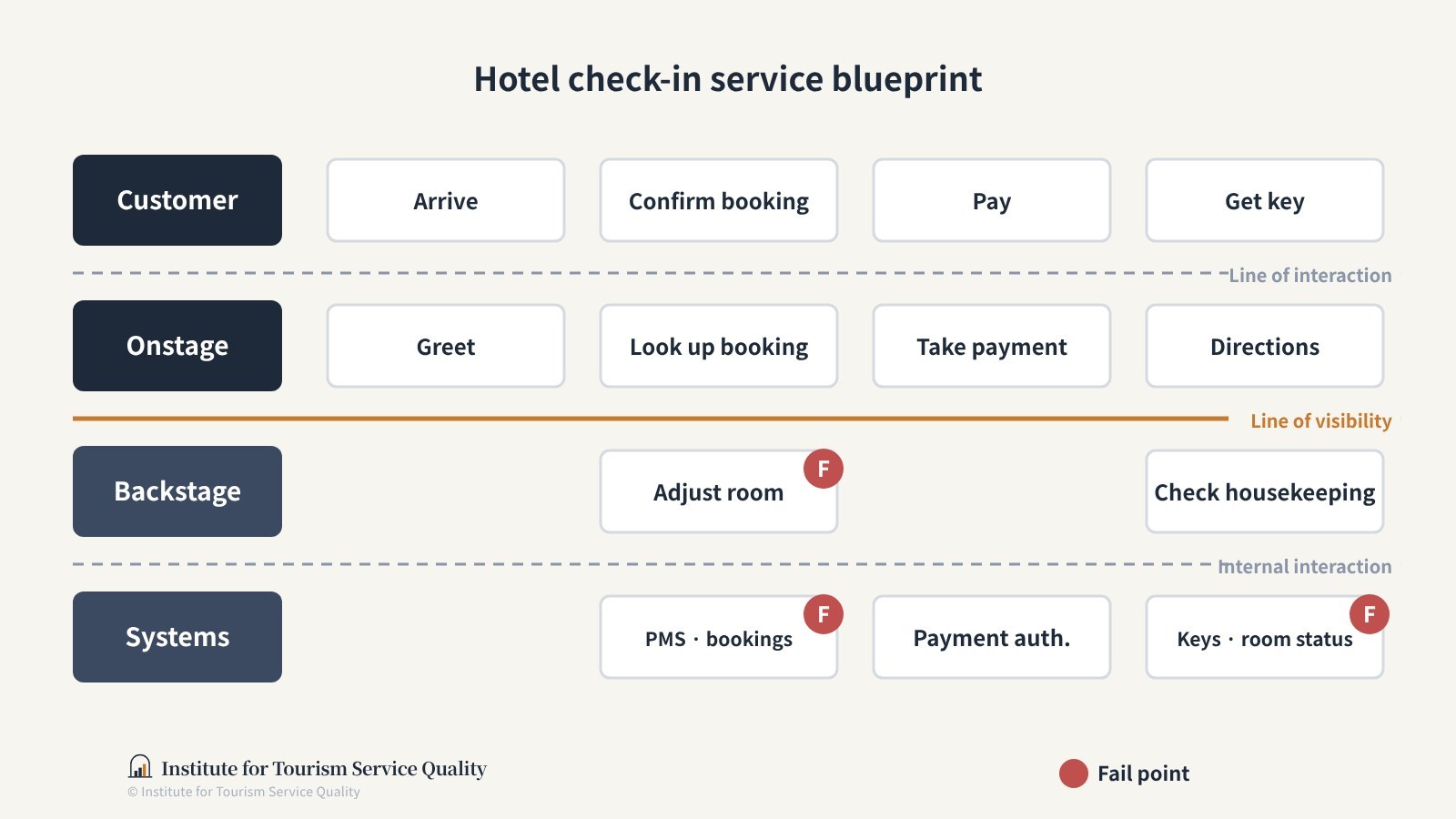
A guest spends only a few minutes at the check-in counter. To make those few minutes possible, however, booking confirmation, room status checks, payment authorisation and key issuance take place one after another out of the guest's sight. A service blueprint is a tool that draws these visible and invisible parts on one page, so that you can see in advance where service quality might break down.
What a blueprint shows
The service blueprint was proposed by Shostack (1984) in an article in the Harvard Business Review. She argued that services should be designed like manufacturing processes and proposed diagramming the steps of a service, the boundary of what customers can see and the points where failures can occur. Bitner, Ostrom and Morgan (2008) later set out the standard structure of blueprints used in business practice, which can be summarised as five layers and three lines.
- Physical evidence: What guests see and touch, such as the lobby, the counter, the kiosk screen and the room key
- Customer actions: Arriving, asking for the booking to be confirmed, presenting ID, paying, receiving the key
- Onstage actions: What staff do in front of guests, such as greeting, looking up the booking and giving directions
- Backstage actions: Staff work guests do not see, such as adjusting room assignments and liaising with housekeeping
- Support processes: Internal departments and systems that support staff, such as the property management system (PMS), payment authorisation and key encoders
Between the layers run the line of interaction, where guests and staff meet directly; the line of visibility, which marks what guests can see; and the line of internal interaction, which separates staff from support processes.
Hotel check-in as a blueprint
Mapping check-in as a blueprint reveals that the area below the line of visibility is thicker than one might think. Below the single box "the guest gives the name on the booking" lies the staff member's booking lookup, and below that the PMS lookup function and booking data passed on from external sales channels. Below "the guest receives the room key" lie the check that the room has been cleaned, housekeeping's status update, and the integration between the key encoder and the PMS.
Drawn this way, it becomes possible to tell which layer is causing the delays guests experience. Whether the problem is staff skill, information passing between the front desk and housekeeping, or slow system response, the way to improve it is entirely different. Guest survey scores alone cannot make this distinction, as we also discussed in After SERVQUAL: is hotel service quality measurement looking at systems?.
Marking failure points in advance
What Shostack particularly emphasised in the blueprint was the marking of fail points: marking in advance the steps where service is most likely to go wrong, and designing procedures to deal with them. At check-in, the following points come to mind.
- The booking cannot be found: a booking from an external channel has not yet reached the PMS, or the name is spelled differently
- The room is not ready: cleaning is finished but the status has not been updated
- Payment authorisation is delayed or fails
- The kiosk cannot handle the case and must hand it over to staff
Many of these lie near the line of internal interaction, where staff and systems meet. Guests cannot see below it, but the results of failure break through the line of visibility and become the waiting and inconvenience guests experience. How people should recover after a failure is covered in When the kiosk stops, service recovery is a human job.
The link to the gap model
In the gap model of service quality, Parasuraman, Zeithaml and Berry (1985) identified as one gap the difference that arises when management's understanding of customer expectations is not properly translated into service design and standards. A blueprint can be seen as a tool for narrowing this gap, because it turns an abstract goal such as "fast and accurate check-in" into a concrete design of steps, people responsible, systems and contingency procedures.
Suggestions from the editorial team
The editorial team suggests that hotels use blueprints as follows.
- Draw it with frontline staff: Frontline staff know how backstage work and systems actually operate better than the manual does.
- Name the systems in the support process layer: Writing down specifics such as the PMS, channel manager, payment and key encoder shows the scope of impact when something fails.
- Use the failure points as lists for testing and training: The marked fail points become test items to check whenever systems change and a list of exceptions new staff need to learn.
The quality guests see lies above the line of visibility, but most of the work that creates it happens below.
Conclusion
The service blueprint is not a new theory. But now that guest touchpoints are moving to kiosks and mobile devices and the support process layer keeps getting thicker, its usefulness has, if anything, grown. Mapping what lies below the invisible line can be the starting point for service quality management and system quality assurance to look at the same map.
References
Most sources are in Korean.
- Shostack, G. L. (1984). Designing services that deliver. Harvard Business Review, 62(1), 133–139.
- Bitner, M. J., Ostrom, A. L., & Morgan, F. N. (2008). Service blueprinting: A practical technique for service innovation. California Management Review, 50(3), 66–94.
- Parasuraman, A., Zeithaml, V. A., & Berry, L. L. (1985). A conceptual model of service quality and its implications for future research. Journal of Marketing, 49(4), 41–50.
Was this article helpful?
This is an English version of the original Korean article. If the two differ, the Korean original prevails.
© Institute for Tourism Service Quality. All rights reserved.