After SERVQUAL: Is Hotel Service Quality Measurement Looking at Systems?
Now that guest touchpoints have moved into digital channels, software quality should be treated as part of service quality
Picture a long queue at the check-in counter. Guests feel that "the staff are slow", and the post-stay survey shows a low score for responsiveness. But if the real cause was not the staff but slow responses from the property management system (PMS), what did that score actually measure?
Measurement tools centred on people
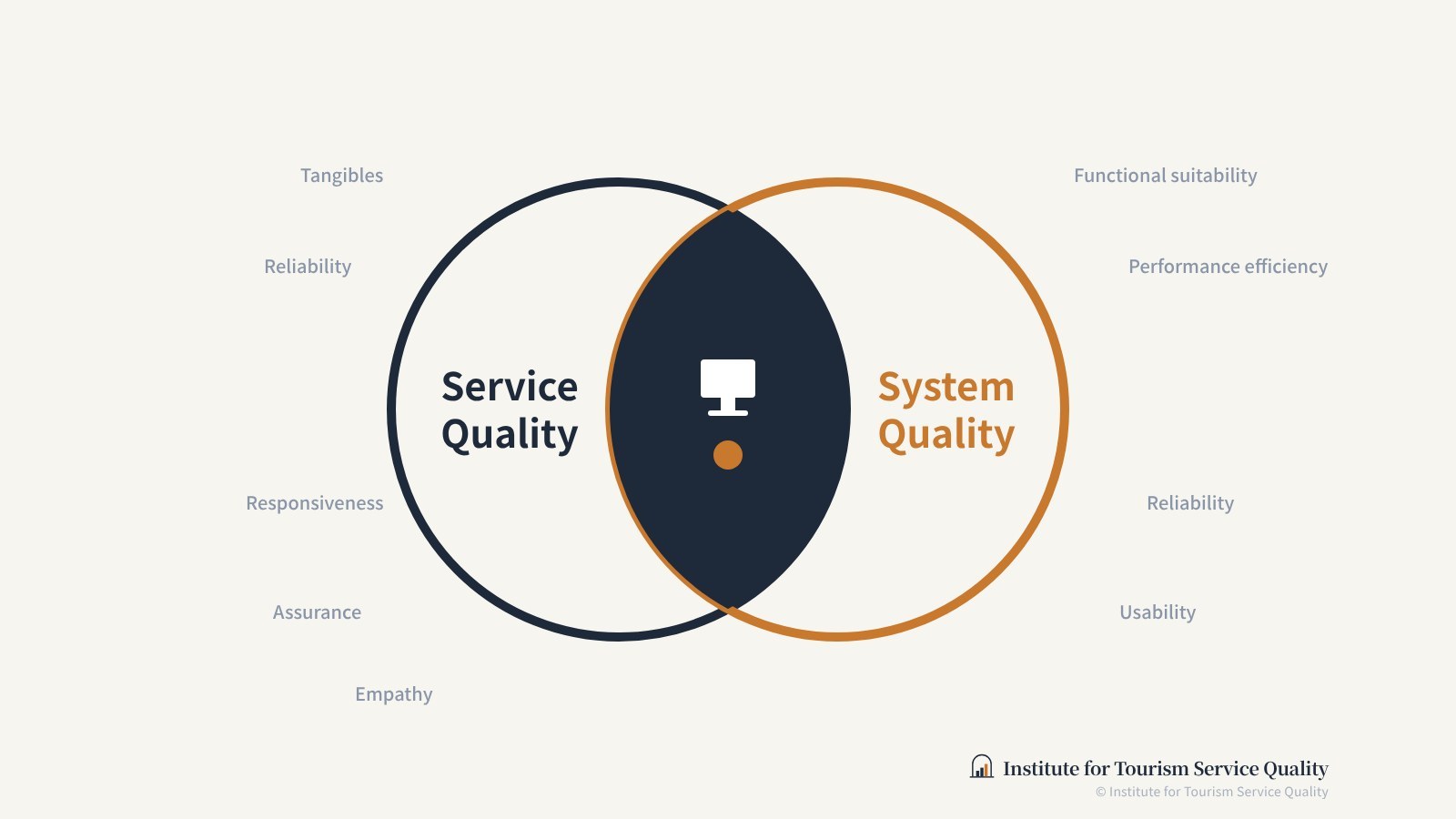
The gap model of Parasuraman, Zeithaml and Berry (1985), regarded as the starting point of service quality research, defined service quality as the difference between customers' expectations and perceptions. SERVQUAL (1988), which turned this into a measurement tool, consists of five dimensions: tangibles, reliability, responsiveness, assurance and empathy, and has since been adapted for many industries, including lodging. Cronin and Taylor (1992) continued the debate over measurement by proposing SERVPERF, which measures only perceptions without expectations.
These scales were all designed on the assumption of a person delivering the service. Reliability asks whether the provider "performs the promised service accurately", and responsiveness whether it is "willing to help promptly". The subject here is usually a member of staff.
Guest touchpoints are moving into systems
Today, much of a hotel's contact with guests passes through systems. Bookings arrive through channel managers and booking engines, check-in takes place at kiosks or in mobile apps, and the PMS manages room status and rates. Even when staff are serving guests, systems are retrieving and processing information behind them.
In this environment, many of the quality problems guests experience can stem from system defects or degraded performance. Booking information that does not match across channels, slow payment processing and room status that updates late all remain in guests' minds as "the service was bad". Scales designed around people, however, make it hard to tell where this experience came from.
Part of the service quality guests perceive is already software quality.
A perspective that links two research traditions
There have been attempts to fill this gap. Parasuraman, Zeithaml and Malhotra (2005) developed E-S-QUAL to measure the quality of online services, with dimensions such as efficiency, system availability, fulfilment and privacy. It targets electronic services in which customers use a website directly, however, and does not directly address the mixed situation in hotels, where staff and systems deliver service together.
Software engineering, meanwhile, has product quality models such as ISO/IEC 25010. In its 2011 edition, this model defines software quality through characteristics such as functional suitability, performance efficiency, reliability and usability. Interestingly, these quality characteristics correspond to a large extent with service quality dimensions. For example, a system's performance efficiency can affect the responsiveness guests perceive, and its reliability can affect the reliability of the service.
Implications for practice and research
In hotel practice, improving service quality is often approached mainly through staff training. If the cause of guest complaints lies in systems, however, training alone will not solve the problem. Simply reviewing guest complaint data alongside system incident records can improve the accuracy of diagnosis.
For research, empirical work is needed on how service quality scales correspond to software quality characteristics. If we can show the pathways through which system quality affects guests' perceptions of service quality, it will become possible to explain the results of hotel IT investment and quality assurance (QA) work in the language of the guest experience.
References
Most sources are in Korean.
- Parasuraman, A., Zeithaml, V. A., & Berry, L. L. (1985). A conceptual model of service quality and its implications for future research. Journal of Marketing, 49(4), 41–50.
- Parasuraman, A., Zeithaml, V. A., & Berry, L. L. (1988). SERVQUAL: A multiple-item scale for measuring consumer perceptions of service quality. Journal of Retailing, 64(1), 12–40.
- Cronin, J. J., & Taylor, S. A. (1992). Measuring service quality: A reexamination and extension. Journal of Marketing, 56(3), 55–68.
- Parasuraman, A., Zeithaml, V. A., & Malhotra, A. (2005). E-S-QUAL: A multiple-item scale for assessing electronic service quality. Journal of Service Research, 7(3), 213–233.
- ISO/IEC 25010:2011. Systems and software engineering — Systems and software Quality Requirements and Evaluation (SQuaRE) — Product quality model.
Was this article helpful?
This is an English version of the original Korean article. If the two differ, the Korean original prevails.
© Institute for Tourism Service Quality. All rights reserved.