Does Flow Happen at the Kiosk?
Self-service experience through flow theory, and the role of digital literacy
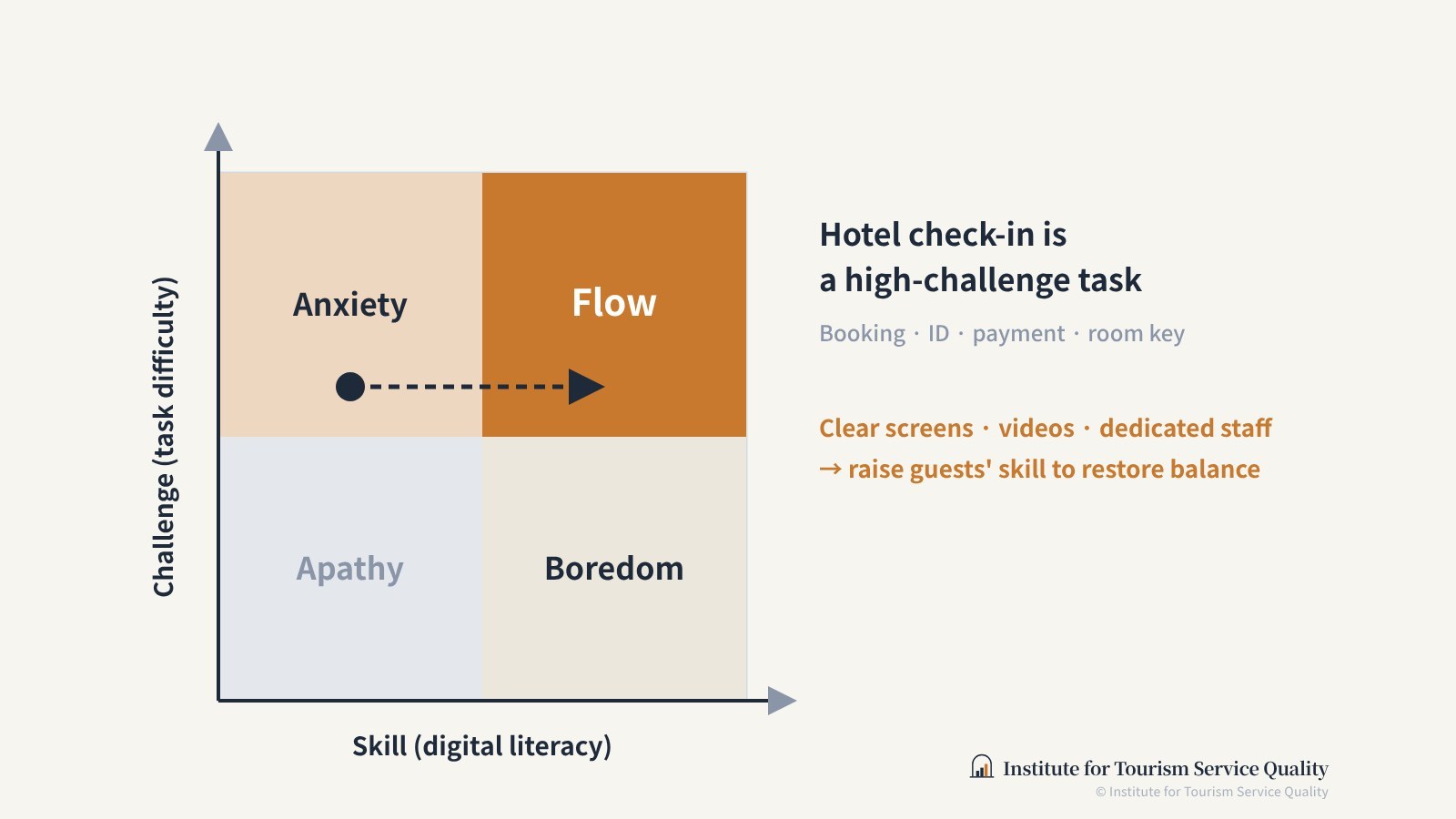
Talking about flow while using a check-in kiosk sounds odd. Flow is usually associated with games, sports and creative work, while a kiosk is closer to a procedure people want to finish quickly. In service research, however, flow has long been a key concept for explaining user experience in online shopping, mobile apps and social media. Director Winston Park's doctoral dissertation brings this concept to an offline self-service setting: the hotel kiosk. This article draws on the dissertation's literature review and empirical results to summarise what flow theory says about self-service experience.
What is flow?
Csikszentmihalyi (1975) defined flow as the holistic sensation people feel when they act with total involvement. People in flow enjoy the activity for its own sake and concentrate so deeply that they lose their sense of time and place. He identified perceived skill and perceived challenge as the most important antecedents of flow.
When flow occurs is explained by the relationship between challenge and skill. The dissertation summarises how the channel models developed.
- Three-channel model: When challenge exceeds skill, anxiety arises; when skill exceeds challenge, boredom arises; when the two are balanced, flow occurs.
- Four-channel model: Following research showing that when challenge and skill are balanced but both low, the result is apathy rather than flow, this model holds that flow arises when both challenge and skill are above a certain level.
- Eight-channel model: To address the four-channel model's inability to explain intermediate levels, this model adds the states of control, worry, arousal and relaxation.
These models are useful for explaining the conditions for flow but cannot explain causal relationships between flow and other variables. Service research has therefore also treated flow as a single variable and analysed its antecedents and outcomes.
From the web to the kiosk
Hoffman and Novak (1996) argued that interaction with machines and continuous feedback in internet environments promote flow. Flow research then spread to online shopping, mobile shopping, social media and online games, and several studies reported that flow increases satisfaction, purchase intention and continuance intention. As the dissertation notes, however, most research on self-service technology and flow has focused on internet and mobile environments, and few studies have looked at settings like kiosks, where people handle a device on site. There are results in the opposite direction too: a Korean study cited in the dissertation found that flow had no significant effect on continuance intention among users of generative AI. The effect of flow can vary with context.
Following Novak et al. (2000) and others, the dissertation measured flow as a single dimension with three items: the flow experience during use, how often it is experienced and how intense it is. Reliability (Cronbach's α) was .910.
What creates flow at the kiosk?
An analysis of 461 users of hotel self check-in and check-out kiosks found that, of the seven factors of self-service technology quality (SSTQUAL), only two had a significant effect on flow: enjoyment (β = .307) and customisation (β = .298). Functionality, convenience, security/privacy and assurance were not significant, and design was at the borderline of significance (p = .052).
One distinction is needed when reading this result. In the correlation analysis, all seven factors showed significant positive correlations with flow. For example, the correlation between convenience and flow was .426, and between functionality and flow .385. This does not mean that functionality or convenience is unrelated to flow; it means that, when all seven factors are considered together, their unique contribution to explaining flow is small. The factors were also highly correlated with each other (enjoyment and convenience .618, enjoyment and design .618). It is more accurate to say that customers who rate a kiosk well tend to rate several qualities highly together, and of these, enjoyment and customisation were most directly linked to flow.
Flow in turn led to continuance intention (β = .610). Part of the effect of enjoyment and customisation on continuance intention passed through flow, which the dissertation interpreted as partial mediation.
Digital literacy as a skill variable
In flow theory, the user's skill level is, together with the level of challenge, a key condition for flow. That is why the dissertation introduced digital literacy as a moderating variable. Digital literacy is the ability to find, share, evaluate and use information with digital technology, and can be seen as an indicator of the skill a guest brings to the kiosk.
The results support this view. The correlation between digital literacy and flow was high at .537, and adding digital literacy to a model that explained flow with SSTQUAL alone raised the explanatory power (adjusted R²) from .372 to .470. Even with the same kiosk, guests who are more comfortable with digital technology experience more flow.
Moderating effects were found for two factors. The interaction between design and digital literacy was negative (β = −.135), which the dissertation interpreted as design having a greater effect on flow among users with low digital literacy. The interaction with assurance was positive (β = .130), interpreted as assurance having a positive effect on flow among users with high digital literacy. For guests less familiar with digital technology, how intuitive the screen is may matter more for flow; for those who are familiar, how far they can trust the provider of the device may matter more. The additional explanatory power of the interaction terms was modest, at 1.5 percentage points, and the sample's limitation, with more than 91% of respondents in their 20s to 40s, should also be kept in mind.
Implications for designing service experience
In the language of flow theory, using a kiosk is a task for the guest. If the task is harder than the guest's skill level, anxiety arises; if it is too monotonous, boredom arises. A task like hotel check-in, which involves looking up a booking, verifying identity, paying and issuing a room key in sequence, is more challenging than ordering food. Designing for flow, then, means matching the difficulty of the task to the guest's skill level and adding enjoyment and personalised elements to the process.
The dissertation's practical suggestions of video monitors explaining how to use the kiosk and staff dedicated to kiosk users can be read in the same light: they are devices for raising guests' skill levels to balance them with the task. The policy discussion continues in the article on kiosks and the service gap.
References
Most sources are in Korean.
- 박건희 (2025). 호텔 키오스크의 셀프 서비스 기술 품질(SSTQUAL)이 플로우(Flow)와 지속이용의도에 미치는 영향: 디지털 리터러시의 조절효과를 중심으로. 박사학위논문, 경기대학교 대학원. 제2장 제2절, 제4장.
- Csikszentmihalyi, M. (1975). Beyond Boredom and Anxiety: Experiencing Flow in Work and Play. San Francisco: Jossey-Bass.
- Csikszentmihalyi, M. (1990). Flow: The Psychology of Optimal Experience. Harper & Row.
- Hoffman, D. L., & Novak, T. P. (1996). Marketing in hypermedia computer-mediated environments: Conceptual foundations. Journal of Marketing, 60(3), 50-68.
- Novak, T. P., Hoffman, D. L., & Yung, Y.-F. (2000). Measuring the customer experience in online environments: A structural modeling approach. Marketing Science, 19(1), 22-42.
Was this article helpful?
This is an English version of the original Korean article. If the two differ, the Korean original prevails.
© Institute for Tourism Service Quality. All rights reserved.