Seven Criteria for Measuring Service Without Staff: SSTQUAL
Why the self-service technology quality scale emerged, its dimensions, and what an empirical study of hotel kiosks showed
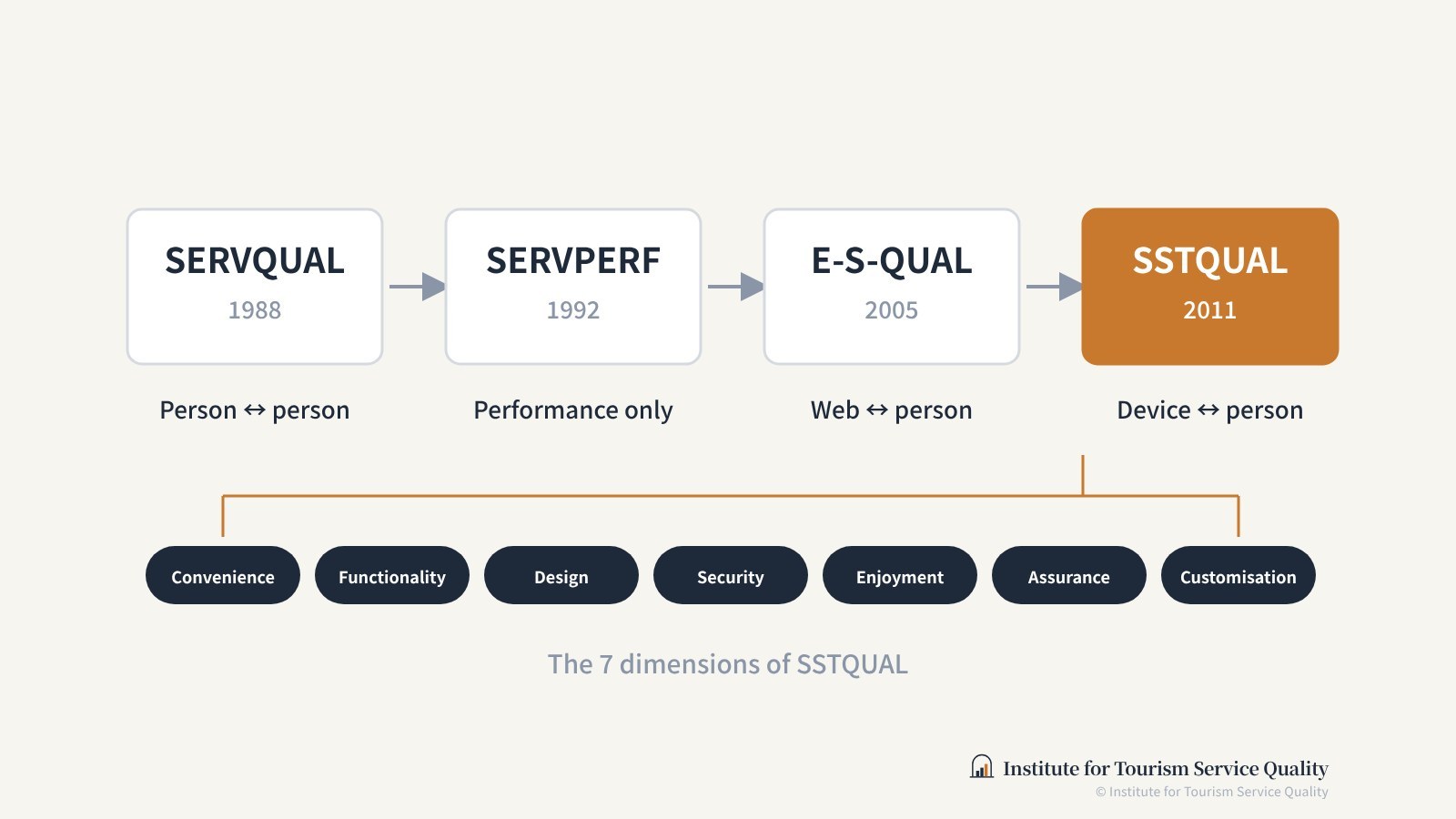
Service quality research began with people. Parasuraman, Zeithaml and Berry's (1988) SERVQUAL measures service quality through five dimensions, reliability, assurance, empathy, responsiveness and tangibles, all of which assume a service encounter between a customer and a member of staff. Staff courtesy and expertise, empathy for customers' needs and prompt responses are concepts that only work when a person is present.
How, then, should we measure the quality of a service in which customers face a machine instead of staff? One of the leading answers service quality research has offered to this question, which the Institute raised earlier in After SERVQUAL: is hotel service quality measurement looking at systems?, is the self-service technology quality scale, SSTQUAL. Drawing on the literature review in Chapter 2 of Director Winston Park's doctoral dissertation, this article summarises why SSTQUAL emerged and what it consists of.
From people-centred to technology-based scales
As interactions between customers and technology increased at service touchpoints, critics pointed out that SERVQUAL and SERVPERF, designed on the assumption of customer–staff interaction, struggle to measure the quality of technology-based services. New scales were developed as a result, mainly for online environments.
- E-S-QUAL (Parasuraman, Zeithaml & Malhotra, 2005): Designed for online shopping services, with 22 items across four dimensions: efficiency, fulfilment, system availability and privacy.
- E-Service Quality (Collier & Bienstock, 2006): Designed for e-retailing, presenting six dimensions: privacy, design, information, accuracy, ease of use and functionality.
- SSTQUAL (Lin & Hsieh, 2011): Developed to evaluate self-service technology in general, not only online, with seven dimensions.
Self-service technology (SST) refers to technological interfaces that enable customers to produce a service themselves through technology without staff involvement (Meuter et al., 2000). Meuter and colleagues divided SSTs into telephone and interactive voice response (IVR), online and internet, video and CD, and interactive kiosks; hotel check-out kiosks already appear as an example of the kiosk type in this classification.
SST and TBSS: looking at the technology or the service?
The dissertation distinguishes between self-service technology (SST) and technology-based self-service (TBSS). SST focuses on the technology, as a system through which customers receive service directly via technology, while TBSS focuses on the service, in that customers perform the service themselves on the basis of technology without the provider's involvement.
This distinction leads to different views of what quality is. If SST quality is seen as the excellence of the technology itself, measurement comes closer to product quality; if it is seen as TBSS quality, it measures the experiential quality that arises from the interaction between the device and the user. The dissertation observes that follow-up studies using SSTQUAL increasingly include interaction among the quality factors, and that the boundary between the two concepts is blurring as a result. The perspective is shifting toward seeing self-service devices not as a category of technology but as providers of service.
The seven dimensions of SSTQUAL
The dimensions of SSTQUAL proposed by Lin and Hsieh (2011), as summarised in the dissertation, are as follows.
- Convenience: The extent to which customers can easily access the SST and use it without constraints of time and place
- Functionality: The ability of the SST to work accurately and quickly and to provide the functions users want
- Design: Visual appeal, interface layout and colours, and how up to date the equipment is
- Security/privacy: The extent to which the risk of hacking and data leaks is low and personal information is managed in a trustworthy way
- Enjoyment: The extent to which users feel positive emotions and interest while using it
- Assurance: The extent to which the reputation and reliability of the SST provider are assured
- Customisation: The ability to provide tailored service reflecting customers' preferences and usage history
Compared with SERVQUAL, two changes stand out. First, dimensions that relied on staff attitudes, such as empathy and responsiveness, have gone, and dimensions that ask about the technology's performance, such as functionality and security, have come in. Second, dimensions that ask about the experience the technology gives customers, such as enjoyment and customisation, have been added. Assurance appears in both scales but means different things: in SERVQUAL it refers to trust arising from staff expertise and courtesy, while in SSTQUAL it refers to trust arising from the reputation of the company providing the device.
As an example of customisation, the dissertation cites not only multilingual screens but also offering the payment methods commonly used in the guest's country. It shows how a machine can take over the personalised service that people used to provide.
How the scale performed at hotel kiosks
SSTQUAL has been used in many settings, including bank ATMs, restaurant kiosks, airport kiosks and unmanned ordering systems in food service. The dissertation applied the scale to 461 users of hotel self check-in and check-out kiosks in Korea.
As a measurement tool, it proved stable. In exploratory factor analysis, the 20 items grouped into seven factors without any items being removed, with overall reliability (Cronbach's α) of .947 and factor reliabilities ranging from .823 (design) to .940 (functionality).
What is interesting is that the roles of the seven factors differed depending on the outcome variable. For guests' intention to keep using the kiosk (continuance intention), all six factors except convenience had significant effects (adjusted R² = .552). For the experience of absorption while using the kiosk (flow), however, only enjoyment (β = .307) and customisation (β = .298) were significant (adjusted R² = .372). Within the same scale, the factors that explain reuse differ from those that explain flow. The results on flow are examined in more detail in the article on flow theory.
Limitations of the scale
The dissertation is also clear about SSTQUAL's limitations. Because SSTQUAL was developed to cover self-service technology in general, it is limited in evaluating a specific technology such as hotel kiosks in detail. As a scale developed in 2011, it is also limited in measuring today's much more advanced technology by the same standards. A hotel kiosk runs a complex process in which booking lookup, room assignment, room key issuance and payment are linked in real time with the hotel's property management system (PMS), but SSTQUAL's items do not directly ask about the quality of this business integration. That is why the dissertation proposes developing a new measurement tool specific to kiosks as a task for future research.
Service quality measurement has created a new language every time the touchpoint has changed. Now that the touchpoint has moved from people to the web and from the web to machines on site, SSTQUAL is best read not as a finished answer but as a starting point for asking about the quality of service without staff.
References
Most sources are in Korean.
- 박건희 (2025). 호텔 키오스크의 셀프 서비스 기술 품질(SSTQUAL)이 플로우(Flow)와 지속이용의도에 미치는 영향: 디지털 리터러시의 조절효과를 중심으로. 박사학위논문, 경기대학교 대학원. 제2장 제1절, 제4장.
- Lin, J. S. C., & Hsieh, P. L. (2011). Assessing self-service technology encounters: Development and validation of SSTQUAL scale. Journal of Retailing, 87(2), 194-206.
- Meuter, M. L., Ostrom, A. L., Roundtree, R. I., & Bitner, M. J. (2000). Self-service technologies: Understanding customer satisfaction with technology-based service encounters. Journal of Marketing, 64(3), 50-64.
- Parasuraman, A., Zeithaml, V. A., & Berry, L. L. (1988). SERVQUAL: A multiple-item scale for measuring consumer perceptions of service quality. Journal of Retailing, 64(1), 12-40.
- Parasuraman, A., Zeithaml, V. A., & Malhotra, A. (2005). E-S-QUAL: A multiple-item scale for assessing electronic service quality. Journal of Service Research, 7(3), 213-233.
- Collier, J. E., & Bienstock, C. C. (2006). Measuring service quality in e-retailing. Journal of Service Research, 8(3), 260-275.
Was this article helpful?
This is an English version of the original Korean article. If the two differ, the Korean original prevails.
© Institute for Tourism Service Quality. All rights reserved.