When the Kiosk Stops, Service Recovery Is a Human Job
Reading self-service failure through service recovery theory, and the recovery design hotels need
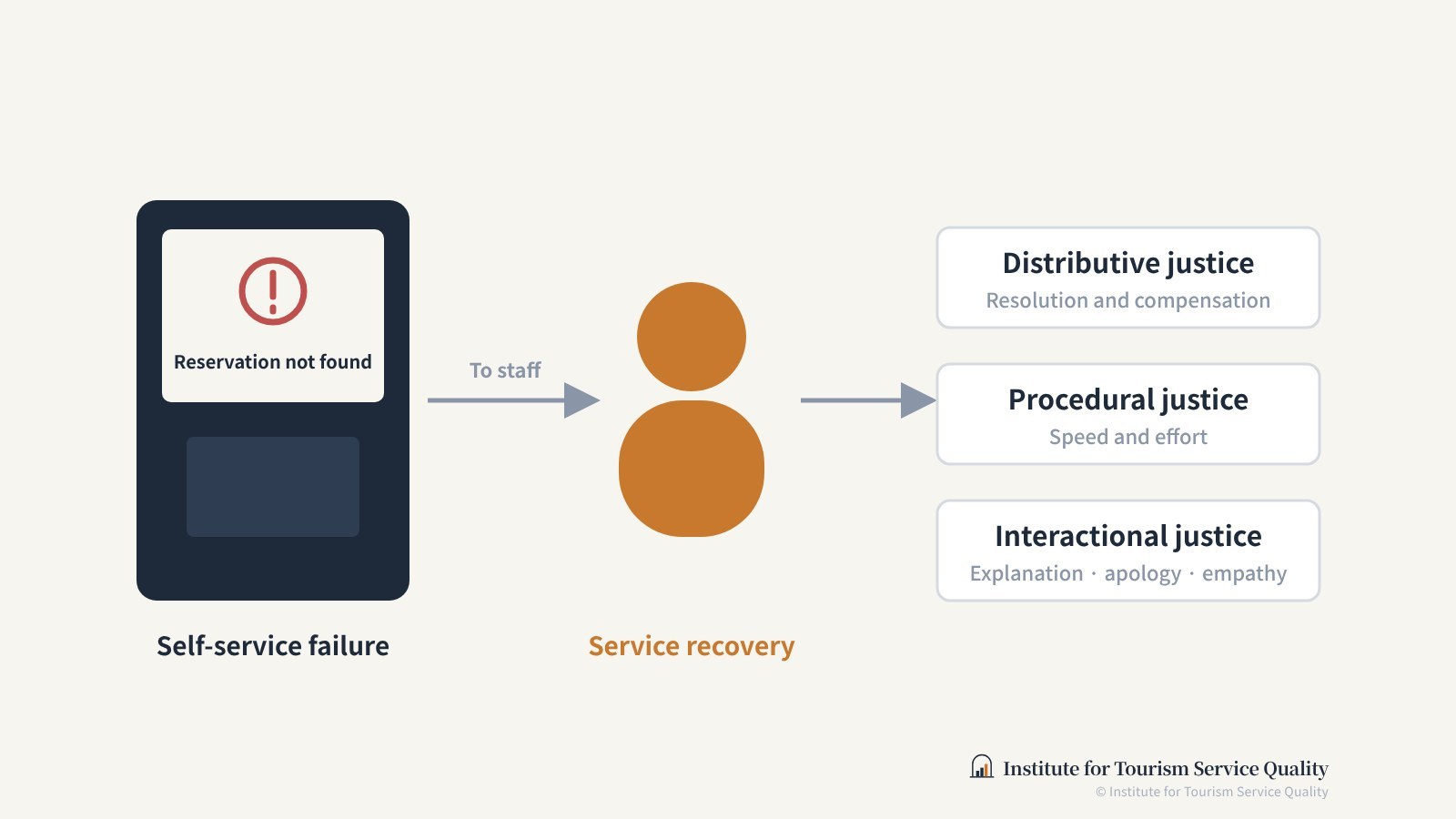
Late at night, a guest stands at a kiosk trying to check in. They have entered their booking number, but the screen keeps repeating "Reservation not found". There is no one at the front desk. What the guest experiences at this moment is not a kiosk error but a failure of the hotel.
Self-service technology (SST) is designed so that service can be completed without staff. At the moment it fails, however, people are needed again. Drawing on research on service failure and recovery, this article considers how recovery should be designed in self-service settings.
How self-service fails
Meuter et al. (2000) collected and analysed customers' satisfying and dissatisfying experiences with self-service technologies. The causes of dissatisfaction they identified were failure of the technology itself, cases where the technology worked but the service process went wrong (for example, an order was accepted but the product never arrived), poor design that made the technology hard to use, and customers' own mistakes.
Applied to hotel kiosks, this classification looks like this.
- Technology failure: The screen freezes, the card terminal does not respond or the room key encoder does not work.
- Process failure: The kiosk works normally, but integration with the hotel's property management system (PMS) goes wrong, so a room that has already been sold is assigned or a payment is authorised twice.
- Design failure: Guests cannot find the next step, there is no foreign-language guidance or the on-screen wording cannot be understood.
- Customer error: Guests enter the wrong booking number or a number from a different booking channel.
The last type deserves attention. Even when a failure starts with the guest's own mistake, if the guest cannot get out of the situation, it is remembered as a service failure. When a person is serving, staff notice and correct the mistake; a kiosk simply repeats the same error message.
Three kinds of justice in evaluating recovery
Hart, Heskett and Sasser (1990) emphasised service recovery as a management activity that corrects failures and retains customers. Later research has explained how customers evaluate the recovery process in terms of justice (Tax, Brown & Chandrashekaran, 1998; Smith, Bolton & Wagner, 1999).
- Distributive justice: Was the outcome fair? This concerns whether the problem was solved and whether the customer received appropriate compensation for the inconvenience.
- Procedural justice: Was the process fair? This concerns how quickly, how easily and with how little effort the problem was resolved.
- Interactional justice: Was the treatment fair? This concerns explanation, apology, empathy and courtesy.
In self-service failures, this framework becomes a useful checklist. What a kiosk can provide on its own is mainly procedural justice: it can explain what the error is and show how to try again or ask for help. Apology, empathy and compensation suited to the situation, however, are mostly provided by people. Designing recovery for self-service ultimately means dividing what the machine handles from what is handed to people.
Does good recovery leave customers better off than before?
A long-debated topic in service recovery research is the service recovery paradox: the claim that customers who experience a failure followed by excellent recovery can end up more satisfied than those who never experienced a failure. A meta-analysis by de Matos, Henrique and Rossi (2007) reported that this effect appears for satisfaction but was not significantly confirmed for repurchase intention, word of mouth or corporate image.
In practice, this result means two things. First, recovery clearly works for restoring satisfaction. Second, failure should not be treated as an opportunity for recovery; the evidence that the desire to return is restored as well is weak. Reducing failures and recovering well when they happen are separate capabilities that both need to be in place.
Designing recovery for hotel kiosks
Based on this discussion, the editorial team suggests that hotels check the following to prepare for kiosk failures.
- Does the error screen tell guests what to do next? Instead of "An error has occurred", the screen should tell guests what they can do, for example "Your booking number is in the ○○ field of your confirmation email" or "Press the call button and staff will help you within ○ minutes". This is where procedural justice begins.
- Is there a route to a person? Check which of a call button, a phone connection or directions to the front desk are available, and whether they work at night. Director Winston Park's doctoral dissertation suggested assigning staff dedicated to kiosk users as a practical implication, which can be read in this context.
- Can staff pick up where the guest left off? If staff cannot immediately see how far the guest got on the kiosk and whether payment was authorised, the guest has to explain everything again. The more effort recovery requires, the lower the procedural justice.
- Is the authority to compensate defined? Distributive justice can be restored quickly only if the range of compensation staff can offer immediately to guests kept waiting by a kiosk failure is defined.
- Are failures recorded and analysed? Link kiosk error logs with customer feedback (VOC) to identify which failures recur. This is the step that leads from recovery to prevention.
The quality of self-service is not judged only in the normal flow. Guests probably trust a kiosk not because it always works well, but because they have experienced the hotel not losing track of them even when it does not. As kiosks take over the work of the front desk, the people and procedures that catch guests at the moment of failure need to be designed as well.
References
Most sources are in Korean.
- Meuter, M. L., Ostrom, A. L., Roundtree, R. I., & Bitner, M. J. (2000). Self-service technologies: Understanding customer satisfaction with technology-based service encounters. Journal of Marketing, 64(3), 50-64.
- Hart, C. W. L., Heskett, J. L., & Sasser, W. E. (1990). The profitable art of service recovery. Harvard Business Review, 68(4), 148-156.
- Tax, S. S., Brown, S. W., & Chandrashekaran, M. (1998). Customer evaluations of service complaint experiences: Implications for relationship marketing. Journal of Marketing, 62(2), 60-76.
- Smith, A. K., Bolton, R. N., & Wagner, J. (1999). A model of customer satisfaction with service encounters involving failure and recovery. Journal of Marketing Research, 36(3), 356-372.
- de Matos, C. A., Henrique, J. L., & Rossi, C. A. V. (2007). Service recovery paradox: A meta-analysis. Journal of Service Research, 10(1), 60-77.
- 박건희 (2025). 호텔 키오스크의 셀프 서비스 기술 품질(SSTQUAL)이 플로우(Flow)와 지속이용의도에 미치는 영향: 디지털 리터러시의 조절효과를 중심으로. 박사학위논문, 경기대학교 대학원.
Was this article helpful?
This is an English version of the original Korean article. If the two differ, the Korean original prevails.
© Institute for Tourism Service Quality. All rights reserved.