When Offices Become Hotels: Seoul Hotel Investment and Conversions in 2026
Rising hotel transactions in Seoul seen through real estate advisers' reports, and the service quality challenges conversion hotels leave behind
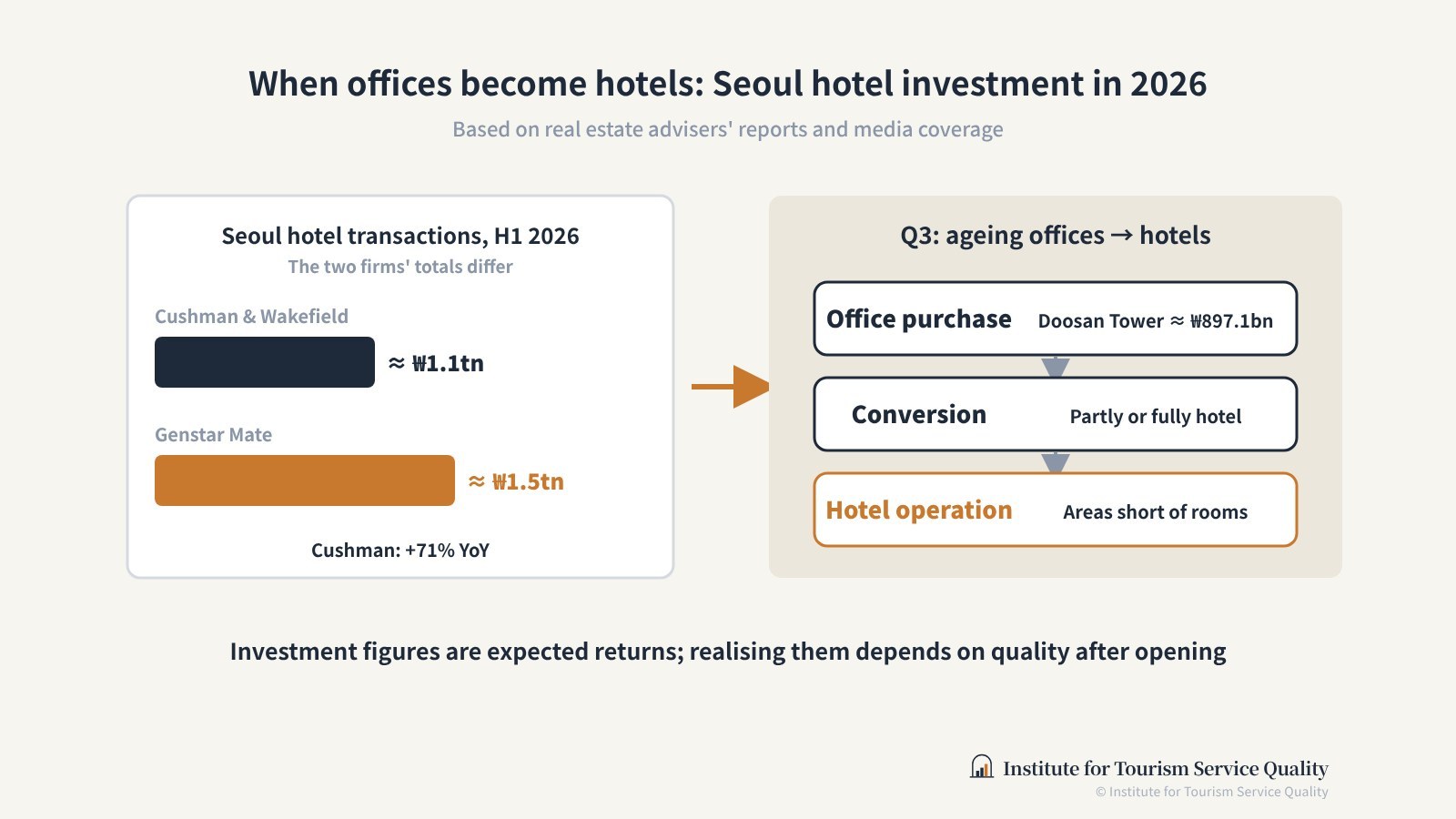
Hotels stand out as the asset class that recovered most clearly in Seoul's commercial real estate market in 2026. Hotel transactions exceeded KRW 1 trillion in the first half, and in the third quarter conversion deals, buying old city-centre offices to turn them into hotels, continued. This article summarises Seoul hotel investment trends based on real estate advisers' reports and media coverage, and looks at the challenges for service quality management when a building designed for another use becomes a hotel.
First-half transactions, counted differently by each source
According to Hankyung (6 August 2026), Cushman & Wakefield Korea's Q2 2026 Seoul Investment Market Report put Seoul hotel transactions in the first half at about KRW 1.1 trillion, up about 71% on the same period a year earlier. There were four deals worth about KRW 588.5 billion in the second quarter alone; the largest was Singapore-based CapitaLand Investment's purchase of voco Seoul Myeongdong (576 rooms) for about KRW 368.6 billion.
According to The Financial News (22 September 2026), the research centre of real estate services company Genstar Mate put first-half transactions at about KRW 1.5 trillion, about 85% of the 2025 annual total (about KRW 1.8 trillion). The average price per 3.3 m² was KRW 28.81 million, the highest since records began, and the average price per room was KRW 460 million.
The two firms' first-half figures differ by about KRW 400 billion. They appear to use different criteria for which deals to include and different cut-off dates; this article presents both figures as they are. Both sources agree, however, that Seoul hotel transactions rose sharply and that foreign capital and real estate investment trusts (REITs) took part as major buyers.
In Q3, buying offices to make hotels
According to Cushman & Wakefield Korea's Q3 report released on 30 October, Seoul commercial real estate transactions totalled about KRW 5.3 trillion, up about 20% quarter on quarter. The firm named value-add deals converting ageing city-centre offices into hotels as the leading trend in the office market and expected this theme to remain a major focus for investors in the fourth quarter.
Etoday and Seoul Economic TV (2 November 2026) reported examples. IGIS Asset Management acquired Doosan Tower in Dongdaemun for about KRW 897.1 billion and plans to convert part of it into a hotel, and Koramco Asset Management, together with Paradise Group, bought K-Square Hongdae for KRW 150 billion with plans to redevelop it around a hotel. Citing Cushman & Wakefield data, Etoday reported that these two deals accounted for about 23% of Q3 office transactions (about KRW 4.6 trillion). In Jongno, the Pagoda Building has already been converted, with medical facilities on the lower floors and hotel rooms above.
The background is the gap between demand and supply. Foreign visitors to Korea reached a record 18.94 million in 2025, while, according to Etoday, new hotel supply in Seoul has been around 1,000 rooms a year since 2023. Genstar Mate noted that most large hotels due to open are tied to major mixed-use developments, making a large short-term increase in supply unlikely. With new building difficult, existing buildings are being converted.
Between investment logic and operating quality
This trend signals that investors recognise the profitability of Seoul hotels. We noted in Pricier rooms, the same guests that growth in Korea's lodging market relies on room rates; higher rates are, in turn, pushing up asset prices.
In the editorial team's interpretation, however, two points need attention from a service quality perspective. First, offices are designed for different conditions from hotels. Floor plate size, window placement, plumbing, ventilation and the number of lifts directly affect room size, noise, water pressure and waiting times. Sharing a building with medical or retail uses can also mix guests' routes with those of other users. Second, in structures where a REIT or asset manager owns the property and a separate operator or brand runs it, decisions balancing return targets against service investment are split between owner and operator. Cushman & Wakefield Korea's remark, reported by Etoday, that deals will be decided not just by location and lease stability but mainly by how asset value can be raised, can be read in the same light. We discussed the operational challenges of reflagging in Up to high-end, out to the regions: how Korean hotel companies are reshaping their brands.
Suggestions from the editorial team
Those planning or operating conversion hotels may want to check the following.
- Look first at the baseline quality set by the structure: Soundproofing, ventilation, water pressure and lift waiting times are hard to fix after opening. Set performance standards for rooms at the design stage and verify them with trial stays.
- Separate routes in mixed-use buildings: In buildings shared with medical, retail or office uses, map with a service blueprint how much guests' entry, check-in and luggage routes overlap with those of other users.
- Put quality indicators in the management contract: Where ownership and operation are separate, specify indicators such as guest satisfaction, complaint resolution time and room defect counts, along with reporting intervals, in the contract so that service investment is not pushed aside.
- Break demand down by source: If the investment case rests on rising foreign visitor numbers, check whether demand is concentrated in particular nationalities or purposes. For a discussion of the quality of foreign visitors' stays, see More visitors, shorter stays: the quality of welcome beyond the numbers.
Conclusion
In Seoul's hotel market in 2026, money is flowing toward converting existing buildings into hotels rather than building new ones. In a city short of rooms, this is a rational choice, but buildings not designed as hotels can be at a disadvantage in the basic conditions of the guest experience. Investment figures show expected returns; whether those expectations are realised ultimately depends on the quality guests experience after opening.
References
Most sources are in Korean.
- 한국경제 (2026.08.06). 외국계 자본, 서울 호텔로 몰렸다…상반기 거래액 71% 증가. https://www.hankyung.com/article/2026080676666
- 파이낸셜뉴스 (2026.09.22). \"반가운 외국인...\" 서울 호텔 거래 올 상반기 약 1.5조 [fn마켓워치]. https://www.fnnews.com/news/202609220906355226
- 쿠시먼앤드웨이크필드 코리아 보도자료, 뉴스와이어 (2026.10.30). 쿠시먼앤드웨이크필드, 3분기 서울 상업용 부동산 거래 5.3조원 선별 회복. https://www.newswire.co.kr/newsRead.php?no=1045917
- 이투데이 (2026.11.02). 관광객 늘고 객실은 부족…호텔로 눈 돌리는 빌딩 투자. https://www.etoday.co.kr/news/view/2642502
- 서울경제TV (2026.11.02). 3분기 서울 상업용 부동산 거래액 5.3조…전분기 대비 20%↑. https://www.sentv.co.kr/article/view/sentv202611020009
Was this article helpful?
This is an English version of the original Korean article. If the two differ, the Korean original prevails.
© Institute for Tourism Service Quality. All rights reserved.