Up to High-End, Out to the Regions: How Korean Hotel Companies Are Reshaping Their Brands
Hotel brand strategy in 2026 through the opening of The Grand Lotte and Josun Hotels & Resorts' expansion plans
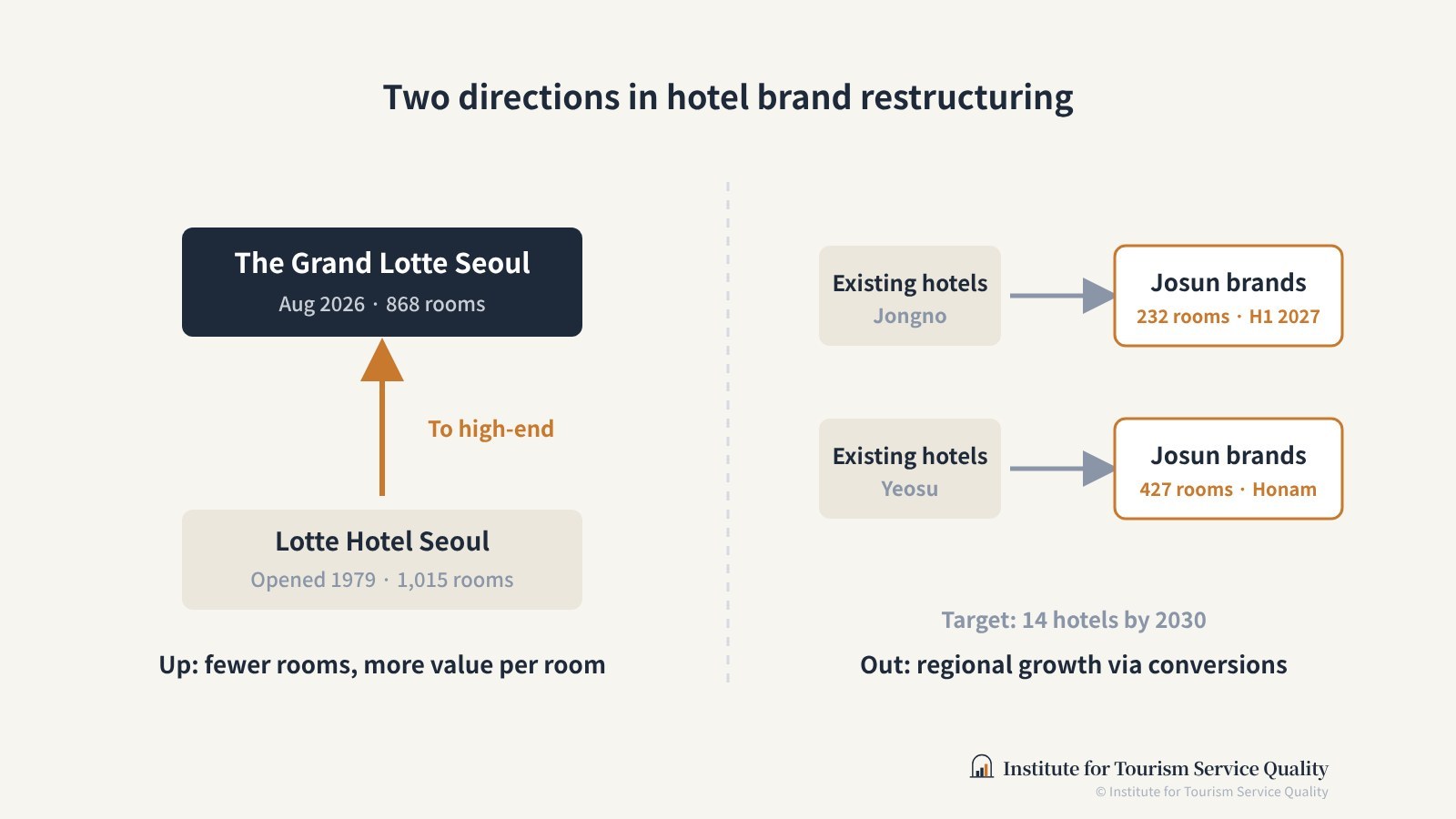
Rebuilding brand portfolios was a prominent theme in Korea's hotel industry in 2026. On one side, a long-established flagship hotel was moved up to a higher-tier brand; on the other, companies are expanding into the regions by acquiring existing hotels and reflagging them under their own brands. This article summarises both cases based on media reports and looks at the challenges brand restructuring poses for service quality management.
Case 1: From Lotte Hotel Seoul to The Grand Lotte
According to Hankyung (24 June 2026), Lotte Hotels & Resorts launched THE GRAND LOTTE, its first new high-end brand since Signiel in 2017. The first property is Lotte Hotel Seoul, which opened in 1979.
According to Herald Economy (14 August 2026), the hotel reopened that day as The Grand Lotte Seoul. Floors 7 to 21 of the main building were renovated over about 15 months; main building rooms fell from 737 to 590, and total rooms across the main building and Executive Tower fell from 1,015 to 868. Rooms were enlarged and bathrooms expanded in exchange for fewer rooms.
The reduction in rooms is worth noting. With fewer rooms, rates must rise to generate the same revenue. This can be read as a choice to raise the value of each room rather than the number of rooms available for sale. It also connects with the fact that growth in the lodging market in Q3 2026 came mainly from higher rates, which we summarised in Pricier rooms, the same guests.
Case 2: Josun Hotels & Resorts expands through conversions
According to Segye Ilbo and Seoul Economic Daily (2 November 2026), Josun Hotels & Resorts will open two hotels in Jongno, Seoul and Yeosu, South Jeolla Province, in the first half of 2027. Both are conversions of acquired hotels: the existing Orakai Daehakro Hotel (232 rooms) in Jongno and the Ramada Plaza by Wyndham Yeosu (427 rooms) in Yeosu. Yeosu will be the company's first hotel in the Honam region.
The company said it plans to grow to 14 hotels in Korea by 2030, also expanding to Cheongna and Andong. According to the reports, the assets will be acquired by a consortium formed with Shinsegae Property Investment Management, and the hotels will be operated under management contracts. This structure separates ownership from operation, allowing the company to run more hotels with less capital.
What the two directions share
The two cases move in different directions. Lotte raised the tier of an existing hotel, while Josun took hotels from other brands and converted them to its own. Both, however, renovated existing hotels and gave them a new brand rather than building new ones. Brand conversion reduces construction time and cost, but leaves the task of bringing service up to the new brand's standards.
Where service quality is tested when a brand changes
For guests, a brand is a promise of a certain level of service. Under the same brand, they expect a similar experience at any hotel in any region. When a brand changes or expands to new regions, whether that promise is kept becomes the core of service quality. The editorial team suggests checking the following.
- Have the people changed before the sign? Staff at converted hotels are used to the previous brand's ways of working. Check that the new brand's service standards have taken hold through training and on-site inspections.
- Can you handle higher expectations? At a hotel moved up to high-end, guests' expectations rise even with the same staff and the same spaces. Compare reviews and complaint types just after the rebranding with those before.
- Is the systems transition invisible to guests? Changing brands often means changing reservation systems, loyalty programmes, the property management system (PMS) and channel integrations at the same time. Missing bookings and inventory errors during the transition become the guest's first experience of the new brand. We covered how to check channel integrations in Channel manager integration testing.
- Can regional hotels keep the same promise? The further a brand expands into the regions, the harder staffing becomes and the greater the distance to manage. Brand standards can be adapted to local conditions, but the core experience guests expect must be kept.
Conclusion
Korean hotel companies are moving in two directions at once: toward more expensive brands and toward more regions. Both rely on converting existing hotels rather than building new ones, so success depends on how quickly service is brought up to the new standard once the sign has changed. As brands multiply, delivering consistently the experience guests expect from a brand name will become a central task of hotel management.
References
Most sources are in Korean.
- 한국경제 (2026.06.24). 롯데호텔 서울 47년 만에 변신…8월 '더그랜드롯데'로 재개관. https://www.hankyung.com/article/2026062460181
- 헤럴드경제 (2026.08.14). 클래식 럭셔리의 정점…롯데호텔, '더그랜드롯데 서울' 개관. https://biz.heraldcorp.com/article/10841613
- 세계일보 (2026.11.02). 조선호텔앤리조트, 2027년 종로·여수에 호텔 2곳 개관… 2030년까지 14곳으로 확대. https://www.segye.com/newsView/20261102508702
- 서울경제 (2026.11.02). 조선호텔앤리조트, 내년 종로·여수에 호텔 2곳 개관한다. https://m.sedaily.com/article/20109064
Was this article helpful?
This is an English version of the original Korean article. If the two differ, the Korean original prevails.
© Institute for Tourism Service Quality. All rights reserved.