Pricier Rooms, the Same Guests: Reading Korea's Lodging Market in Q3 2026
Price-led growth and its limits in Yanolja Research's Q3 lodging industry report
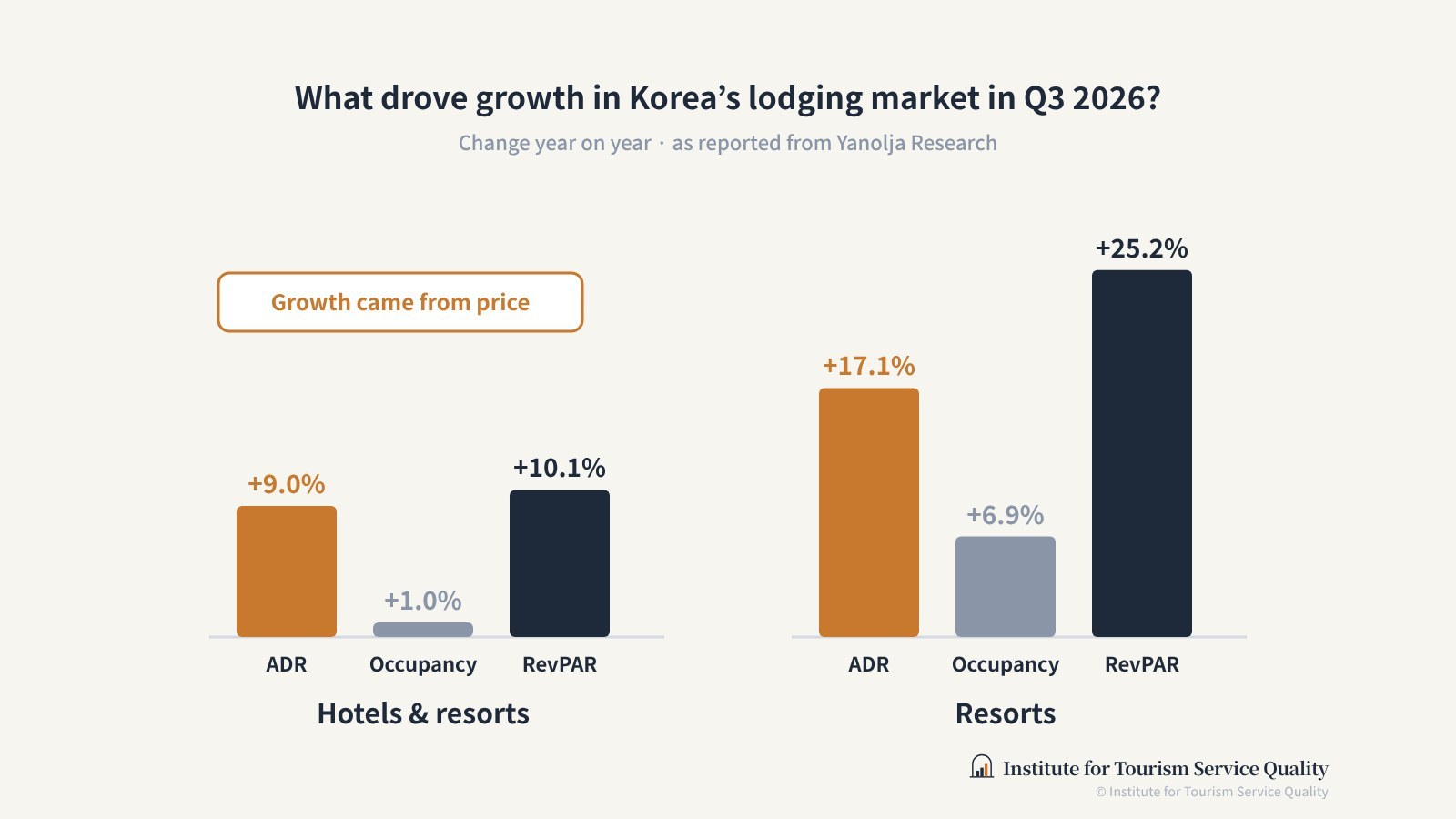
On the numbers alone, Q3 2026 was a good quarter for Korea's lodging market. Revenue per available room (RevPAR) at hotels and resorts rose by more than 10% on the same quarter last year. A look at what drove that growth, however, tells a different story: revenue grew because rooms became more expensive, not because more guests came. This article reviews the reported figures and asks what a period of price-led growth demands of hotel service quality.
All figures in this article come from press coverage of Yanolja Research's Q3 2026 Domestic Lodging Industry Trends Report. Because several outlets reported on the same report, their coverage cannot be treated as independent cross-checking, and some figures are labelled with different baselines (same quarter last year or previous quarter) in different reports. The detailed figures should be checked against the original report.
The reported figures
According to Hotel & Restaurant and Hankyung (27–28 October 2026), the average daily rate (ADR) at hotels and resorts rose 9.0% year on year in Q3, while occupancy (OCC) rose only 1.0%. As a result, RevPAR rose 10.1%. Most of the revenue growth came from price.
The picture differed sharply by grade. According to the reports, five-star hotels raised room rates by 15.3% but saw occupancy fall. Four-star hotels also raised rates by 13.2% while occupancy declined. Travel Times reported that Yanolja Research interpreted this as a sign of possible price resistance.
Resorts grew the most of any property type. Their RevPAR rose 25.2%, the highest of all types, with both rates (17.1%) and occupancy (6.9%) increasing. They were almost the only type in which price and demand rose together.
The outlook for Q4 is cautious. In the same report's outlook index (baseline 100), hotel room rates stood at 101.5, suggesting stable or slightly higher prices, but occupancy stood at 97.5, below the baseline. For motels, more respondents expected both price and demand to weaken, with indices of 95.5 for rates and 96.8 for occupancy.
Foreign demand did not spread evenly
Over the same period, Korea welcomed about 17.11 million foreign visitors in January–September, up 21.5% year on year. According to Hankyung, however, the effect varied greatly by property type and region. Foreign guests stayed at 96% of hotels but only 69.4% of motels, and three in ten motels had no foreign guests at all during the survey period.
The regional gap was also clear. The share of hotels that felt foreign demand had increased was 81.3% in Busan and 63.2% in Seoul, but only 18.2% in the Jeolla and Gangwon regions and 16.7% in the Gyeongbuk–Daegu region. Rising visitor numbers do not automatically translate into a recovery for lodging businesses across all regions. We discussed visitors' length of stay in More visitors, shorter stays.
Price-led growth tests service quality more strictly
From a revenue management perspective, raising rates is a rational choice. Raising prices when demand is strong is a basic principle of revenue management. The problem arises when occupancy does not rise with them. Rising rates and falling occupancy at five- and four-star hotels suggest that some guests did not accept the higher prices and moved to other options.
Service quality research has long emphasised that customers judge value by weighing price against quality. If the same room costs 15% more than last year, guests' expectations rise accordingly. From the perspective that explains service quality as the gap between expectations and actual experience, a price increase raises the level of expectation and makes guests judge the same service more harshly. A hotel that has raised its prices risks receiving lower ratings even if it delivers the same service as before.
Based on this discussion, the editorial team suggests that hotels check the following while room rates drive growth.
- Can you explain the price increase? Check whether there are changes guests can feel as the reason for the higher price, such as refurbished rooms, breakfast, lounges or the check-in experience.
- Do you watch for early signs of dissatisfaction? Track review scores, price-related complaints and cancellation rates every quarter after a rate increase. These signals appear before occupancy falls.
- Do you have a strategy to hold rates in the low season? When demand weakens, as the Q4 outlook suggests, consider protecting rates through product design, such as packages and multi-night benefits, before turning to discounts.
- Do you distinguish regions that rely on foreign demand from those that do not? Even within the same chain, pricing strategies should differ where the structure of regional demand differs.
Conclusion
Q3 growth is a clear achievement, but it rests on price. As prices rise, so do guests' expectations, and expectations that go unmet come back as lower occupancy in the following quarter. Resorts, which raised both rates and occupancy, show that properties offering experiences that justify their prices still attract demand. The Q4 low season will reveal whether each hotel's prices are backed by its service.
References
Most sources are in Korean.
- 호텔앤레스토랑 (2026.10.28). 3분기 숙박업 '전 부문 성장'… '객실단가' 상승이 실적 견인. https://www.hotelrestaurant.co.kr/news/articleView.html?idxno=22433
- 한국경제 (2026.10.27). 외국인 관광객 1700만명 왔는데…모텔 10곳 중 3곳은 손님 0명. https://www.hankyung.com/article/202610277622g
- 여행신문 (2026.10.30). 숙박업 회복세 중저가까지 확산…핵심 동력은 이것. https://www.traveltimes.co.kr/news/articleView.html?idxno=500637
Was this article helpful?
This is an English version of the original Korean article. If the two differ, the Korean original prevails.
© Institute for Tourism Service Quality. All rights reserved.