Same Quarter, Different Asia: Marriott and Hilton in Q3 2026
Regional differences in demand and the spread of conversions, seen through the results of two global hotel chains
The world's two largest hotel chains have released their third-quarter 2026 results. Hilton reported on 27 October and Marriott International on 2 November, and both raised their full-year outlooks. The headline numbers look similar, but broken down by region, results diverged within the same quarter and even within the same Asia Pacific region. Based on the companies' announcements and trade press reports, this article summarises the global hotel market in the third quarter.
What was announced
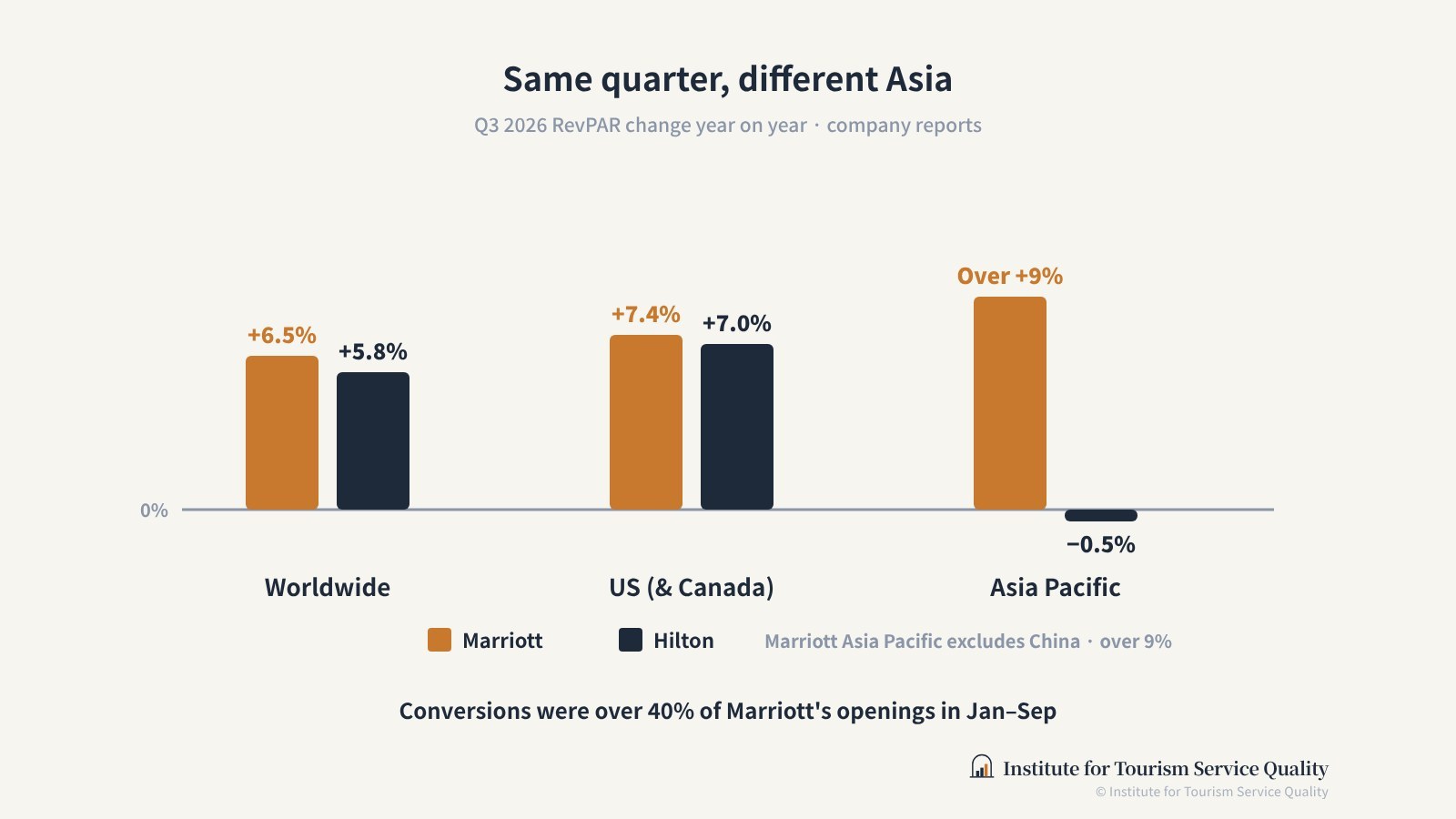
Hilton: According to the company's release and an Asian Hospitality report (27 October), system-wide comparable revenue per available room (RevPAR) rose 5.8% year on year in the third quarter. Occupancy rose 1.4 percentage points to 75.8%, and average daily rate (ADR) rose 3.9% to USD 164.57. By region, RevPAR rose 7.0% in the US, 6.5% in Europe and 6.3% in the Americas outside the US, while it fell 5.6% in the Middle East and Africa and 0.5% in Asia Pacific. Hilton cited the World Cup and favourable holiday timing as growth factors, and raised its full-year RevPAR growth outlook from 3–3.5% to 4–4.5%. For the fourth quarter it expects growth of 3–3.5%, citing the effects of the US midterm elections and conditions in the Middle East. It opened 182 hotels (27,000 rooms) in the quarter and has 543,100 rooms in development.
Marriott: According to HOTELS Magazine and Asian Hospitality (2–3 November), worldwide RevPAR rose 6.5% in the third quarter. US & Canada rose 7.4% and international markets 4.4%; within international, Asia Pacific (APEC, excluding China) grew the most, at more than 9%. Europe, the Middle East and Africa grew more than 4%, and while the Middle East was still affected by conflict, trends improved on the second quarter. Marriott raised its full-year RevPAR growth outlook to 4.5–5%. Its development pipeline is a record 4,209 hotels and more than 634,000 rooms, and conversions of existing hotels made up more than a third of signings and more than 40% of openings in the first nine months. Its loyalty programme has about 309 million members.
The two companies define regions differently. Marriott's Asia Pacific figure excludes China, and whether Hilton's Asia Pacific figure includes China is not confirmed in the reports and should be checked in the original. It is therefore safer to read the two figures as a difference in direction rather than to compare them directly.
Interpretation
First, events and rates lifted the US. Both companies recorded growth of around 7% in the US. Hilton cited the World Cup and holiday timing, which also means one-off factors are mixed in. The background to the upgraded US hotel outlook earlier in the year is covered in US Hotels Held Up Without International Visitors: What the 2026 Outlook Tells Us.
Second, growth in Asia depended on which demand a portfolio captures. Marriott said Asia Pacific excluding China grew strongly on international travel demand, while Hilton's Asia Pacific declined slightly. Which countries and which demand dominate a portfolio appear to have decided results within the same region. The effect of shifting Chinese demand on neighbouring markets can also be seen in Japan's Hotels After the Drop in Chinese Visitors: Tokyo Up, Osaka Down.
Third, growth is coming through conversions more than new builds. Marriott said more than 40% of its openings were conversions. Putting a new brand on an existing hotel is fast and cheap, but because the building and staff stay the same while only the brand promise changes, aligning service standards remains a challenge. The same trend in Korea was examined in When Offices Become Hotels: Seoul Hotel Investment and Conversions in 2026.
Editorial suggestions
Lessons for Korean hotels from the global chains' third-quarter results are as follows.
- Review guest mix at the regional level: Just as results diverged within Asia Pacific, check whether your hotel's guest mix by nationality and purpose is concentrated in particular markets.
- Separate event effects from underlying strength: Results lifted by large concerts or international events come back as base effects the following year. Track performance excluding event periods separately.
- Check service standards at converted hotels: Hotels preparing for or completing a brand conversion should check not only facilities but whether service procedures, staff training and system transitions live up to the new brand's promise.
- Treat loyal guests as a buffer against demand swings: Global chains stress membership numbers because direct bookings and repeat stays are what withstand demand volatility. Independent hotels should also treat repeat-guest management as part of revenue management.
Even when the numbers move in the same direction, the guests behind them differ by region.
Closing
Marriott's and Hilton's third-quarter results signal that global hotel demand remains solid, but growth was uneven across regions and guest mixes. The message for Korean hotels is clear. As inbound demand grows, the hotels that know exactly which guests come and why will be the ones that hold steady through the next swing.
References
Most sources are in Korean.
- Hilton (2026.10.27). Hilton Reports 2026 Third Quarter Results. https://stories.hilton.com/releases/hilton-reports-2026-third-quarter-results
- Asian Hospitality (2026.10.27). Hilton Q3 RevPAR rises 5.8 percent. https://www.asianhospitality.com/hilton-q3-revpar-rises/
- HOTELS Magazine (2026.11.2). Marriott bullish on 2026 outlook as global RevPAR rises during Q3. https://hotelsmag.com/news/marriott-bullish-on-2026-outlook-as-global-revpar-rises-during-q3/
- Asian Hospitality (2026.11.3). Strong Q3 lifts Marriott’s outlook. https://www.asianhospitality.com/marriott-q3-earnings-revpar-2026-outlook/
- Journal des Palaces (2026.11.3). Marriott International Reports Third Quarter 2026 Results. https://www.journaldespalaces.com/en/pressrelease-79964-marriott-international-reports-third-quarter-2026-results.html
Was this article helpful?
This is an English version of the original Korean article. If the two differ, the Korean original prevails.
© Institute for Tourism Service Quality. All rights reserved.