The Service Gap Kiosks Create, and How Hotels Can Close It
Digital literacy research and Korea's 2026 kiosk accessibility mandate, and the tasks they set for hotel self-service
One of the longest-standing goals of hotel service is standardisation. Writing service manuals, dressing staff in the same uniform and standardising greetings all aim to ensure that every guest receives the same level of service. Kiosks seem to fit this goal well. Machines do not get tired, and their service does not change with their mood.
At a kiosk, however, the variable that decides service quality shifts from the staff to the guest. On the same screen, a guest who is comfortable with digital devices and one who is not have entirely different experiences. Director Winston Park's doctoral dissertation frames this difference as a problem of service inequality. This article looks at the dissertation's findings together with recent regulatory changes.
What the research found: digital skills shape flow
The dissertation surveyed 461 users of self check-in and check-out kiosks at hotels in Korea and analysed whether the effect of kiosk quality on users' flow, their absorption during use, varies with their digital literacy. Digital literacy is the ability to find, share, evaluate and use information with digital technology.
- Digital literacy showed a relatively strong correlation with flow (r = .537).
- Adding digital literacy to a model that explained flow with kiosk quality alone raised the explanatory power (adjusted R²) from .372 to .470.
- Among the quality factors, the effects of design and assurance varied with the level of digital literacy. The dissertation interpreted design as having a greater effect on flow for users with low digital literacy, and assurance as having a greater effect for users with high digital literacy.
From this, the dissertation draws a paradoxical implication. If the effect of quality depends on guests' abilities, that can be a burden for hotels that value standardisation. Hotels should therefore strengthen the factors less affected by guests' abilities, namely convenience, functionality, security and privacy, enjoyment and customisation, while also putting in place measures that reduce the gap in abilities itself.
A gap in the research: older guests
The study has an important limitation. More than 91% of respondents were in their 20s to 40s. The dissertation notes that, as a result, most respondents had high digital literacy, which may have weakened the moderating effect. This is the same reason digital literacy research tends to focus on older adults, and the dissertation proposes follow-up research on people aged 60 and over.
Put another way, even in a sample made up mainly of younger users, differences in digital skills shaped flow. If older guests unfamiliar with digital devices, foreign tourists and guests with disabilities were included, the gap could well be larger. This hypothesis has not yet been tested, but given how varied hotel guests are in age, nationality and physical condition, it is a question for industry and researchers to examine together.
Regulatory change: the kiosk accessibility obligation from January 2026
The gap has already entered the realm of regulation. According to media reports, under an amendment to the enforcement decree of Korea's Act on the Prohibition of Discrimination against Persons with Disabilities, public and private sites with unmanned information terminals (kiosks) had to complete reasonable accommodations for people with disabilities by 28 January 2026. The main points of the amended decree, approved by the Cabinet in November 2025, are as follows (Herald Economy, 10 November 2025).
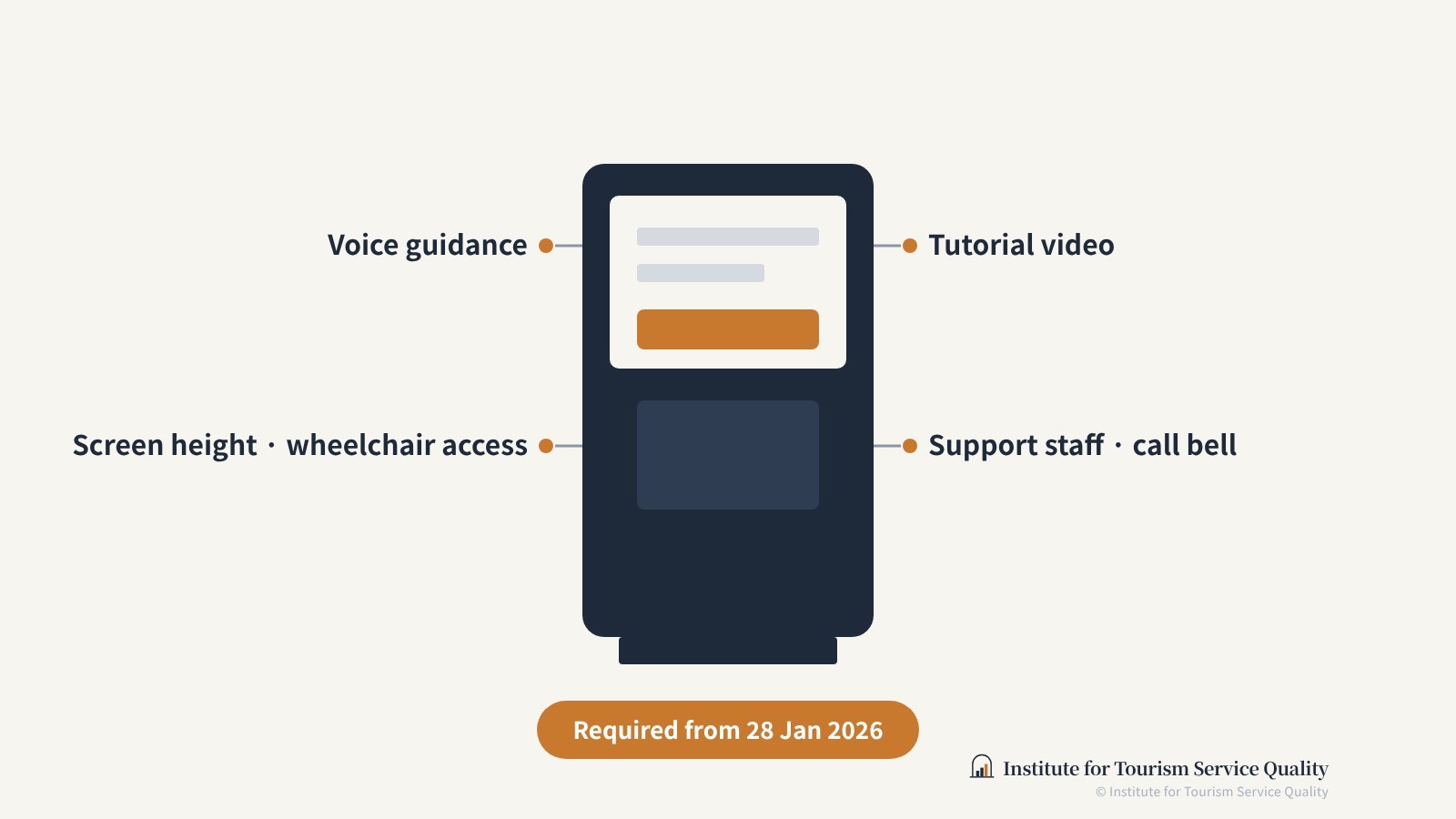
- Basic standard: Sites must have terminals that meet the Ministry of Science and ICT's verification standards and a voice guidance device that announces the terminal's location. Before the amendment, all six types of accommodation, including wheelchair accessibility, were required; this was relaxed.
- Exceptions: Small neighbourhood facilities with a floor area under 50 m², small business owners and sites with small table-order devices may instead install assistive devices or software compatible with standard terminals, assign support staff or install a call bell.
- Non-compliance: If discrimination is found after a complaint to and investigation by the National Human Rights Commission, it can lead to a corrective recommendation and then a corrective order from the Minister of Justice, after which a fine of up to KRW 30 million may be imposed.
Hotels with kiosks are subject to this obligation. However, whether the basic standard or an alternative applies may depend on the size and type of the business, so individual hotels should check the Ministry of Health and Welfare's guidance and related notices directly. This article is based on media reports and is not legal advice.
Tasks for hotels
Taken together, the research and the regulation show that kiosk accessibility is both a legal obligation to accommodate people with disabilities and an extension of hotels' efforts to standardise service so that every guest receives the same service. The practical implications drawn in the dissertation cover more ground than the regulation requires.
- Introduce barrier-free kiosks: Install kiosks designed for wheelchair users and others, so that service is standardised physically as well.
- Tutorial video monitors: Place a monitor showing how to use the kiosk next to it, so that guests with lower digital skills can learn from audiovisual material.
- Dedicated kiosk staff: Assign staff to help guests using the kiosk. The dissertation presents this as a way to raise satisfaction with minimal staffing.
- Kiosk booths: Set up separate booths, like bank ATMs, to reduce the discomfort of entering names and contact details amid lobby traffic. This suggestion targets both data protection and flow.
Of these, assigning dedicated staff is especially telling. If kiosks are introduced only to cut labour costs, putting staff back seems contradictory. From the dissertation's perspective, however, staff are not a replacement for the kiosk but a means of raising guests' skills so that the kiosk experience becomes standardised. In the language of flow theory, their role is to balance the difficulty of the task with the guest's skill level.
Conclusion
A kiosk can be a tool for standardising service or a source of a new service gap. Which it becomes depends less on the device itself than on the design around it. The 2026 accessibility mandate sets only a minimum standard. Making sure that guests who are not comfortable with digital devices have the same experience remains a service quality task for hotels.
References
Most sources are in Korean.
- 박건희 (2025). 호텔 키오스크의 셀프 서비스 기술 품질(SSTQUAL)이 플로우(Flow)와 지속이용의도에 미치는 영향: 디지털 리터러시의 조절효과를 중심으로. 박사학위논문, 경기대학교 대학원. 제1장, 제4장, 제5장.
- 헤럴드경제 (2025.11.10). 장애인 무인정보단말기 설치 의무화…미이행 시 과태료 최고 3000만원. https://www.heraldk.com/article/2025111020253239984
- 경인일보 (2026.1.21). 장애인차별금지법 개정 28일 의무화. https://www.kyeongin.com/article/1758044
- Csikszentmihalyi, M. (1975). Beyond Boredom and Anxiety: Experiencing Flow in Work and Play. San Francisco: Jossey-Bass.
Was this article helpful?
This is an English version of the original Korean article. If the two differ, the Korean original prevails.
© Institute for Tourism Service Quality. All rights reserved.