US Hotels Held Up Without International Visitors: What the 2026 Outlook Tells Us
The US hotel market through forecasts by CoStar and Marcus & Millichap, and lessons for Korean hotels
The US hotel market performed better than expected in 2026. International visitors declined, but domestic group and business demand and major events filled the gap. This article summarises the joint forecast by hotel data provider CoStar (STR) and economic consultancy Tourism Economics, and a report by commercial real estate brokerage and research firm Marcus & Millichap. The two sources use different bases and dates, so their figures do not match; this article presents the differences as they are.
The outlook was raised
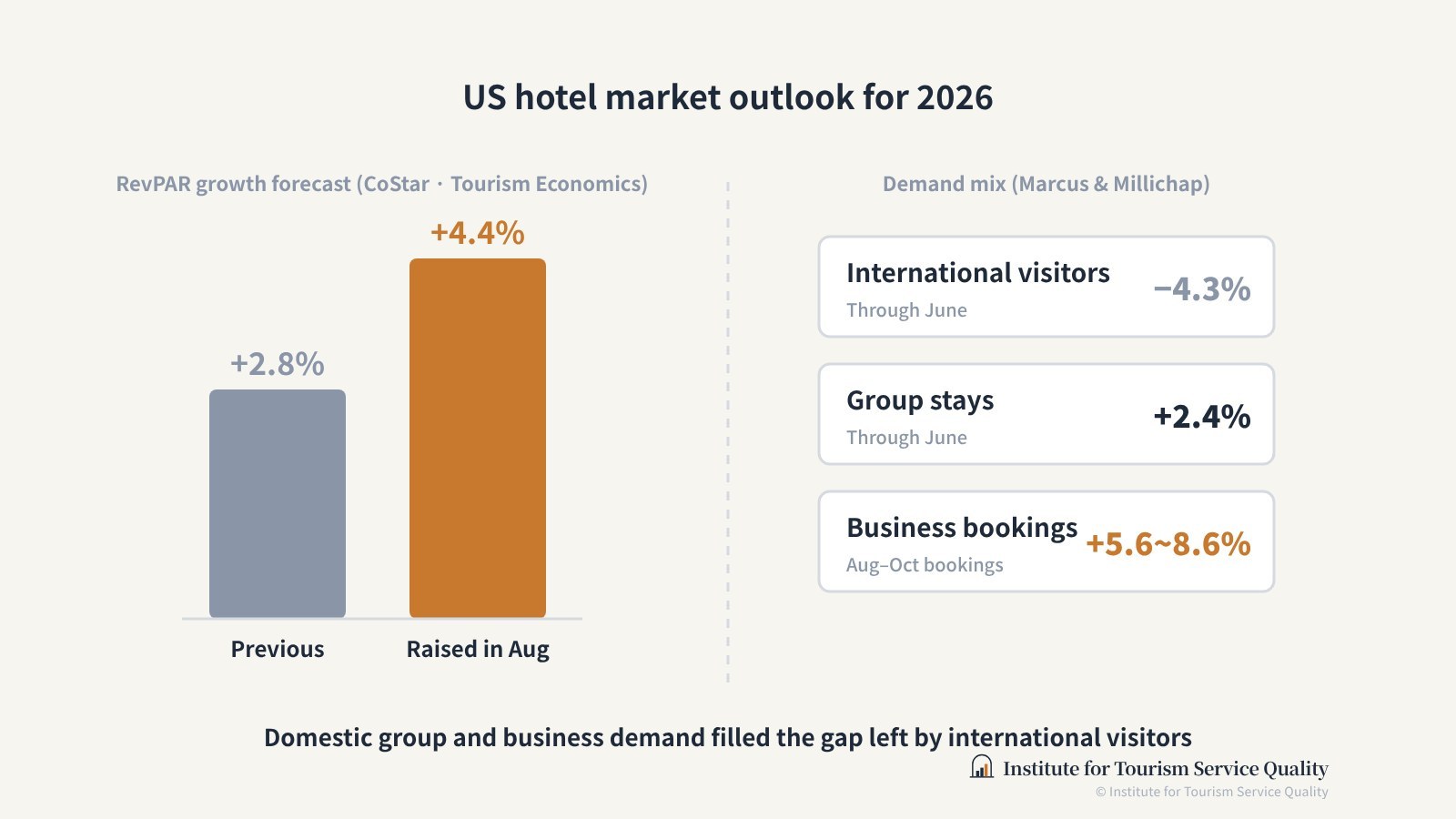
According to Hotel Dive (7 August 2026), CoStar and Tourism Economics raised their forecast for 2026 growth in US hotel revenue per available room (RevPAR) from 2.8% to 4.4%. The forecast for average daily rate (ADR) growth rose from 2% to 3.1%, and for occupancy from 62.8% to 63.1%.
Stronger-than-expected leisure and business demand was cited as the reason. Amanda Hite, president of STR, said the World Cup and events marking the 250th anniversary of the United States had some effect. According to the report, US hotels sold more rooms in the first half of 2026 than ever before, with room nights sold up 11.4 million and room revenue up more than USD 5.4 billion year on year. Growth was expected to slow somewhat in the second half and to remain led by room rates.
International visitors fell
The Marcus & Millichap report (October 2026) shows the composition of demand in more detail. According to the report, international visitors to the United States through June 2026 were down 4.3% year on year. Group stays, by contrast, rose 2.4% over the same period to 129 million room nights, and business travel bookings for August to October were running 5.6–8.6% ahead of the previous year. Domestic group and business demand filled the gap left by international demand.
The report's 2026 RevPAR growth forecast is 3.8%, lower than CoStar's 4.4%. It expects ADR to rise 2.8% to USD 165.30 and occupancy to reach 63%. Because each source uses different data and forecast dates, it is more useful to look at the direction than the numbers. Both forecasts agree that growth is centred on room rates.
Prices diverged by segment
The same report also showed differences by hotel type. In the 12 months to July, ADR at full-service hotels rose 4.4%, while at limited-service hotels it fell 1.0%. The report attributed this to the pressure on price-sensitive travellers and rising labour costs. Upscale hotels were able to raise prices; budget hotels were not.
Risks were also identified. According to the report, about 143,000 rooms were under construction as of July, and about 30% of outstanding US hotel and motel mortgage debt matures in 2026. With interest rates high, the burden of refinancing may grow.
Lessons for Korean hotels
Trends in the US market resemble Korea's lodging market in Q3 2026. In both markets, growth was centred on room rates, and price trends diverged between upper and lower segments. We summarised the Korean situation in Pricier rooms, the same guests. The demand structure, however, is the opposite. In the United States, domestic group and business demand filled the gap left by fewer international visitors; in Korea, growth in foreign visitors drove growth. From this difference, the editorial team draws the following implications.
- Break demand down by source: Growth that relies on rising foreign visitor numbers can turn quickly with exchange rates, flight supply and international affairs. Just as US hotels weathered weaker international demand with group and business demand, Korean hotels should review the share of domestic MICE and corporate demand.
- The effect of major events is temporary: The US outlook also mentioned tougher comparisons after the World Cup as a burden. Hotels should consider whether rates raised during an event can be sustained afterwards.
- Budget properties have little pricing room: The fall in ADR at US limited-service hotels suggests that Korean mid- and low-priced properties may face the same pressure. In this segment, operational efficiency and reliable basic service matter more than price as a competitive edge.
Conclusion
The US hotel market in 2026 showed that growth is possible through domestic demand and pricing strategy even when international demand is weak. It also showed that this growth is concentrated in upper segments and carries the burden of new supply and financing costs. For Korean hotels growing on the back of rising foreign visitors, it can be read as a signal to broaden their sources of demand and build the service needed to support their prices.
References
Most sources are in Korean.
- Hotel Dive (2026.08.07). CoStar, Tourism Economics 'significantly' boost US hotel outlook. https://www.hoteldive.com/news/costar-tourism-economics-raise-us-hotel-performance-outlook-2026/827318/
- Marcus & Millichap (2026.10). 2026 U.S. Hotel Outlook: Domestic Demand Supports Growth as Financing and Supply Risks Rise. https://www.marcusmillichap.com/research/special-report/2026/10/2026-us-hotel-outlook-domestic-demand-supports-growth-as-financing-and-supply-risks-rise
Was this article helpful?
This is an English version of the original Korean article. If the two differ, the Korean original prevails.
© Institute for Tourism Service Quality. All rights reserved.