AI Concierges for Guest Messaging: What to Delegate and When to Hand Over to People
The structure of multi-agent guest service and its service quality challenges, seen through Yanolja Cloud Solution's launch of Pulse AI
Much of a hotel front desk's day takes place not in front of the guest but in a message window. Booking confirmations, questions about check-in times, requests for extra towels and payment checks continue all day. In August 2026, Yanolja Cloud Solution (YCS), part of the Yanolja group, launched Pulse AI, an AI concierge in which task-specific AI agents share this guest communication. This article reviews what has been reported and, from a service quality perspective, the division of roles between people and AI that hotels need to set as AI handles more guest contact.
What was announced
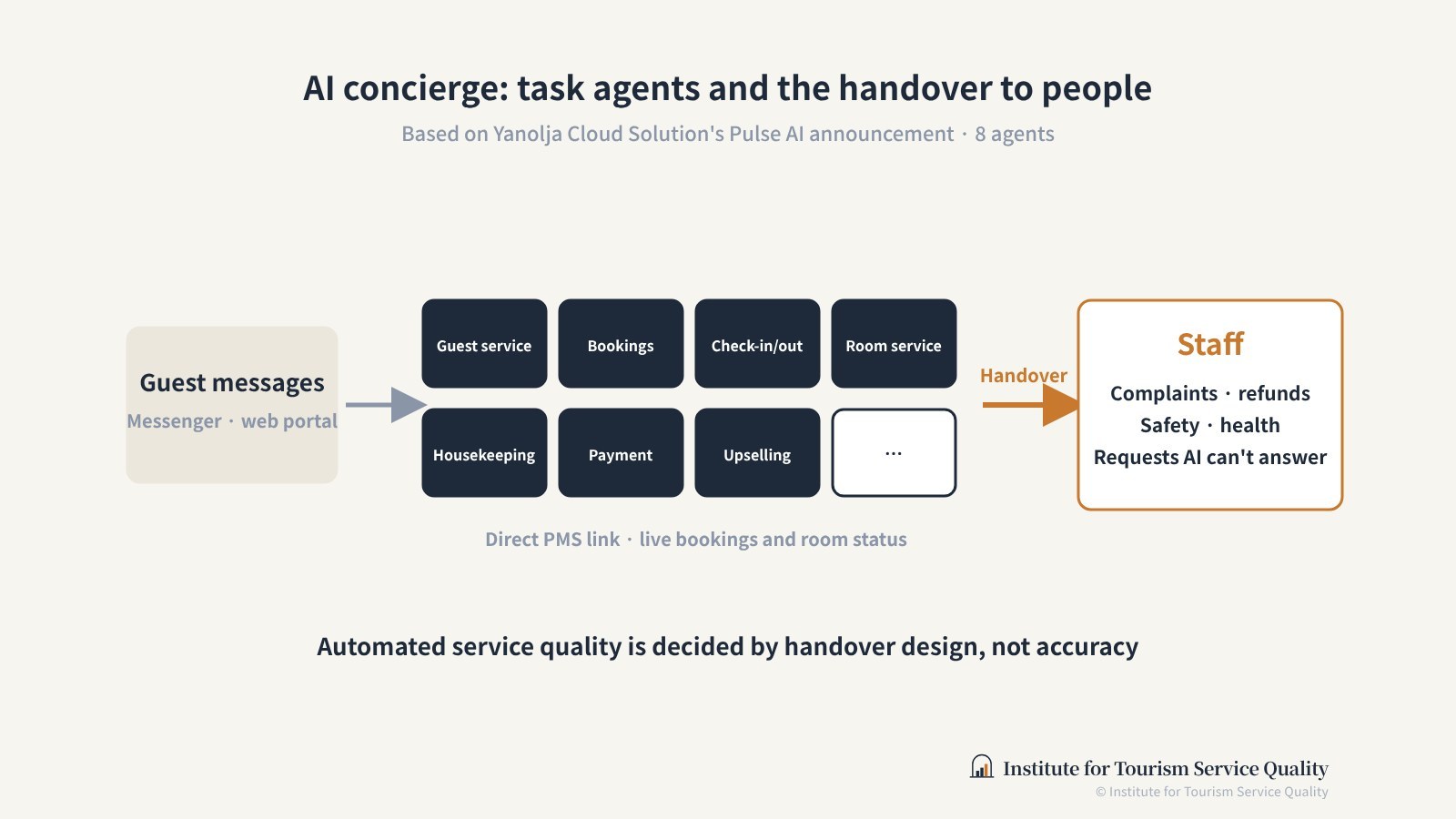
According to Electronic Times and ZDNet Korea (13 August 2026), Pulse AI is not a single chatbot but a multi-agent structure in which several agents divide the work. It consists of eight AI agents built for specific tasks, including guest service, reservations, check-in and check-out, room service, housekeeping, payment and upselling (suggesting room upgrades and extra services). Each agent connects directly to the company's property management system (PMS) and handles tasks based on live reservation and room status information.
Guests can confirm bookings, check in, request room service and pay through WhatsApp or a web-based guest portal. The system can also hand requests the AI cannot answer to staff in real time. The company said it has built up operating data by deploying the product at about 1,000 hotels in India, and plans to expand to the United States, Malaysia and Africa, starting with Thailand. ZDNet Korea, citing the company, reported that a 25-room hotel spends up to eight hours a day on guest communication. This figure was provided by the company, and the basis for it was not disclosed.
Why divide by task?
A multi-agent structure can draw clearer task boundaries than a single AI that answers every question. If the payment agent handles only payments and the housekeeping agent only cleaning requests, each agent needs only the data and permissions required for its task. The direct connection to the PMS is also important. A generic chatbot can answer questions with fixed answers, such as "What time is check-in?", but answering "Has my room been cleaned yet?" requires reading live room status.
The inclusion of an upselling agent, on the other hand, shows that automated guest messaging is being designed not only to cut costs but also to increase revenue. Balancing service quality against sales pressure becomes something hotels must manage themselves.
Set the criteria for handing over to people first
From a service quality perspective, an AI concierge succeeds or fails less at the moments it answers than at the moments it cannot. Guests' experience of failure with self-service technology (SST) is often judged by the response after the failure rather than by the technology itself, the same principle discussed in When the kiosk stops, service recovery is a human job. The editorial team suggests that hotels decide the following when introducing AI guest messaging.
- Specify handover conditions: Requests related to complaints, refunds, safety or health should be passed to staff even if the AI could answer them. Guests who repeat the same question twice should also be handed over.
- Manage waiting time after handover: If the response is slow after "Connecting you to a member of staff", the experience is worse than having no AI at all. Assign people for night-time and peak hours in advance.
- Limit the frequency and timing of upselling: A guest who has just complained should never be offered an upgrade. Rules are needed to stop sales offers depending on the context of the conversation.
- Disclose that it is AI: Tell guests that they are dealing with AI, so that they do not make important decisions believing they are talking to a person.
- Consider the local messaging environment: The announced channels are WhatsApp and a web portal. Hotels with a large share of Korean guests should first check whether the product integrates with the messengers those guests mainly use.
Conclusion
An AI concierge can reduce repetitive inquiries and free up staff time for face-to-face service. For that time to actually go back to guests, however, hotels must first decide the boundary between what AI handles and what people handle. The quality of automated guest messaging is determined not by the AI's accuracy but by the design of the handover. No plans for a Korean launch of this solution have been announced, but it is a useful reference for the criteria to check when similar services arrive in Korea.
References
Most sources are in Korean.
- 전자신문 (2026.08.13). 야놀자, AI 컨시어지 솔루션 출시…글로벌 호텔 산업 공략. https://www.etnews.com/20260813000048
- 지디넷코리아 (2026.08.13). 예약·체크인·룸서비스까지...야놀자, AI 컨시어지 솔루션 출시. https://zdnet.co.kr/view/?no=20260813082735
- 한국경제 (2026.08.13). 야놀자, AI 컨시어지 솔루션 'Pulse AI' 공식 출시(보도자료). https://www.hankyung.com/article/202608138112P
Was this article helpful?
This is an English version of the original Korean article. If the two differ, the Korean original prevails.
© Institute for Tourism Service Quality. All rights reserved.