From the Hotel Front Desk to QA: Director Winston Park Publishes an Introductory Book for Non-Specialists
'Let's Do QA Together with AI Agents' (in Korean) explains core ISTQB CTFL concepts through a hypothetical hotel and covers practical use of AI agents
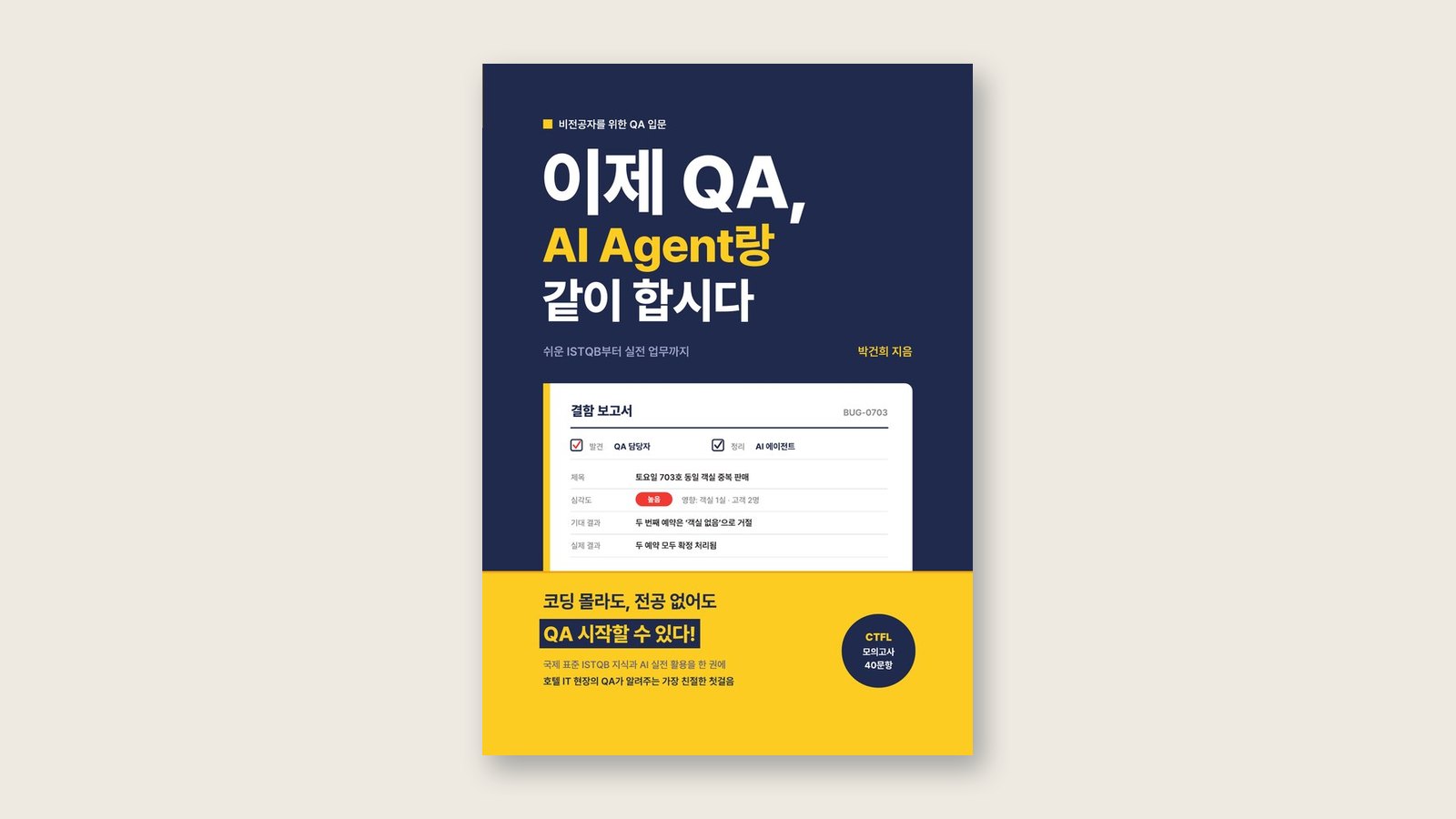
Director Winston Park of the Institute for Tourism Service Quality has published Let's Do QA Together with AI Agents, an introductory book on software quality assurance (QA). The book was released on 22 October 2026 by Bookk as print on demand (POD) and runs to 222 pages. It is written in Korean.
Starting from the question, "Will front desk staff be replaced by kiosks?"
The book starts from a long-standing worry on the hotel front line. Amid concerns that kiosks would one day take over front desk work, the author joined a hotel IT solution company as someone without an IT background and took on QA work. The book organises what he learned through hands-on experience along the way, at the level of someone starting QA for the first time.
The message the author stresses is that QA is not determined by coding skill alone. The habit of noticing first where guests feel inconvenienced and asking, "What happens in this case?" is a capability built on the service front line, and it becomes the starting point of test design as it is. The book focuses on showing how to translate service and operations experience into the language of QA.
Four parts
Parts 1 and 2 cover the core concepts of the International Software Testing Qualifications Board (ISTQB) Foundation Level (CTFL) syllabus v4.0.1. Using bookings, discounts and rooms at a hypothetical hotel, "QA Stay", they explain techniques such as equivalence partitioning, boundary value analysis, decision tables and state transition testing, and every number used in the examples has been checked.
Part 3 shows the process of doing real QA work with AI agents. At each stage, from deriving test conditions from specifications to writing test cases and organising defect reports and test result reports, it includes example prompts and responses, and also covers verifying and correcting results when the AI gets things wrong.
Part 4 guides career preparation, including the types of QA roles, a roadmap for preparing for the CTFL certification and how to build a portfolio. The appendices contain a glossary of key terms, a collection of prompts by situation, practical templates, IT basics for non-specialists and a CTFL practice exam.
Judging whether the results that come back are right matters more than the ability to hand work to AI.
A path open to people from the service front line
The book's intended readers are service and operations professionals preparing to move into QA roles, non-specialists starting QA without coding experience, ISTQB CTFL candidates, and junior QA staff who want to use AI agents in testing work.
As customer touchpoints in the hotel and tourism industry move to digital, system quality is becoming service quality. The need for people with both front-line service instincts and software quality management skills looks set to grow. The book is meaningful in that it guides readers along a path connecting these two fields in the language of non-specialists.
The book can be ordered from online bookstores such as Kyobo Book Centre, and copies are printed and shipped after ordering. Full bibliographic details are on the Publications page (in Korean).
References
Most sources are in Korean.
- 박건희 (2026). 이제 QA, AI Agent랑 같이 합시다. 부크크.
- ISTQB. Certified Tester Foundation Level (CTFL) Syllabus, v4.0.1.
Was this article helpful?
This is an English version of the original Korean article. If the two differ, the Korean original prevails.
© Institute for Tourism Service Quality. All rights reserved.